
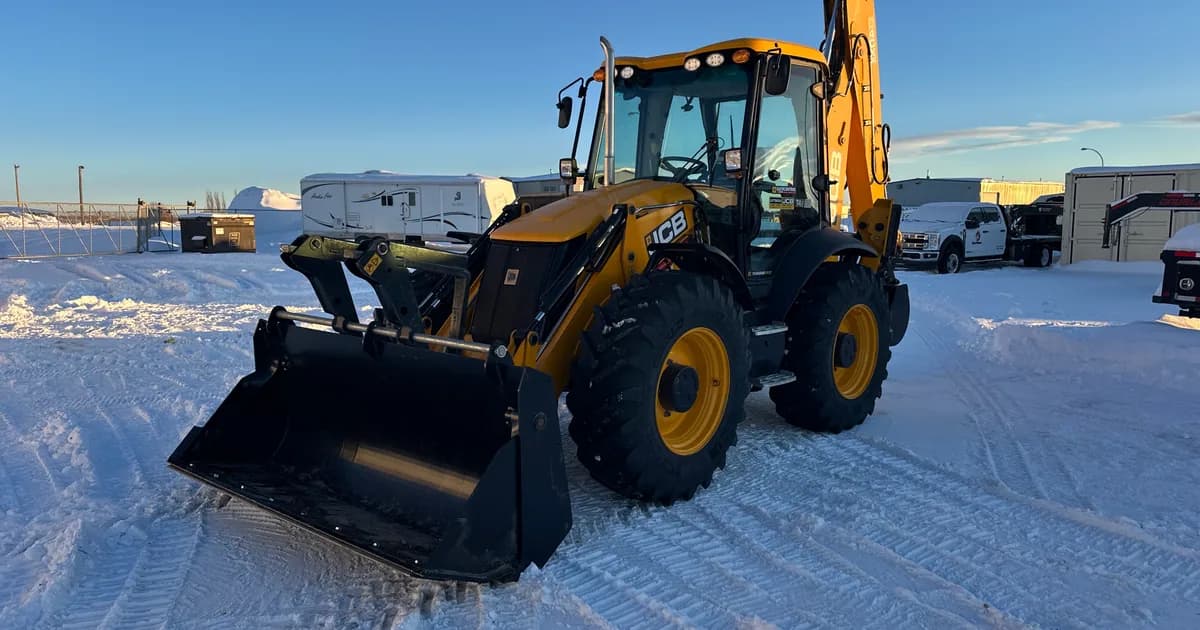
Equipment loan rates in Canada vary more by lender category than by anything else on your file. The same 660-credit contractor buying the same 2019 Cat 320 can be quoted 8.5% by one type of lender and 14.5% by another — same week, same machine, same numbers. The job of this page is to show you, in 30 seconds, which lender category your file actually fits, what rate range is realistic, and how to compare offers without falling for a low headline rate that turns out to be more expensive than the next one over.
Fast answer. Banks and captive finance arms usually price the lowest on equipment loans in Canada. Equipment finance companies sit in the middle. Private equipment lenders price the highest — but they approve files the banks decline. The mistake most contractors make is not applying for the wrong rate. It is applying in the wrong lender category first.
See Your Likely Rate Range
Two questions, no credit pull. Get a directional rate range and the lender category your file is most likely to fit.
Pick a credit tier and equipment age to see your likely rate range.
Which Lender Type Has the Lowest Equipment Loan Rates?
The fast answer most contractors actually need.
| Lender Category | Typical Rate Tendency | Best For | Approval Speed | Main Trade-Off |
|---|---|---|---|---|
| Big banks & credit unions | Lowest | 700+ credit, established business, newer dealer equipment | 2–4 weeks | Slow, strict, decline anything outside the box |
| Captive finance (Cat, Deere) | Lowest on promo deals | New equipment from their own dealers | 1–2 weeks | Promo rates are gated; standard rates closer to bank pricing |
| Equipment finance companies | Middle | Mid-tier credit, used equipment, faster turnaround | 3–7 days | Higher rates than banks, but flexible on age and credit |
| Private equipment lenders | Highest | Challenged credit, older iron, fast-funding deals | 2–5 days | Highest cost, but approve files banks won't |
A note on BDC: the Business Development Bank of Canada sits between banks and equipment finance companies on rate, with a focus on established small and mid-size businesses with 2+ years of operating history. Useful path for the right file — conservative on credit and documentation-heavy, so not the right call for a fast-turnaround or challenged-credit deal.
Key takeaway: No single lender category is "best." The cheapest rate goes to the borrower whose file fits the category that fits — a 580-credit contractor at a Big-5 bank gets a decline, not a low rate. The comparison that matters is which category fits your file, not which lender publishes the lowest number.
The comparison-layer problem. To know which category fits your file, you would normally need to apply at multiple lenders across categories — burning credit pulls, weeks of waiting, and walking your file past underwriters who were never going to approve forestry collateral or older iron. That is what IronFinance solves: one application, one credit pull, your file submitted across the categories most likely to approve it. We are not a competing lender — we are the comparison layer that sits across all of them.
What Rate Bucket Am I In?
A 30-second self-diagnose before you read further:
- 700+ credit, newer dealer equipment, 3+ years in business → likely 6.5–10%, your file fits banks, credit unions, and captive finance promos. Apply at the bank or dealer first.
- 640–699 credit, used major-brand machine, 1–3 years in business → likely 9–14%, your file fits equipment finance companies and some credit unions. Banks may approve but slowly.
- Below 640, older or private-sale machine, or under 1 year in business → likely 13–22%, your file fits private equipment lenders. Banks will decline; do not waste the credit pull.
If you want a more specific read on your file before applying anywhere, our financeability checker gives you a 2-minute diagnostic with no credit pull — that's the no-friction way to know your category before any lender sees the file.
Current Canadian Rate Environment — September 2026
Last verified: September 14, 2026Where Canadian equipment loan pricing sits today. The Bank of Canada policy rate and major bank prime rates feed into every equipment loan offer made in the country — they set the floor that lender margins are built on. Your actual rate depends on credit, equipment, term, and lender appetite, which is what we navigate for you as your broker.
Bank of Canada
| Series | Rate | Verified |
|---|---|---|
| Bank of Canada (Valet API) | 2.50% | September 14, 2026 |
Canadian Bank Prime Rates
| Lender | Prime | Verified |
|---|---|---|
| ATB Financial Prime Rate | 4.45% | September 14, 2026 |
| BMO Prime Rate | 4.45% | September 14, 2026 |
| Bank of Canada (Valet API) | 4.45% | September 14, 2026 |
| CIBC Prime Rate | 4.45% | September 14, 2026 |
| RBC Prime Rate | 4.45% | September 14, 2026 |
| Scotiabank Prime Rate | 4.45% | September 14, 2026 |
| TD Prime Rate | 4.45% | September 14, 2026 |
| Vancity Prime Rate | 4.45% | September 14, 2026 |
What Makes Up an Equipment Loan Rate
Before you can compare rates, you need to understand what goes into the number a lender quotes you. Equipment loan rates in Canada are influenced by several factors, and knowing these helps you understand why two lenders quoting on the exact same machine can give you different numbers.
The Bank of Canada benchmark. All lending rates are influenced by the Bank of Canada's policy rate — 2.25% as of August 2026, with bank prime at 4.45% — held since October 2025 and reaffirmed at the July 15, 2026 decision (the sixth consecutive hold). When it goes up, equipment loan rates go up. When it drops, rates eventually follow — though lenders are always faster to raise rates than to lower them.
Your credit profile. This is the single biggest factor in your rate. A contractor with a 740 credit score, five years in business, and clean financials gets a fundamentally different rate than someone with a 600 score and 18 months of operating history. The rate difference between those two profiles on the exact same machine can be 5-8 percentage points.
The equipment itself. Lenders assign risk based on what you are financing. A new John Deere 135G from a dealer has a known value, a warranty, and strong resale demand — that gets a lower rate. A 2013 excavator with 9,000 hours from a private seller is harder to value and riskier to the lender, which means a higher rate.
The loan amount and term. Larger loans sometimes get slightly better rates because the lender earns more in absolute dollars. Longer terms may carry slightly higher rates because the lender is exposed to risk for more years. A 3-year term on a $50,000 Bobcat E35 might be priced differently than a 6-year term on a $250,000 Cat 330.
The lender type. Banks, credit unions, captive finance arms (like Cat Financial or John Deere Financial), and private lenders all have different cost structures and risk appetites, which translate into different rates. Our banks vs. private lenders guide digs into this comparison.
Fixed vs. Variable Rates
Equipment loans in Canada come in two flavours, and understanding the difference matters more than most contractors realize.
Fixed rate means the interest rate stays the same for the entire term. If you lock in at 9.25% on a 5-year loan, you pay 9.25% from the first payment to the last. Your monthly payment never changes. Most equipment financing in Canada is fixed rate, and for good reason — contractors need predictable payments to manage cash flow on projects.
Variable rate means the interest rate is tied to a benchmark (usually prime rate) and fluctuates as that benchmark moves. You might start at prime + 3%, which could be 8.5% today, but if prime goes up by 1% next year, you are suddenly at 9.5%. Your payments change accordingly.
| Feature | Fixed Rate | Variable Rate |
|---|---|---|
| Payment predictability | Same every month | Changes with rate movements |
| Starting rate | Usually slightly higher | Usually slightly lower |
| Risk | Rate locked in, no surprises | Could go up or down |
| Best for | Contractors who need stable payments | Contractors who expect rates to fall |
| Typical availability | Most lenders | Some banks and credit unions |
| Common for equipment | Yes, the standard | Less common |
Key takeaway: For most contractors, fixed rate is the way to go. The slight premium you pay for a fixed rate is worth the certainty. You are running a construction business, not a hedge fund — you do not need rate risk on top of everything else.
APR vs. Stated Rate: The Number That Actually Matters
This is where rate comparison gets tricky. A lender quotes you 8.5%, but what does that actually mean?
Stated rate (also called the nominal rate or contract rate) is the interest percentage applied to your principal balance. If you borrow $150,000 at a stated rate of 8.5%, the interest calculation is based on that percentage.
APR (Annual Percentage Rate) takes the stated rate and adds in fees and costs associated with the loan, expressed as an annualized percentage. If that 8.5% loan also comes with a $1,200 documentation fee and a $500 admin charge, the APR might be 9.1%.
Here is a practical example:
| Lender A | Lender B | |
|---|---|---|
| Stated rate | 8.5% | 9.25% |
| Documentation fee | $1,200 | $0 |
| Admin fee | $500 | $0 |
| Appraisal fee | $800 | $0 |
| APR (approximate) | 9.3% | 9.25% |
| Total cost over 5 years on $150K | ~$36,800 | ~$36,600 |
Lender A looks cheaper at first glance with an 8.5% stated rate. But after you add the fees, Lender B at 9.25% with no fees is actually the cheaper deal. This happens more often than you would think.
How to calculate total cost yourself: Ask each lender for the total of all payments over the life of the loan, including all fees. Subtract the principal amount you are borrowing. The difference is your true cost of financing. Compare that number across lenders, and you have an apples-to-apples comparison.
Hidden Fees to Watch For
Lenders have creative ways of making their rate look low while adding costs elsewhere. Here is what to look for:
Documentation or origination fees. Charged at closing, typically $250-$1,500. Some lenders roll this into the loan so you do not feel it as an upfront cost, but you end up paying interest on it.
Appraisal fees. Required on some deals, especially used equipment from private sellers. Costs $500-1,500. Some lenders cover this, others pass it to you. What the appraisal comes back at matters more than the fee — our guide to financing a private-sale machine covers the gap between an agreed price and an appraised value.
Broker fees. If you work with a financing broker, there may be a fee. Reputable brokers like IronFinance are transparent about this. Ask upfront.
Prepayment penalties. Some loans charge you a fee if you pay off the loan early. This can be 1-3% of the remaining balance or a set number of months of interest. If you think you might pay off the loan early — say, after a big contract — this fee matters.
Insurance requirements. Some lenders require you to carry specific insurance on the equipment and may charge for forced-placed insurance if you let your policy lapse. Make sure you understand the insurance requirements and factor that cost in.
Late payment fees. These should not factor into your comparison if you plan to pay on time, but look at them anyway. A lender that charges $150 per late payment is meaningfully different from one that charges $25.
End-of-lease costs. If you are comparing a lease offer to a loan offer, make sure you understand the buyout amount at the end of the lease and any return conditions. A $1 buyout lease is essentially a loan. A fair-market-value buyout lease has a balloon payment at the end that changes the total cost calculation. Our lease vs. finance guide explains these differences in full.
Rate Ranges by Credit Tier
Here is what you should expect to see when shopping equipment loan rates in Canada. These are general ranges — your actual rate depends on the full picture including equipment type, age, loan amount, and lender.
| Credit Tier | Score Range | Typical Rate Range | Typical Down Payment | Common Lender Type |
|---|---|---|---|---|
| Excellent | 750+ | 6.5-8.5% | 0-10% | Banks, credit unions, captive finance |
| Good | 680-749 | 8-10.5% | 5-15% | Banks, credit unions, some private |
| Fair | 620-679 | 10-14% | 10-20% | Private lenders, some credit unions |
| Challenged | 550-619 | 13-18% | 15-25% | Private lenders |
| Rebuilding | Below 550 | 16-22% | 20-30%+ | Specialized private lenders |
A few notes on this table:
- These rates assume standard construction equipment (excavators, dozers, loaders, skid steers) from major brands like Cat, Komatsu, John Deere, Volvo, Hitachi, or Bobcat.
- Rates on newer equipment tend to be at the lower end of each range. Older or higher-hour machines push rates toward the higher end.
- Rates on specialty or niche equipment (tree spades, directional drills, unusual attachments) can be higher because resale markets are thinner.
- Captive finance arms (Cat Financial, John Deere Financial, Kubota Credit) sometimes offer promotional rates below these ranges, especially on new equipment.
Key takeaway: Your credit score sets the starting range, but the equipment and your business history adjust within that range. A contractor with a 660 score financing a 2024 Cat 320 from a dealer will get a better rate than the same contractor financing a 2015 no-name excavator from Kijiji.
Current Equipment Lease Rates in Canada — and How They Are Priced
Most of this page is about loan rates, but a large share of contractors finance through a lease, and lease pricing works differently enough that comparing a lease to a loan on the headline rate alone will mislead you. Here is how to read a lease rate. For the full walkthrough of how leasing works — the $1/10%/FMV buyout structures, the tax treatment, and which companies lease heavy equipment in Canada — see our equipment leasing guide.
Leases are priced with a rate factor, not a posted percentage. Instead of quoting "9.5%," a leasing company often quotes a lease rate factor — a small decimal multiplied against the equipment cost to produce your monthly payment:
Monthly payment = equipment cost × lease rate factor. A $200,000 machine at a 0.0192 factor is 200,000 × 0.0192 = $3,840/month (illustrative).
The factor rolls three things into one number: the interest rate, the term, and the residual value (what the machine is assumed to be worth at lease-end). Because they are bundled, the factor is not an interest rate — a lower factor does not always mean a cheaper deal. So when you compare a lease against a loan, ask the lessor for the two numbers you can actually line up: the total of all payments over the term and the equivalent APR. Any legitimate lessor can give you both.
Why a lease payment can be lower than a loan payment on the same machine. It comes down to residual value. On a $1-buyout lease you are paying off essentially the whole machine, so the payment lands close to a loan. On a fair-market-value lease you are only financing the depreciation during the term — the residual is left for the end — so the monthly payment is lower, sometimes meaningfully. A higher residual lowers the payment because you finance less depreciation. The trade-off shows up at lease-end, not in the monthly number.
| Lease Structure | What It Is | Monthly Payment | End of Term |
|---|---|---|---|
| $1-buyout (finance lease) | Acts like a loan — you own the machine for $1 | Highest (close to loan) | You own it outright |
| Fair-market-value (operating) | You use the machine, lessor keeps residual risk | Lowest | Buy at market value, return, or upgrade |
Under current Canadian lease-accounting terms these are a finance lease ($1-buyout) and an operating lease (FMV); "capital lease" is the older term for the same thing. Our lease vs. finance guide walks through the buyout structures and the tax side in depth.
Typical lease rate ranges (2026). Lease rates track the same Bank of Canada prime (4.45% as of August 2026) and the same risk-based logic as loans, so they land in a similar neighbourhood by credit tier:
| Credit Tier | Score Range | Typical Lease Rate Range | Common Structure |
|---|---|---|---|
| Excellent | 750+ | ~6-9% | FMV or $1-buyout, low/no down |
| Good | 680-749 | ~9-12% | $1-buyout common |
| Fair | 620-679 | ~12-14% | $1-buyout, first/last upfront |
| Challenged | Below 620 | ~14-16%+ | $1-buyout, larger upfront |
Key takeaway: These are directional benchmarks from active Canadian leasing pricing, not a quote — your factor depends on the machine, the term, the residual, and your file. Compare lease and loan offers on total cost and equivalent APR, never on the rate factor alone. The lease-rates-vs-loan-rates guide does that conversion step by step, with the worked math.
The tax angle in one line. With an operating (FMV) lease, the full lease payment is generally deductible as a business expense in the year you pay it; when you finance a purchase instead, you deduct the loan interest and recover the machine's cost through Capital Cost Allowance over several years. Which comes out ahead depends on your tax situation — that is an accountant question, and our lease vs. finance guide lays out both sides.
How Your Province Affects Loan and Lease Rates (and What Does Not)
The base rate ranges on this page — loan and lease — are largely national. The same finance company quoting a contractor in Alberta and one in Ontario at the same credit tier, on the same machine, lands in similar territory. Equipment lenders price off the Bank of Canada prime and your file, not your postal code. So a search for "equipment loan rates Calgary" or "lease rates Vancouver" is really a search for the national rate — what actually changes by province is three things:
1. Which lenders are most active. Regional credit unions and provincial lenders sometimes price a local file better than a national bank that does not know the industry: ATB Financial in Alberta, Vancity and Coast Capital in BC, Conexus and Affinity in Saskatchewan, Assiniboine in Manitoba, and Farm Credit Canada across the ag-heavy Prairies.
2. Sales tax on the purchase. This does not change your rate, but it changes the cash you need at signing — and whether tax can be financed into the deal:
- Alberta — 5% GST only (lowest tax cost at signing in Canada).
- BC / Saskatchewan / Manitoba — 5% GST plus provincial sales tax (PST/RST), for roughly 11-12% combined.
- Ontario — 13% HST.
- Atlantic Canada — 14-15% HST depending on the province.
- Quebec — 5% GST plus QST.
GST/HST registrants can generally recover the GST/HST portion as an input tax credit; PST is usually a hard cost. Confirm the treatment with your accountant.
3. Provincial industry mix. Ag-heavy provinces lean on Farm Credit Canada — and a farm purchase has its own rate ceiling worth knowing, since a CALA-guaranteed loan may not exceed prime plus 1%; see the farm equipment financing guide. Forestry regions have lender specialists who price challenged-credit forestry files differently than a generalist would. For province-specific lender landscapes on challenged-credit forestry files, see our Alberta, BC, and Saskatchewan guides.
Key takeaway: Do not chase a "[your city] equipment rate" as if it were a different number — the rate is national. Chase the right lender category for your file, and budget for your province's sales tax at signing.
For a worked example of what a province actually changes — sales tax at signing, lien registration, the regional lender mix, and the seasonal revenue pattern an underwriter prices — see equipment financing rates in Alberta.
New Equipment vs. Used Equipment Rates
The age and condition of the machine has a direct impact on the rate you pay. Lenders treat new and used equipment as fundamentally different risk categories.
| Factor | New Equipment | Used Equipment (Under 7 Years) | Used Equipment (7-15 Years) | Used Equipment (15+ Years) |
|---|---|---|---|---|
| Typical rate premium | Baseline | +0.5-2% | +1.5-4% | +3-6% or declined |
| Down payment | 0-10% | 10-15% | 15-20% | 20-30%+ |
| Max term | 72-84 months | 60-72 months | 48-60 months | 36-48 months |
| Lender availability | All types | All types | Most types | Private lenders mainly |
Why the gap? New equipment has a known value, a manufacturer warranty, and strong resale demand. A new Cat 320 holds its value predictably for the first several years. A 2012 Cat 320 with 11,000 hours is harder to value, has no warranty, and could have hidden mechanical issues. The lender prices that uncertainty into the rate.
Where the deals are: Used equipment in the 3-7 year range with moderate hours often represents the best value for contractors. The initial depreciation hit has already happened, the machines are still well within their working life, and rates are only slightly above new equipment rates. This is the sweet spot where you get a proven machine at a fair rate. For the full picture on how lenders evaluate used deals by age, hours, and credit tier, see our used heavy equipment financing guide.
For more on how hours affect financeability, see our guides on excavator hours, dozer hours, and skid steer hours.
Rate Examples by Machine Type
Rates vary not just by credit and lender but by what you are financing. Machines with strong resale markets get better rates because the lender has better collateral. Here are real-world examples for a contractor with good credit (680-720) financing through an equipment finance company.
| Machine | Typical Price Range | Example Rate (Good Credit) | Monthly Payment Example | Notes |
|---|---|---|---|---|
| Cat 320 Excavator (2022, 2,500 hrs) | $220,000-$280,000 | 8.5-10% | ~$4,900/mo on $250K over 60 months | Strong resale, major brand — best rates in the market |
| Bobcat S650 Skid Steer (2021, 1,800 hrs) | $40,000-$55,000 | 9-11% | ~$1,050/mo on $48K over 60 months | High demand, holds value well |
| Cat D6 Dozer (2019, 4,200 hrs) | $180,000-$250,000 | 9-11.5% | ~$4,300/mo on $200K over 60 months | Slightly older but Cat dozers hold value |
| Kenworth T800 Log Truck (2018, 350K km) | $80,000-$120,000 | 10-13% | ~$2,200/mo on $95K over 60 months | Trucks assessed on mileage, not hours |
| Tigercat 635E Skidder (2020, 8,000 hrs) | $200,000-$280,000 | 9.5-12% | ~$5,100/mo on $240K over 60 months | Forestry equipment — thinner resale market |
| Komatsu PC210 (2014, 9,500 hrs) | $80,000-$110,000 | 11-14% | ~$2,100/mo on $90K over 60 months | Older with high hours — still financeable but higher rate |
| No-name or niche equipment | Varies | 13-18%+ | Varies | Thin resale market means higher risk for lender |
These examples assume 10-15% down payment, 60-month term, and a contractor with 3+ years in business. Your rate will vary based on the full picture — use our payment calculator to model specific scenarios, or run our financeability checker to see which lender category your file actually fits before applying anywhere.
See your likely rate range. If you want a specific read on your file before any lender pulls credit, submit your details to IronFinance — we route the file to the lender categories that match your credit tier and equipment, on a single application and credit pull, and bring the offers back to you.
How to Shop Rates Without Hurting Your Credit
Contractors worry about this constantly, and the fear often prevents them from getting the best deal. Here is how credit inquiries actually work:
Hard inquiries happen when a lender pulls your credit to make a lending decision. Each one can temporarily reduce your score. But — and this is the important part — most credit scoring models recognize that shopping for the same type of credit in a short window is normal comparison shopping, not a sign of desperation. They typically group multiple equipment loan inquiries within a short comparison window as a single inquiry.
Soft inquiries happen when you check your own credit, or when a lender pre-qualifies you without a full application. These do not affect your score at all.
Best strategy for rate shopping:
- Check your own credit first. Get your Equifax and TransUnion reports so you know your score before any lender tells you. This is free from both bureaus once a year.
- Do all your shopping within a 2-3 week window. This minimizes the credit score impact.
- Use a broker. A broker like IronFinance pulls your credit once and submits to multiple lenders on your behalf. You get multiple rate quotes with a single inquiry. This is the most credit-efficient way to shop.
- Get pre-qualification first. Some lenders will give you a rate estimate based on a soft pull before doing a full hard pull. Use this to narrow your options before committing to formal applications.
When a Higher Rate Still Makes Sense
Not every financing decision should be purely about getting the lowest rate. Here are real situations where paying a higher rate is the smarter move:
Speed matters more than savings. You won a contract that starts in two weeks, and you need a Cat D6 on-site. The bank might give you 8%, but it takes 5 weeks. The private lender at 12% can fund in 5 days. The profit from starting the contract on time far exceeds the interest difference. Think of the higher rate as the cost of speed — which in this case is a bargain.
A lower rate comes with restrictive covenants. Some banks require financial covenants — minimum revenue levels, debt ratio limits, restrictions on taking on additional debt. If you breach these covenants, the loan can be called. A private lender at a higher rate with no covenants gives you operational freedom that might be worth more than the rate savings.
The machine will pay for itself quickly. If you are financing a Bobcat S650 at $55,000 and you have contracts lined up that will generate $15,000 a month with that machine, the difference between 9% and 13% interest is about $100 a month. That is noise compared to the revenue the machine generates. Getting the machine working is what matters.
You are building credit history. If your current credit makes a bank deal impossible, taking a higher-rate private lender deal and making 12-18 months of perfect payments improves your credit profile. Your next equipment purchase can then qualify for better rates. Think of the extra interest as an investment in your future borrowing power.
The lower rate requires a much larger down payment. If a bank wants 20% down ($30,000 on a $150,000 machine) to give you 8%, but a private lender will do 10% down ($15,000) at 11%, that extra $15,000 in your pocket can be used as working capital for the project. Cash in hand has real value for contractors who need to cover payroll, fuel, and materials while waiting for progress draws. If the equipment you already own is paid off, a sale-leaseback raises that working capital at secured rates rather than unsecured ones. That gap — work performed, payment not yet received — is a different financing problem from the machine, and the one Crewline Financing handles for Canadian contractors.
A Step-by-Step Rate Comparison Process
Here is a practical process for comparing equipment loan offers:
-
Get at least 3 quotes. More options mean better comparison data. Contact your bank, one or two private lenders, and the manufacturer's captive finance (if applicable). Or work with a broker who does this for you.
-
Request standardized information from each. Ask every lender to provide:
- Stated interest rate
- APR
- Monthly payment amount
- Total of all payments over the full term
- All fees itemized (documentation, admin, appraisal, etc.)
- Prepayment penalty terms
- Down payment required
-
Build a comparison table. Put the numbers side by side.
| Quote 1 (Bank) | Quote 2 (Private) | Quote 3 (Captive) | |
|---|---|---|---|
| Stated rate | 8.0% | 10.5% | 7.5% (promo) |
| APR | 8.6% | 10.8% | 8.9% |
| Monthly payment | $2,028 | $2,164 | $1,998 |
| Total all payments | $121,680 | $129,840 | $119,880 |
| All fees | $2,100 | $395 | $2,800 |
| True total cost | $123,780 | $130,235 | $122,680 |
| Down payment | $15,000 (15%) | $10,000 (10%) | $15,000 (15%) |
| Prepayment penalty | 2% of balance | None | 3 months interest |
| Approval timeline | 4 weeks | 5 days | 3 weeks |
-
Factor in the non-financial terms. Speed, flexibility, and restrictions matter. A deal that is $3,000 cheaper over five years but takes a month longer and comes with restrictive covenants might not be the best deal for your business.
-
Negotiate. Once you have multiple offers, you have leverage. Tell Lender B that Lender A offered you a better rate. Ask if they can match or beat it. Lenders expect this, and many will improve their offer to win the deal. The worst they can say is no.
Key takeaway: The cheapest deal on paper is not always the best deal for your business. Compare total cost, timeline, flexibility, and terms before deciding. And always negotiate — the first offer is rarely the final offer.
What About Manufacturer Financing?
Cat Financial, John Deere Financial, Kubota Credit, and other captive finance arms deserve special mention. These are the financing divisions of the equipment manufacturers, and they sometimes offer rates that beat both banks and private lenders.
Pros: Promotional rates as low as 0-3.9% on new equipment (especially end-of-year or model changeover deals). Simple application through the dealer. They understand the equipment perfectly.
Cons: Promotional rates are only for new equipment with the strongest applicants. Once you are outside the promo criteria, their rates are often in line with or slightly above bank rates. Limited flexibility on used equipment or weaker credit profiles. And the low-rate promo might come with a shorter term that increases your monthly payment.
If you are buying new equipment from a dealer, always ask about the manufacturer's financing. Compare it against your other options using the process above. Sometimes the promo rate is unbeatable. Other times, the restrictions make a different lender better.
See Your Likely Rate Range
The single biggest mistake on a rate-shopping file is applying at the wrong lender category. A 580-credit contractor walking into a Big-5 bank gets a decline, not a low rate — and the hard credit pull that goes with it makes the next application harder. A 720-credit contractor at a private equipment lender gets a 14% offer when the bank down the street would have priced the same deal at 8%. The category has to fit the file before the application goes in.
That is what we do. Submit your file to IronFinance — one application, one credit pull. We route it to the lender categories your file actually fits, bring the offers back to you, and you compare them side by side. Our job is the routing, not selling our own loan. If your file fits a bank, the bank is who you should be talking to, and we will tell you that. If it fits a private equipment lender, we know which ones approve forestry files, which ones approve older iron, and which ones fund inside a week.
For a no-credit-pull diagnostic before you apply anywhere, run our financeability checker — two minutes, no contact info, just an honest read on which lender category your file fits.
Sources: Bank of Canada — Policy Rate (2.25% as of the July 15, 2026 decision; bank prime 4.45%), BDC — Equipment Loans, Government of Canada — Canada Small Business Financing Program. Loan and lease rate ranges last verified August 2026 against active Canadian lender and lessor pricing; lease-rate bands are directional benchmarks, not quotes.
For more context on how the full equipment financing process works, check out our complete guide to financing heavy equipment, the equipment leasing guide, the banks vs private lenders breakdown, or the down payment guide.
Already own equipment, or eyeing a different machine?
Frequently Asked Questions
What are heavy equipment loan rates in Canada right now?
As of August 2026, with the Bank of Canada policy rate held at 2.25% and the major banks' prime rate at 4.45% (sixth consecutive hold, July 15, 2026), heavy equipment loan rates in Canada generally fall between 6.5% and 22% depending on credit tier, equipment age, and lender type. Strong-credit borrowers (750+) financing newer equipment from a dealer typically see 6.5-8.5% through banks, credit unions, or captive finance programs. Mid-tier credit (650-700) commonly sees 9-12%. Challenged credit (below 620) typically lands in the 13-18% range with private equipment lenders. Rates move with the Bank of Canada policy rate, so the snapshot shifts as monetary policy shifts.
What is a good interest rate for equipment financing in Canada?
For contractors with credit scores above 700 financing newer equipment, a good rate is 7-9%. Credit scores in the 650-700 range typically see 9-12%. Below 650, expect 12-16% or higher. The equipment itself also matters — a late-model Cat or Komatsu from a dealer will get a better rate than a 12-year-old machine from a private seller.
Do equipment loan rates differ by province in Canada?
The base rates lenders quote are largely national — the same finance company will quote a contractor in BC similarly to one in Ontario at the same credit tier. What does differ by province is which lenders are most active, the sales tax treatment of equipment purchases (PST in BC/SK/MB/QC, HST in Ontario and Atlantic provinces, GST-only in Alberta), and the strength of regional lenders like ATB Financial in Alberta or provincial credit unions in BC and Saskatchewan. Provincial industries also matter — ag-heavy provinces lean on Farm Credit Canada more, forestry-heavy regions have lender specialists who price differently than generalists.
Does shopping for equipment loan rates hurt my credit score?
Most credit scoring models group multiple loan-shopping inquiries within a short comparison window as a single inquiry, so shopping equipment lenders within a couple of weeks should not significantly impact your score. Working with a broker is even better because they submit to multiple lenders with a single credit pull.
What is the difference between APR and the stated interest rate on equipment loans?
The stated rate is just the interest percentage the lender charges on the principal. The APR (Annual Percentage Rate) includes the interest plus fees like documentation fees, admin charges, and other costs rolled into an annualized number. APR gives you a more accurate picture of the true cost of borrowing, and it is the number you should use when comparing offers side by side.