
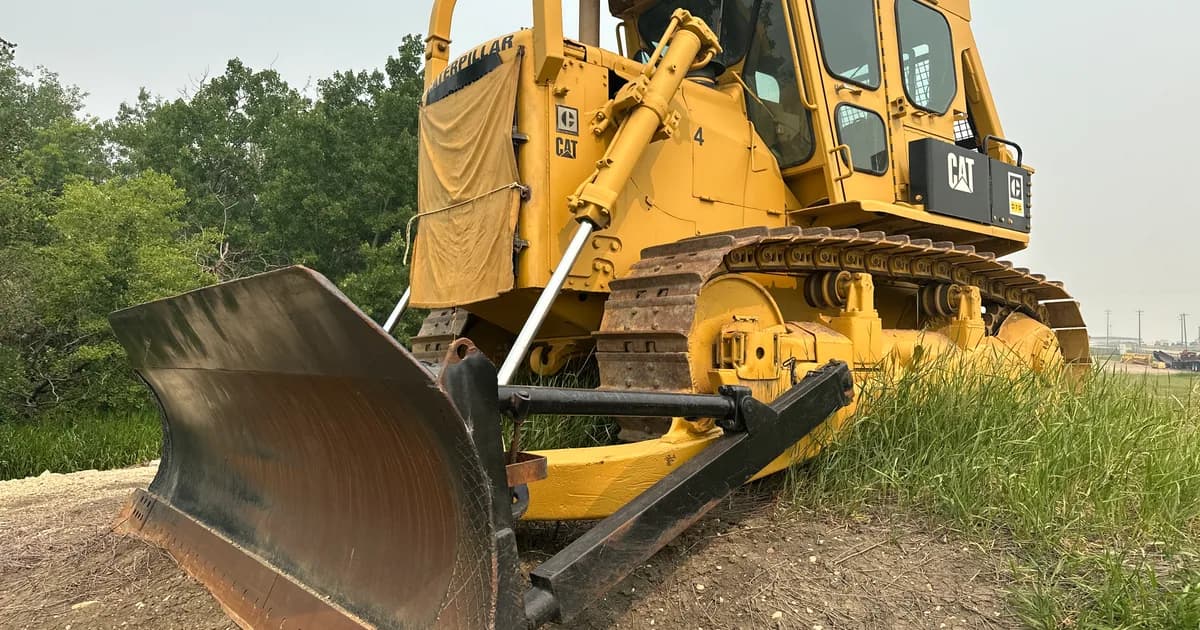
You are looking at a used Cat D6T listed for $195,000 with 7,200 hours. Or maybe a Komatsu D65 with 11,000 hours for $130,000. The price seems fair, but that hour number is sitting in your head. Is this machine halfway through its life or getting close to the end? Will a lender even touch it?
These are the right questions, and the answers are different for dozers than for any other equipment. A dozer lives a harder life than an excavator or a skid steer, but it is also built heavier to handle it. Understanding how dozer hours work — and what they really mean at each threshold — will help you make a smarter buying decision and avoid expensive surprises.
One thing to clear up first, because it trips up almost everyone: there is no magic hours number that makes a dozer "unfinanceable." Canadian lenders do not post an hours cap the way they cap age. What they actually do is appraise the machine's value and cap its age at the end of your term — often a 10-to-15-year window depending on the lender and the asset. Hours matter because they drive that value and the machine's remaining useful life, which then shape your rate, term, and down payment. On a dozer there is a second lever that matters just as much: the undercarriage. Keep both in mind as we go.
Why Dozer Hours Are Different
A dozer does not work like other equipment. Every hour on a dozer involves the entire machine pushing against the ground under continuous load. Think about what a dozer does all day: the blade drops into the dirt, the machine pushes forward under full power, the tracks grind against the ground, the drivetrain absorbs the resistance, and the whole frame flexes under the strain. Then it backs up and does it again. All day. Every day.
Compare that to an excavator, which sits in one spot and swings a boom. The excavator's undercarriage is not fighting the ground every second. The engine is not under continuous load — it cycles between digging, swinging, and waiting for trucks. An excavator idles between cycles. A dozer almost never idles during operation.
The biggest difference is the undercarriage. On a dozer, the undercarriage is the primary wear component, and it is expensive. Track chains, rollers, idlers, sprockets, and track shoes take constant abuse from the ground. This is not a minor line item: equipment manufacturers and dealers consistently put the undercarriage at roughly 20% of a crawler dozer's purchase price and around half of its lifetime repair and maintenance costs. Finning, the Caterpillar dealer for Western Canada, states plainly that "your undercarriage can account for 50% of the repair and maintenance expenses on track machines," and Komatsu pegs it at 45–60%. Few equipment types have a wear item as consistently expensive and central to value as a dozer undercarriage.
A full undercarriage replacement on a mid-size dozer like a Cat D6 is commonly quoted in the range of $35,000 to $55,000 (and more on a larger D8-class machine), depending on components, OEM versus aftermarket parts, and dealer pricing. Treat that as a general industry range rather than a firm Canadian quote — published full-undercarriage prices are scarce in Canada, and the figure moves with the exchange rate, freight, and how much of the undercarriage actually needs replacing. For Canadian component pricing, suppliers such as Undercarriage Warehouse Canada (Ontario) list individual rollers, idlers, chains, and shoes in Canadian dollars, which is the realistic way most of these jobs get priced.
This means when you evaluate dozer hours, you are really asking two questions: how much life is left in the powertrain, and what is the undercarriage situation? A dozer with 8,000 hours and a fresh undercarriage is a completely different proposition than one with 8,000 hours on original tracks.
Key takeaway: Dozer hours represent harder work per hour than most equipment because of continuous load and undercarriage wear. Always evaluate hours alongside undercarriage condition — the two together tell the real story.
Hour Thresholds: What the Numbers Mean
Here is what different hour ranges mean for a used dozer, what you should expect at each level, and how it affects your buying decision and financing options.
| Hours | Condition Category | What to Expect | How It Affects Financing |
|---|---|---|---|
| 0 - 2,000 | Low Hours | Near-new condition, original undercarriage, minimal wear | Strongest collateral — best rates, longest terms, lowest down |
| 2,000 - 5,000 | Moderate | Proven machine, first undercarriage may be nearing replacement | Straightforward — standard terms and down payment |
| 5,000 - 8,000 | Working Machine | Undercarriage likely replaced depending on application, powertrain solid if maintained | Financeable — value-driven, may want a recent undercarriage to hold the term |
| 8,000 - 12,000 | High Hours | Multiple undercarriage changes, engine and transmission need monitoring | Tighter structure — more down or a shorter term to offset lower value, not a flat decline |
| 12,000 - 18,000 | Very High | Major powertrain work likely done or due, significant maintenance history | Shorter terms, more down; broker or specialized lenders fit best |
| 18,000+ | Extreme | Full rebuild likely done or needed, frame fatigue possible on smaller machines | Appraisal-led — a documented or Certified Rebuild can restore financeable life |
These ranges apply to mid-size dozers like the Cat D6, John Deere 750, or Komatsu D65. Smaller dozers (Cat D3, D4, John Deere 450) have lower thresholds — shift everything down by about 20-30%. Larger production dozers (Cat D8, D9, D10) are built heavier and can tolerate higher hours — shift everything up by 20-30%.
What 3,000 Hours Looks Like
At 3,000 hours, a dozer is barely broken in. This is the sweet spot for used buyers who want a machine with most of its life still ahead.
What should have been done by now:
- Multiple engine oil and filter changes (every 250-500 hours)
- Hydraulic oil and filter changes
- Undercarriage inspection and track adjustments
- Final drive oil changes
- Air filter replacements
- Blade cutting edge replacement (likely one or two sets depending on material)
What to inspect at 3,000 hours:
- Undercarriage measurements — track shoes, rollers, idlers, and sprockets should still have 50-70% life remaining unless the machine has been working in rock
- Engine for blow-by (remove the oil fill cap with the engine running — excessive smoke means worn rings)
- Transmission shift quality — shifts should be smooth and immediate
- Final drives for leaks or noise
- Frame and ROPS for cracks or damage
- Blade and push arms for straightness and wear
A dozer at 3,000 hours with maintenance records is one of the safest used purchases you can make. The machine has proven itself past the early-failure window, and it has 10,000+ hours of productive life ahead. Financing is straightforward — most lenders treat a 3,000-hour dozer as a standard used equipment deal. For more on financing options, see our complete dozer financing guide.
What 6,000 Hours Looks Like
At 6,000 hours, a dozer has done real work. This is where maintenance history separates the good buys from the expensive mistakes.
What should have been done by now:
- Everything on the 3,000-hour list, multiple times
- May have had one undercarriage replacement, depending on application and maintenance — undercarriage life varies widely based on ground conditions, track tension practices, and material type
- Hydraulic pump inspection or reseal
- Transmission and torque converter inspection
- Multiple blade cutting edge and end bit replacements
- Coolant system service including water pump and thermostat
- Possibly a turbocharger reseal or replacement
What to watch for at 6,000 hours:
- Undercarriage condition — if the machine is on its second undercarriage, how much life is left? Getting measurements on the current undercarriage is essential
- Transmission performance under load — does it hesitate, slip, or lose power on grades?
- Engine oil consumption — if the machine is adding oil between changes, internal wear is progressing
- Final drive noise — grinding or whining from the final drives means expensive repairs ahead
- Hydraulic system temperature — a system that runs hot is telling you the pump is wearing
The price should reflect the hours. A 6,000-hour Cat D6T should be priced 35-45% below a comparable low-hour machine. If the seller is asking near low-hour prices, walk away.
Key takeaway: At 6,000 hours, a dozer's maintenance history matters more than the hour number. A 6,000-hour machine with full records and a recent undercarriage is a strong buy. A 6,000-hour machine with no records is a gamble you should not take at dozer prices.
What 10,000 Hours Looks Like
At 10,000 hours, a dozer is deep into its working life. On a mid-size machine like a Cat D6, this is past the midpoint but not near the end if the machine has been maintained. On a smaller dozer like a Cat D3 or D4, this is getting close to the economic limit.
What has likely been replaced or rebuilt:
- Undercarriage (at least twice, possibly starting a third set)
- Hydraulic pump (at least once)
- Turbocharger
- Water pump, alternator, starter
- Multiple sets of blade cutting edges and end bits
- Various hydraulic cylinders resealed
- Final drive seals (possibly complete final drive rebuild)
Red flags at 10,000 hours:
- Frame cracks — especially around the push arm pivots, ROPS mounts, and rear ripper mounting points. Welded frame repairs that have re-cracked indicate structural fatigue
- Transmission slipping or hunting between gears under load
- Engine blow-by or excessive oil consumption — a full engine rebuild on a D6-class machine can easily run into the tens of thousands of dollars
- Final drives that are noisy or leaking — final drive rebuilds are a significant expense on each side
- Undercarriage that was recently replaced on a machine being sold — the seller may be dressing it up for sale
Financing at 10,000 hours: This is where the structure tightens, not where financing stops. There is no hard hours cutoff in Canada — lenders appraise the machine and cap on its age at the end of the term, so at this level expect more money down, a shorter term, and a higher rate to offset the lower collateral value. A clean undercarriage and complete records can hold a longer term; thin records push it the other way. Mainstream lenders may want a larger down payment, while a broker like IronFinance can place the deal with an equipment-finance lender that underwrites high-hour iron every day. Read more about high-hour financing in our guide on financing 10,000-hour equipment.
How the Type of Work Affects Hours
Not all dozer hours are equal. The material a dozer pushes and the application it works in dramatically affect how much wear those hours represent.
The following table is an illustrative rule of thumb — not a measured engineering standard — but it reflects the general pattern that experienced operators and mechanics describe in the field:
| Work Type | Relative Wear Level | Rough Equivalent (per 6,000 actual hours) |
|---|---|---|
| Finish grading (sand, topsoil) | Light | ~4,000 hours of average-condition wear |
| General earthmoving (clay, mixed) | Average | ~6,000 hours of average-condition wear |
| Road building | Average-Heavy | ~7,000 hours of average-condition wear |
| Stockpile work | Average | ~6,000 hours of average-condition wear |
| Land clearing (stumps, roots) | Heavy | ~8,000 hours of average-condition wear |
| Rock ripping and pushing | Very Heavy | ~9,000-10,000 hours of average-condition wear |
| Mining production (abrasive material) | Extreme | ~10,000-12,000 hours of average-condition wear |
These numbers are not precise multipliers — they are a way to illustrate that application matters as much as the hour meter reading.
A dozer that has spent its life pushing clean sand for a golf course developer is in fundamentally different condition than one that has been ripping shale on a pipeline right-of-way. The sand machine's undercarriage may still be on its first set at 5,000 hours. The rock machine may be on its third undercarriage at the same hours.
Key takeaway: Always ask what the dozer was used for, not just how many hours it has. A dozer that has been pushing rock ages two to three times faster than one doing finish grading work.
The Undercarriage Question
On every other type of equipment, you evaluate the engine, hydraulics, and frame as the primary concerns. On a dozer, the undercarriage is the first thing you should check — because it is one of the most expensive and predictable wear items, and it directly tells you how the machine has been used and maintained.
Cat and other manufacturers emphasize that undercarriage life varies enormously based on application, maintenance, and track tension. The single most controllable factor is track tension, and the danger is running tracks too tight: Finning (Cat, Western Canada) calls improper track tension "the number one cause of premature undercarriage wear on dozers," Caterpillar warns that over-tight tracks can wear the undercarriage up to four times faster, and trade testing has found that tension beyond spec can shorten undercarriage life by 50–70%. In other words, the lever is real — but it cuts the wrong way when the tracks are over-tensioned, so this is something to check (and ask about) on any used machine. The following ranges are rough guidelines, not guarantees, and they reflect field-reported experience (much of it from US operators) rather than published Canadian figures:
Undercarriage life by material type (approximate, field-reported):
| Ground Conditions | Expected Undercarriage Life |
|---|---|
| Sand, topsoil, clay | 4,000 - 6,000 hours |
| Mixed earth and gravel | 3,000 - 4,500 hours |
| Rocky ground | 2,000 - 3,500 hours |
| Abrasive rock (granite, quartzite) | 1,500 - 2,500 hours |
What to measure: When inspecting a used dozer, measure the track shoes, rollers, idlers, and sprockets. Most brands publish wear charts that show the acceptable dimensions and the point at which components need replacement. Your dealer can take these measurements, or a qualified inspector can do it during a pre-purchase inspection.
The cost reality: If a dozer needs an undercarriage, you need to factor a significant expense into your purchase decision — on a D6-class machine, a full undercarriage replacement is commonly quoted in the range of $35,000 to $55,000 or more depending on parts and dealer pricing. Treat that as a general industry range, not a firm Canadian quote: most jobs get priced component by component (rollers, idlers, chains, shoes), and Canadian suppliers such as Undercarriage Warehouse Canada list those parts in Canadian dollars. Either way, it is not a routine maintenance item — it is a major capital expense that should come directly off the asking price. A dozer that needs an undercarriage is not the bargain the sticker price suggests.
Inspection Checklist by Hour Range
Use this checklist when inspecting a used dozer. The items marked are what to pay special attention to at each hour range.
Under 3,000 Hours — Standard Inspection:
- Verify hours match maintenance records
- Measure undercarriage components
- Check all fluids (engine oil, hydraulic fluid, coolant, final drive oil)
- Test all functions (blade lift, tilt, angle, ripper if equipped)
- Drive forward and reverse, checking transmission shifts
- Start cold and listen for unusual noises
- Check blade cutting edge and end bit condition
- Test the backup alarm, lights, and gauges
3,000 to 6,000 Hours — Add These Checks:
- Detailed undercarriage measurements with wear percentage calculations
- Transmission performance under load on a grade
- Final drive oil for metal contamination (drain a sample if possible)
- Frame weld points around push arm pivots and ROPS mounts
- Engine blow-by test
- Hydraulic cycle times (blade lift and ripper should be crisp)
- Check engine oil for coolant contamination (milky appearance)
6,000 to 10,000 Hours — Add These Checks:
- Request an oil analysis if possible (engine and transmission)
- Check final drives for noise under load
- Look for any welded frame repairs
- Test ripper performance under load
- Check torque converter stall speed (indicates transmission health)
- Look at wiring harness condition
- Inspect radiator and cooling system for leaks and damage
- Check all pivot pins and bushings for play
Over 10,000 Hours — Seriously Consider:
- Having a dealer or independent mechanic do a full inspection ($500-$1,000)
- Getting transmission and hydraulic pressure tests
- Budgeting $10,000 to $30,000 for near-term major maintenance
- Getting a comprehensive undercarriage evaluation with remaining life percentage
- Negotiating the price down to reflect expected maintenance
How Hours Affect Resale Value
Hours are the single biggest factor in a used dozer's resale value after brand and model. The following table illustrates how value typically moves as hours accumulate on a mid-size dozer like a Cat D6. These are market approximations drawn largely from North American (mostly US) listing patterns, not a universal depreciation formula and not Canadian-specific figures — year, condition, region, attachments, exchange rate, and market demand all affect actual pricing.
| Hours | Approximate Value (% of New) | Example: $600,000 New |
|---|---|---|
| 500 | 85-92% | $510,000 - $552,000 |
| 2,000 | 75-85% | $450,000 - $510,000 |
| 4,000 | 60-72% | $360,000 - $432,000 |
| 6,000 | 50-62% | $300,000 - $372,000 |
| 8,000 | 40-52% | $240,000 - $312,000 |
| 10,000 | 32-45% | $192,000 - $270,000 |
| 15,000 | 18-30% | $108,000 - $180,000 |
The depreciation curve is steepest in the first 3,000 hours. After that it flattens out. Buying in the 3,000-6,000 hour range often gives you the best value because someone else has absorbed the steepest depreciation, and the machine still has significant productive life remaining. Our dozer payment guide shows how these prices translate into monthly payments at different financing terms.
How Hours Affect Financing
Lenders evaluate dozer hours through the lens of risk, but not as a pass/fail gate. There is no hard hours number that triggers an automatic decline in Canada. As one Alberta equipment-finance lender puts it, "hours are the mileage on heavy equipment" — underwriters use them to estimate remaining life and repair risk, then sanity-check four things: hours today, expected annual usage, projected hours at the end of the term, and whether major components are nearing rebuild. If the projected end-of-term value still supports the loan, the deal works. If it doesn't, the lender shortens the term, raises the down payment, or declines — in that order. Hours drive the structure, not a flat cutoff.
What lenders actually cap on is age at the end of the term — often a 10-to-15-year window depending on the lender and the asset. BDC, for example, finances new or used equipment with terms up to 12 years; equipment-finance companies sometimes run a year or two longer. Used dozers typically land in a 36-to-72-month term depending on age and condition.
The following table reflects common patterns we see in the market when contractors finance dozers. Every lender underwrites differently based on borrower strength, machine age, dealer support, and intended use — but these ranges give you a general sense of how the structure moves, not whether you get a yes:
| Hours | How the Deal Structures | Typical Terms Available |
|---|---|---|
| Under 3,000 | Strongest collateral | Up to 6-7 years, ~10% down, competitive rates |
| 3,000 - 6,000 | Straightforward | Up to 5 years, 10-15% down |
| 6,000 - 8,000 | Value-driven | 3-4 years, 15-20% down |
| 8,000 - 12,000 | Tighter structure | 2-3 years, 20%+ down, higher rates |
| Over 12,000 | Appraisal-led | Broker or specialized lenders, 25%+ down, shorter terms |
The age of the machine matters alongside the hours. A 2022 Cat D6 with 6,000 hours was worked hard but it is a recent-year machine. A 2014 Cat D6 with 6,000 hours was lightly used but it is old. Lenders factor both age and hours into their decision, and because they cap on age at the end of the term, the older machine often gets the shorter term even with fewer hours.
For a broader look at how credit, age, and hours interact on financing decisions, our equipment financing guide covers the full picture.
Why "End of Life" on a Dozer Usually Means Rebuild, Not Scrap
Here is the part that changes how you should think about a high-hour dozer. On most equipment, enough hours eventually means the machine is finished. On a Cat-class dozer, the manufacturer treats high hours as a rebuild decision point, not a scrap point — and that is a genuinely Canadian, dealer-supported option, not a US-only practice.
Both major Canadian Cat dealers offer it. Finning (Western Canada) markets a Certified Rebuild that "can return your end-of-life D6 to like-new condition — restoring its original performance and productivity — at a fraction of the cost of buying new." Toromont (Eastern Canada) runs a dedicated rebuild centre at Candiac, Quebec, and has rebuilt D6R dozers there. A Cat Certified Powertrain Rebuild reconditions the torque converter, transmission and oil pump, final drives, and differential steering and brake groups, and includes a reman engine — exactly the components that come due on a high-hour dozer. The full Certified Rebuild typically runs around 40% less than buying new.
Two things make this matter for your purchase and your financing:
- A rebuilt machine resets the remaining-life clock. A Cat Certified Rebuild machine receives a new serial number or product identification number and a like-new standard warranty. To a lender, that is no longer a 14,000-hour machine — it is a documented, warrantied asset with fresh useful life, which is exactly what supports a longer term.
- It reframes "too many hours." A high-hour dozer that has just been rebuilt, or one priced to leave room for a rebuild, can be a smarter buy than a tired mid-hour machine with no path forward. Ask whether a rebuild has been done, by whom, and whether documentation exists — a dealer Certified Rebuild is worth far more than a shop overhaul with no paper.
This is the single biggest reason the "how many hours is too many" question has no fixed answer for dozers: the most expensive parts of the machine are designed to be restored.
Brand Differences in Dozer Longevity
Not all dozers are created equal when it comes to long-term durability. The major brands have different reputations in the market, and those reputations affect both resale value and lender confidence.
Caterpillar is the benchmark. Cat dozers — particularly the D6 and D8 — tend to hold the strongest resale values and the most predictable lifespan in the market. Parts availability is excellent across Canada, and every Cat dealer can service them. In our experience, lenders tend to be more comfortable with Cat dozers at higher hours because the resale floor is more predictable — though this is a market pattern, not a universal rule.
John Deere dozers are popular and well-supported, especially in Western Canada. The 650 and 750 series are reliable machines with competitive longevity. Resale values are slightly below Cat but the purchase price is also typically lower, so the value proposition is similar.
Komatsu has a strong reputation for fuel efficiency and intelligent machine control on newer models. The D65 is their most popular mid-size dozer in Canada. Parts availability is good in most regions, though not quite at the Cat or Deere level in remote areas. Lenders are comfortable with Komatsu dozers within standard hour ranges.
Dressta, Shantui, and LiuGong are less common in Canada. While some of these machines offer lower purchase prices, parts availability is limited, resale values are significantly lower, and many lenders will not finance them at all. If you are considering an off-brand dozer, understand that you may be limited to cash purchases or private lending.
Red Flags That Matter More Than Hours
Sometimes the hour number is less important than what you find when you inspect the machine.
Mismatched hours. If the hour meter shows 4,000 hours but the machine has a 2014 build date and looks like it has been through a war, the hours may not be accurate. Newer dozers with electronic control modules track hours internally and can be verified through the dealer, but older machines with mechanical meters can be tampered with.
Frame cracks. A dozer frame absorbs enormous forces during operation. Cracks around the push arm pivots, ROPS mounts, and ripper attachment points are serious. Small cracks can be welded, but cracks that have been welded and re-cracked indicate a frame that has reached its fatigue limit. Walk away from a dozer with recurring frame cracks.
Transmission problems. A dozer transmission rebuild is one of the most expensive repairs you can face — costs vary widely depending on the machine and the extent of the damage, but it is routinely one of the largest single repair bills in heavy equipment. Symptoms of transmission trouble include sluggish shifts, gear hunting on grades, loss of power in one direction, or overheating. Test the transmission thoroughly by driving the machine uphill under load.
Final drive failure. Final drive rebuilds are a significant expense — the exact cost depends on the machine size, brand, and parts availability. Listen for grinding, whining, or clunking from the final drives. Check for oil leaks around the final drive seals. Drive the machine in a straight line — if it pulls to one side, one final drive may be failing.
No maintenance records. On a machine that costs $100,000 to $400,000, no records is a serious red flag. A well-maintained dozer has a stack of invoices, service records, and oil analysis reports. If the seller cannot produce any documentation, assume the worst and price accordingly.
⚠Key takeaway: A dozer with moderate hours and complete maintenance records is almost always a better purchase than a low-hour machine with no history. The undercarriage condition, maintenance documentation, and frame integrity tell you more than the hour meter alone.
So How Many Hours Is Too Many?
There is no single number. But here is a practical framework for making the decision.
If you are buying a dozer to run as a core machine in your fleet for the next 5 to 10 years, look for something under 6,000 hours from a major brand. You will get solid performance, reasonable financing terms, and a machine that still has significant resale value when you are ready to move on.
If you are buying a dozer for a specific project, seasonal work, or as a second machine, something in the 6,000 to 10,000 hour range can be a smart buy if the price is right and the undercarriage and powertrain are in good shape. Budget for maintenance and understand that financing terms will be tighter.
Over 10,000 hours, you are buying a machine that is in the back half of its life. That can still make excellent financial sense — a $110,000 dozer that runs for another 5,000 hours at minimal additional cost is a better deal than a $300,000 machine in many situations. But go in with open eyes, a mechanic's inspection, and a maintenance budget.
If you need help financing a used dozer at any hour range, you can apply with IronFinance and we will match you with a lender who fits your situation. We handle dozer deals from low-hour late models to high-hour working machines, and we will give you a straight answer about what is realistic for the machine you are looking at.
Sources: Finning (Cat, Western Canada) and its D6 Certified Rebuild sheet; Toromont Cat; Caterpillar dozer undercarriage maintenance; BDC equipment financing; Mehmi Group — used-equipment financing in Alberta; Undercarriage Warehouse Canada; manufacturer service guidelines. Resale and undercarriage-life figures reflect North American (largely US) field and listing data where Canadian-specific figures are not published. Information current as of June 2026.
For more on related topics, check out our complete dozer financing guide and our guide to Cat D6 monthly payments.
For related reading, see our hours guides for the excavator, skid steer, skidder, wheel loader, motor grader, backhoe, and telehandler, plus how those numbers translate into current equipment loan rates.
Already own equipment, or eyeing a different machine?
Frequently Asked Questions
How many hours does a dozer last?
A dozer's lifespan depends heavily on maintenance, application, rebuild history, and undercarriage care. A well-maintained machine from a major brand can often deliver well into five figures of operating hours, but there is no single number that applies to every dozer.
Is 5,000 hours a lot on a dozer?
Not necessarily. On many dozers, 5,000 hours is a middle-range number rather than an end-of-life number. What matters more is the type of work performed, service history, and the condition of the undercarriage, powertrain, and frame.
Is 3,000 hours a lot for a dozer?
No — 3,000 hours is low-to-mid range for a dozer, which is built heavy to absorb continuous load and, when well maintained, runs well into five figures of hours. At 3,000 the undercarriage is the thing to inspect, since it carries roughly 20% of the value and about half of lifetime repair cost. Financing is straightforward at this level: lenders cap on the machine's age at the end of the term, not on hours, so a clean 3,000-hour machine structures a normal loan.
Should I buy a dozer with 10,000 hours?
You can, if the machine is well maintained, properly priced, and inspected carefully. At that level, maintenance history and undercarriage condition matter far more than the hour meter alone. Financing is still available — Canadian lenders do not apply a hard hours cutoff — but expect the structure to tighten: more down, a shorter term, or a higher rate to offset the lower appraised value. On a Cat-class machine, a dealer Certified Rebuild is also a recognized way to reset remaining life rather than scrapping the machine.
Do dozer hours affect financing approval?
Yes, but indirectly. Canadian lenders do not publish a hard hours cutoff. They cap on the machine's age at the end of the term — often a 10-to-15-year window depending on lender and asset (BDC, for example, lends up to 12 years on new or used equipment) — and read hours as a driver of the machine's appraised value and remaining useful life. High hours mean less collateral value, so lenders offset with more down or a shorter term rather than a flat decline. On a dozer, undercarriage condition swings that appraisal as much as the hour meter does.