
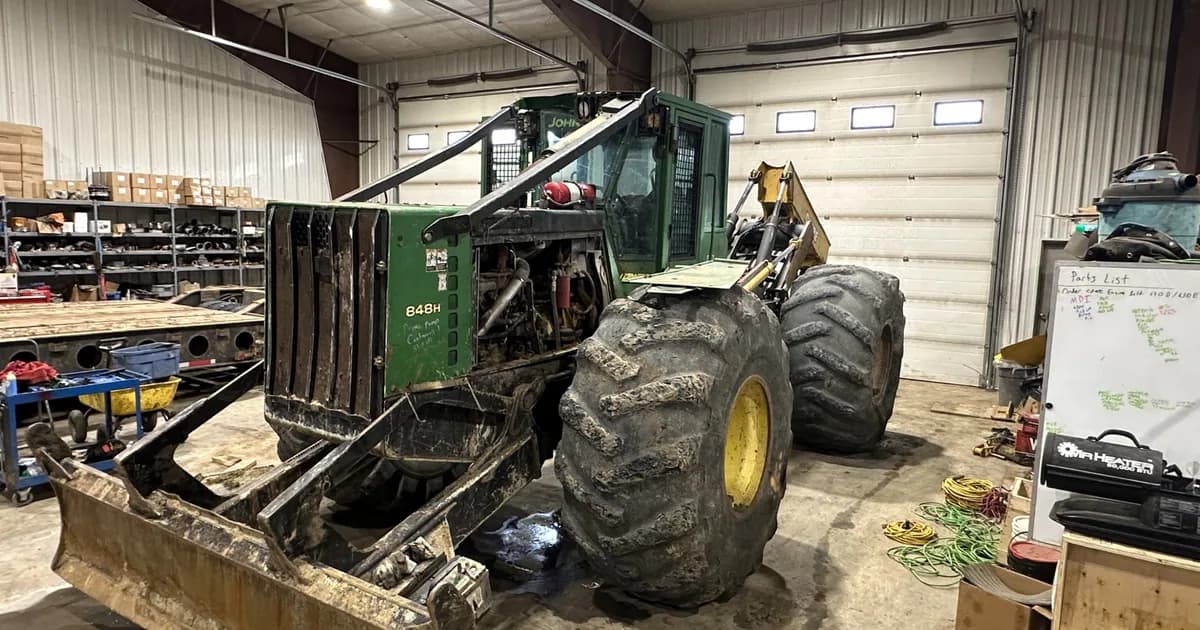
A skidder is the one piece of forestry iron where the hour-meter answer is least useful. On a dozer or an excavator, the operating environment is consistent enough that a 10,000-hour reading tells you something real about what the machine has been through. On a skidder, two machines with the same hours — same model year, same brand — can be in completely different condition. One was a coastal BC machine that fought mud, rain, slope, and salt for every single hour. The other was an Alberta winter machine that ran on frozen ground for half its life and sat idle through breakup. Same 10,000 hours. Two completely different purchases.
That makes "how many hours is too many" the wrong starting question on a used skidder. The right question is: what kind of 10,000 hours was it? This guide walks through how to actually answer that — what to look at, what brand and model patterns matter, and where the hour count starts to bite financing.
Fast answer. On a used skidder, hours alone are not enough. Condition, region, brand, and major-component history matter more than the meter once you move into higher-hour machines. A documented engine, articulation, or hydraulic rebuild can change a high-hour skidder from a write-off to a strong buy.
Why Skidder Hours Tell You Less Than You Think
A skidder is one of the few pieces of heavy iron whose operating environment varies more than the machine itself. The same Tigercat 635E will live a different life depending on which of these realities it walked into:
Coastal BC operations — high rainfall, mud, steep slopes, salt-air corrosion on hydraulic lines, near-constant articulation under load. The hardest hours a skidder accumulates anywhere in Canada. A coastal machine at 8,000 hours is often more worn than an Interior machine at 14,000.
BC Interior, Cariboo, and Northern Interior — drier ground, more stable terrain, salvage and clearcut patterns, dust as a primary contaminant. Wears differently than coast: less hydraulic-seal abuse, more brake and tire wear from longer skid distances.
Northern boreal winter operations (AB/SK/MB/Northern ON) — most of the work is on frozen ground, which is the gentlest substrate a skidder ever runs on. The flip side is hard cold starts, heated-cab demand on the engine, and concentrated production windows that put a season's worth of hours on the machine in three months.
Eastern Canada (Quebec, NB, Ontario) — mixed conditions, often shorter skid distances, more selective harvest patterns on private woodlots. Cable skidders are still common here in a way they no longer are out west. Hours typically accumulate more slowly per year.
Salvage and burn-block work — abrasive debris, hidden steel, fire-damaged wood. A few thousand hours of post-fire salvage will age a skidder hard regardless of region.
The point is not that one region's hours are "better" than another's. The point is that the hour reading on a skidder, in isolation, does not tell you what condition the machine is in. You have to know what the hours represent.
Key takeaway: The same hour reading on two skidders can mean radically different machines. Where a skidder ran, what it pulled, and who maintained it matter at least as much as the number on the meter.
What the Data Actually Says About Skidder Hours
Condition beats the meter — but when the market does price on a number, it prices on hours. Peer-reviewed forestry-economics research is unusually clear on a few points, and they are worth carrying into any used-skidder decision. (One honest caveat up front: the strongest data is American, European, and New Zealand — there is very little published Canadian skidder depreciation data, so read the dollar figures as directional and currency-specific, not as Canadian quotes.)
Hours predict resale value better than age does. A peer-reviewed study of hundreds of US-South forestry-machine auction sales found that annual hours of use was a stronger predictor of a grapple skidder's salvage value than the machine's age. That is the empirical backbone of this whole guide: a low-hour older machine often out-values a high-hour newer one. It is also why lenders read hours as the "mileage" on the asset — but neither hours nor age captures condition, which is why records still win.
Skidders depreciate fast, and the loss is front-loaded. In a New Zealand forest-machine depreciation study, wheeled skidders had the highest per-hour depreciation of any forestry machine — and most of the loss happens early: a wheeled skidder shed roughly NZ$147,000 over its first 5,000 hours but only about NZ$33,000 between 15,000 and 20,000 hours. US auction data points the same way — a one-year-old 250-hp grapple skidder run 2,000 hours lost about 20.6% of its value in year one. The practical lesson for a buyer: let the first owner eat the steep early depreciation, and buy the machine once the curve has flattened.
"About 10,000 hours" is a replacement convention, not a wall. Surveyed logging contractors most commonly replace front-line skidders somewhere in the 9,000–14,000-hour band, clustering near 10,000, on the rule of thumb that the engine is built for roughly a 10,000-hour life before breakdowns climb. But the same contractors note that as long as repair-and-maintenance is up to date, these machines stay productive — and independent engineering puts off-highway diesel rebuild life higher still (commonly 12,000–15,000+ hours, further with oil-analysis monitoring). A documented rebuild resets that clock.
Don't conflate three different "lifespans." Equipment-costing studies assume a skidder economic life of about 5 years — but that is a machine-rate accounting input reflecting the intense 1,200–2,000 hours/year a skidder runs in heavy whole-tree work, not the machine's physical lifespan. By contrast, lower-intensity markets show very different usage: a survey of second-hand European skidders averaged only ~863 hours/year. And a lender's collateral age cap (roughly 10–15 years at the end of the term) is a third number again. They measure different things, so don't let a "5-year economic life" scare you off a well-kept older machine.
For scale against the rest of the cluster, a skidder's ~10,000-hour replacement point sits right alongside the construction fleet: hydraulic excavators leave primary production around 9,800 hours, wheel loaders run an average 7,000–12,000 hours, and crawler dozers get replaced around 12,500 hours. A skidder is not a short-lived machine — it is a hard-used one.
Key takeaway: Hours outrank age as a value signal, depreciation is steepest early, and ~10,000 hours is where contractors choose to replace — not where the machine dies. Buying a documented, post-rebuild skidder after the steep part of the curve is often the best value in the yard.
The Right Questions to Ask the Seller
Skip "how many hours" as your opening question — the meter has already told you that. These are the questions that change a skidder valuation more than the hour count:
Where was this skidder working? Coastal, Interior, boreal winter, eastern selective. The honest answer reframes the hour reading immediately.
Was it cable or grapple — and how was it run? A cable skidder used for selective harvest reads different than a grapple skidder used for clearcut full-tree systems, even at the same hours.
One owner or several? Single-owner skidders with documented maintenance are dramatically more valuable than multi-owner machines, even at higher hours. A long-term owner has reasons to maintain. A flipper does not.
What kind of timber was it pulling? Big coastal logs put completely different load on the drivetrain than small softwood Interior thinning. Same hours, different stress histories.
When was the last hydraulic system service? Skidders contaminate hydraulic fluid faster than almost any other equipment because of constant articulation in mud and water. A machine with religious hydraulic service at high hours is worth more than a low-hour machine that has been ignored.
Articulation joint history? This is the single most important wear point on a skidder. Replaced bushings, rebuilt cylinders, or "wallowed-out" play in the articulation are red flags or green flags depending on what the seller can document.
Tires — original or replacement? A full set of skidder tires runs roughly $8,000 to $14,000+ depending on size and brand. A skidder coming up on tire replacement is worth meaningfully less than one that just had new boots.
Why is it for sale? Retiring contractor, fleet upgrade, end of contract, mechanical issue the seller is not telling you about. The honest answers are short and consistent. The answers that wander tell you something.
Skidder-Specific Wear Points That Matter More Than Hours
A dozer evaluation lives or dies on the undercarriage. A skidder evaluation lives or dies on a different set of components — and these are where you should be looking, regardless of what the hour meter says.
The articulation joint. Skidders are articulated machines, and the articulation joint takes constant load — every turn, every grade change, every load-and-pull cycle puts stress on the pivot bushings, articulation cylinders, and the steel structure around the joint. Look for visible play when the machine is articulated under load, oil weeping around the bushings, or evidence of welded repair near the joint structure. A skidder with a worn articulation joint is a major repair waiting to happen.
The hydraulic system. Mud, debris, and water contamination shorten hydraulic seal life on skidders far faster than on most equipment. Check the colour and condition of the hydraulic fluid (a small sample on a clean rag tells you more than a sight glass). Look for slow grapple cycle times, soft articulation response, and any sign of leaks at the cylinder rod seals. A full hydraulic system overhaul on a skidder can run into the tens of thousands.
The grapple (on grapple skidders). Grapple cylinder seals and the hoses that feed them work in the worst possible environment — directly in the path of debris, mud, and the timber itself. A grapple that opens and closes slowly, leaks at the cylinder rods, or has visibly damaged hoses tells you the grapple system is overdue for service.
The winch (on cable skidders). On cable skidders, the winch is the second-most important system after the powertrain. Cable wear, drum condition, band brake adjustment, and the planetary gear set inside the winch all need evaluation. A worn winch on a cable skidder is the equivalent of a worn undercarriage on a dozer — expected at certain hours, expensive to address, and often missed by buyers focused on the engine.
The drivetrain. Torque converter, transmission, transfer case, and planetaries take continuous load on a skidder. Symptoms of trouble: slipping under load, hesitation in shifts, whining or grinding from the planetaries, oil with metal fines on a magnet check. A drivetrain overhaul is one of the largest single bills you can face on a skidder.
Tires. Skidder tires are not a maintenance item — they are a major cost. A worn set of tires on a skidder coming up for sale should be reflected in the price. Forestry-rated tires (LS-2 chevron, LS-3, or specialty deep-tread patterns) cost more than general-purpose tires and have to be matched to the application.
The frame and main pins. Skidders flex constantly under load. Frame cracks around the articulation, the rear arch attachment, or the boom/grapple mount points are serious. Welded repairs are common; recurring cracks at the same point are a deal-breaker.
Major Component History Can Matter More Than the Meter
Documented replacement or rebuild of a skidder's major components changes the read on the machine more than almost any other factor — often more than the hour count itself. A 14,000-hour skidder with a documented engine replacement, an articulation rebuild, a hydraulic pump overhaul, and a transmission service is frequently a stronger buy than a 9,000-hour machine with no records and no major work behind it. The first machine has paid down its known wear; the second is sitting on it.
This is not theoretical. Working forestry contractors flip their machines when major work is fresh because the maintenance investment is worth more in the next owner's hands than in their own. Listings on ForestryTrader and Supply Post regularly show high-hour skidders priced confidently because the seller can show that the engine has 6,000 hours on a replacement, the centre/articulation was rebuilt at the same time, and the hydraulic system was overhauled along with it. Those machines move because the buyer can see what they are getting.
What buyers and lenders want to see when evaluating a higher-hour skidder:
- Engine replacement, overhaul, or in-frame rebuild records — including the hour reading at the time of the work and the shop or dealer that did it
- Articulation joint or centre rebuild records — bushings, pins, articulation cylinders, structural welding inspected
- Hydraulic pump and cylinder rebuild history — main pump, grapple cylinders, articulation cylinders, steering cylinders
- Transmission, torque converter, and planetary rebuild history
- Differential and final drive service history
- Dealer or independent shop invoices — itemized parts and labour, not handwritten summaries
- Oil sample analysis history — tells the lender and the next owner the machine has been monitored, not just used
- Service logs tied to dates and hour readings — consistent, not retrofitted
On high-hour forestry iron, service records are not just paperwork. They are part of the machine's value. The asking price on a high-hour skidder with documented major-component work should reflect what has been done — and the financing pool for that machine is meaningfully wider than for the same hours with no history.
If a seller cannot produce records on a high-hour skidder, the right read is to assume the work has not been done and price accordingly — or to walk away if the asking price implies it has.
Brand and Model Reality
Forestry-aware lenders and buyers think in specific models, not generic "skidders." Here is how the major brands and models actually read on a used file in Canada.
Tigercat
The dominant brand in Canadian forestry, particularly in Ontario, BC Interior, and the boreal. The 630-series (630, 632, 635) is the workhorse mid-size to large grapple skidder. The 620-series sits below that. Tigercats hold their value well, parts availability through dealer networks (Wajax, Frontier Power Products, Tigercat dealers in Ontario and Quebec) is strong, and lenders are comfortable with them at higher hours than most other brands. A well-maintained 635E at 14,000 hours can still finance reasonably; a similarly aged off-brand machine at 14,000 hours often cannot.
John Deere
Strong national presence, especially in Ontario, Quebec, and the prairies. The 748 series (older) and 848 series (current) are the flagship grapple skidders, both inheriting the Timberjack design lineage that JD acquired in 2000. Brandt is the dealer in the prairies; Nortrax and Brandt cover other regions. JD skidders are well-supported, parts are reasonable, and lenders treat them similarly to Tigercat — major-brand confidence, comfortable financing at moderate-to-high hours.
Caterpillar
Cat's main offering in skidders is the 525-series. Less common than Tigercat or JD in Canadian forestry, but well-built. Finning is the dealer in Western Canada and Toromont in Ontario and Quebec. Parts availability is excellent because of the broader Cat network, but the resale market is thinner than for Tigercat or JD because there are simply fewer used Cat skidders in circulation. Lenders are comfortable with Cat skidders, but pricing reflects the smaller buyer pool.
Komatsu
Komatsu Forest entered the skidder market via acquisitions and has presence in the boreal regions. Less common than the top three brands, parts availability is regional, and lenders are slightly more conservative on hours than they would be on a Tigercat or JD of the same age and condition. Not a problem brand, but evaluate the dealer support in your specific region before committing.
Older brands and outliers
Clark Ranger, Treefarmer (FMC), International, and the older Caterpillar D-series logger machines. These show up regularly in the used market — sometimes at very attractive prices — but parts availability is limited, resale is thin, and lenders generally will not finance them. If you are buying one of these, plan on cash or specialty private lending only, and make sure you have a parts plan before the first breakdown.
Key takeaway: On a skidder, the brand and model do more lifting in the lender's underwriting decision than on most equipment. Tigercat and Deere have the strongest financing profiles at higher hours. Cat is solid but in thinner supply. Off-brands are usually a cash purchase even at low hours.
Where Hours Start Bending the Financing
The lender's read on a skidder is shaped by hours, age, brand, and condition together — and component history can shift the file meaningfully in either direction. The first thing to clear up, because it trips up most buyers: there is no hard hours number that makes a skidder unfinanceable in Canada. Lenders do not publish an hours cap the way they cap age. What they actually do is appraise the machine and cap its age at the end of your term — commonly a 10-to-15-year window depending on the lender and the asset. Hours matter because they drive that appraised value and the machine's remaining life, which then shape your rate, term, and down payment rather than producing a flat "no." That structure also sits on today's cost of money: as of June 2026 the Bank of Canada's overnight rate is 2.25% and prime is 4.45%, and equipment loans are typically priced as prime plus a spread. Programs like BDC's equipment loan can finance new or used machines up to 125% of the purchase price over terms up to 12 years.
The patterns below reflect how forestry-aware lenders typically tend to size up a used skidder file — read them as how the structure tightens, not whether you get a yes. Generalist banks often price tighter; private equipment lenders price looser. Every file is individual.
| Hour Range | How the Deal Structures | Typical Terms |
|---|---|---|
| Under 5,000 | Generally comfortable across all lender types | Up to 6 years, 10–15% down, competitive rates |
| 5,000 – 10,000 | Generally comfortable on major brands at banks/EFCs | 4–5 years, 15–20% down |
| Low-to-mid five figures | Many lenders start tightening terms; EFCs preferred | 3–4 years, 20%+ down, brand and condition matter |
| Mid-to-high five figures | Forestry-aware private lenders most active | 2–3 years, 25%+ down, specific brand/model matters |
| Very high hours | Specialty private lenders; component history critical | Short terms, 30%+ down, condition-and-contracts driven |
A few things shift those tendencies in either direction:
- A signed cutting contract with a recognized licensee strengthens any high-hour file. Lenders want to see the revenue source.
- Maintenance documentation — full service records, oil analyses, hydraulic system overhauls, articulation work — moves the file up a tier or more.
- Brand — a 14,000-hour Tigercat is often more financeable than an 8,000-hour off-brand machine at the same age.
- Region — coastal BC skidders are often discounted by lenders because of the known operating-environment severity. Boreal winter machines often go the other direction.
If your file is challenged credit on top of high-hour iron, our bad-credit logging financing guide and the provincial versions for Alberta, BC, and Saskatchewan cover what changes when banks decline.
Red Flags That Are Worse Than High Hours
Some findings on a skidder inspection are worse signs than the hour count, no matter what the meter reads.
Articulation play under load. Park the skidder, articulate it fully one direction under a load, and watch the joint. Visible play, audible clunking, or oil weeping around the pivot pins indicates a worn articulation joint — a major repair that should come off the asking price or kill the deal.
Recent suspicious paint or repair work near the articulation, frame, or grapple mount. Fresh paint covering structural areas almost always covers structural problems. Look at every weld in the load path.
Hydraulic fluid that is dark, milky, or contains visible debris. Healthy skidder hydraulic fluid is amber and clean. Anything else is a system that has been ignored, contaminated, or run hot, and you are looking at expensive cleanup.
Drivetrain hesitation or noise. Whining from the planetaries, slipping torque converter, transmission shifts that hunt or hesitate. Drivetrain rebuilds are the largest single bill on a skidder. Walk away from anything you cannot diagnose with confidence.
Tire condition that the price does not reflect. A skidder with worn tires being sold at low-tire pricing is fine. The same machine being asked at like-new pricing is over-priced by the cost of a tire set. Tires age regardless of hours, so a low-hour skidder with old tires is a real concern.
No service records. On a $100,000 to $400,000 forestry machine, no records is not a small deal. Every working forestry contractor keeps service records — the seller who claims they were lost is telling you something about their habits.
Mismatched hour readings. Modern skidders track hours through electronic control modules that are dealer-readable. Older machines have mechanical meters that can be tampered with. If the displayed hours do not match the wear, the play in the controls, the hose condition, or the seat foam, the meter is suspect.
Sources: McConnell et al., "Modeling Depreciation of Logging Equipment," Forest Science 67(2) — Oxford Academic; Fahey & Visser, 2019 NZ Forest Machine Depreciation Study — Forest Engineering; MDPI; Construction Equipment; BDC; Mehmi Group — used-equipment financing in Alberta — Mehmi Financial Group. Rate, term, down-payment and approval-timing figures are directional practitioner conventions current as of August 2026 — they move with the prime rate, vary by lender and by machine, and are not quotes or approvals. Equipment prices are asking prices rather than transaction prices. Tax treatment depends on your own contract and circumstances; confirm with your accountant.
How a Forestry Contractor Should Actually Decide
Hours are one input. Here is how the decision actually shapes up on a real used skidder purchase.
If you are running this skidder as a primary machine for the next 5+ years, look for a major-brand machine in the lower hour range for its model from a one-owner forestry contractor with documented service history. The financing path is straightforward, the resale floor is predictable, and the working life ahead is substantial.
If this is a second machine or a project-specific buy, the mid-hour range can be excellent value when the brand is right (Tigercat, Deere) and the maintenance story is real — and even better when major component work is fresh and documented. You may pay tighter financing terms, but the price-per-working-hour ahead of you is often the best in the market.
If you are buying for a specific contract and the machine just needs to finish that work, a high-hour skidder priced correctly — particularly one with a recently rebuilt engine, articulation, or hydraulic system — can be the smartest deal on the lot. Match the working life ahead of the machine to the contract length, and budget for a major component failure as part of the deal pricing.
If you are rebuilding credit and need any path to a working skidder, a high-hour major-brand machine through a forestry-aware private lender is often the only door open — and it gets you working. Six months of clean payments on that file dramatically improves what you can finance next.
In every case, the inspection — and ideally a forestry-experienced mechanic walking the machine with you — is worth more than the hour-meter reading. Pay for the inspection. Skidders are too expensive and too hard on themselves to buy on a sticker.
Thinking about a high-hour skidder?
Send us the deal — the model, the hours, the asking price, and any engine, articulation, or hydraulic repair records the seller has produced. The initial read is a soft-touch review (no credit pull required) — we will tell you whether the file still looks financeable before you commit, which lender categories are realistic on the brand and hour range you are looking at, and what the deal structure (rate, term, down payment) is likely to look like. We work with forestry-aware lenders who price these files on the full picture — brand, condition, contract, region, and component history — not just the meter. For an even lower-friction diagnostic, run our financeability checker.
Sources: McConnell et al., "Modeling Depreciation of Logging Equipment," Forest Science 67(2) (peer-reviewed, hours-vs-age and first-year depreciation); Fahey & Visser, 2019 NZ Forest Machine Depreciation Study (per-hour depreciation and ~10,000-hour replacement); MDPI Forests 12(6):729 (European second-hand annual use); Construction Equipment — economic life of wheel loader/excavator/dozer (cross-class comparison); BDC equipment loan and Mehmi Group — used-equipment financing in Alberta (Canadian lending framing); manufacturer service guidelines from Tigercat, John Deere, and Caterpillar dealer networks. Depreciation and dollar figures are American, European, and New Zealand and are directional, currency-specific, and not Canadian quotes; rate figures are current as of June 2026 and change at each Bank of Canada decision. Information current as of June 2026.
For more on related topics, see our national bad-credit logging financing guide, the log truck financing guide, and the used heavy equipment financing guide.
You can also compare how hours read across machine classes in our hours guides for the excavator, dozer, skid steer, wheel loader, motor grader, backhoe, and telehandler, or see how hours affect your equipment loan rate.
Already own equipment, or eyeing a different machine?
Frequently Asked Questions
How many hours does a skidder last?
Well-built major-brand skidders can still be working at very high hours, especially when major components have been rebuilt or replaced and the machine has been maintained properly. The realistic working life depends far more on operating conditions, component history, and maintenance discipline than on any single ceiling number on the meter. A coastal BC skidder fighting mud, slope, and rain ages faster than an Interior or boreal machine running on dry, frozen, or stable ground.
Is 10,000 hours a lot on a skidder?
It is a decision point, not a death sentence. Around 10,000 hours is where logging contractors most commonly replace a front-line skidder (the surveyed range runs roughly 9,000–14,000 hours), largely on the rule of thumb that the engine is built for about a 10,000-hour life before breakdowns climb. But that is a replacement convention, not a hard ceiling: on a major-brand machine with strong maintenance history — Tigercat 630-series, John Deere 848, Cat 525 — a documented engine rebuild, sound hydraulics, and a tight articulation joint can carry substantial working life well past 10,000 hours.
What is the difference between cable and grapple skidder hours?
Cable skidders carry an additional wear system — the winch, drum, brakes, and cable itself — that grapple skidders do not have, but they typically work less aggressively per hour. Grapple skidders cycle faster, carry larger payloads, and put more continuous load on the drivetrain and hydraulics. Hour-for-hour, a grapple skidder generally accumulates more powertrain wear; a cable skidder accumulates more winch and steering-system wear.
Will a lender finance a skidder with high hours?
Yes. There is no hard hours cutoff in Canada — lenders cap on the machine's age at the end of the term (often a 10-to-15-year window depending on lender and asset) and read hours as the "mileage" that estimates remaining life and repair risk, which shapes your rate, term, and down payment rather than triggering a flat decline. Documented work completed — a rebuilt engine, articulation, or hydraulic system — can make even a high-hour skidder financeable. Banks and captive finance arms are usually most comfortable on lower-hour major-brand skidders, while equipment finance companies and forestry-aware private lenders extend further when condition, records, and contracts support the file. BDC, for example, finances new or used equipment up to 125% of the purchase price with terms up to 12 years.