
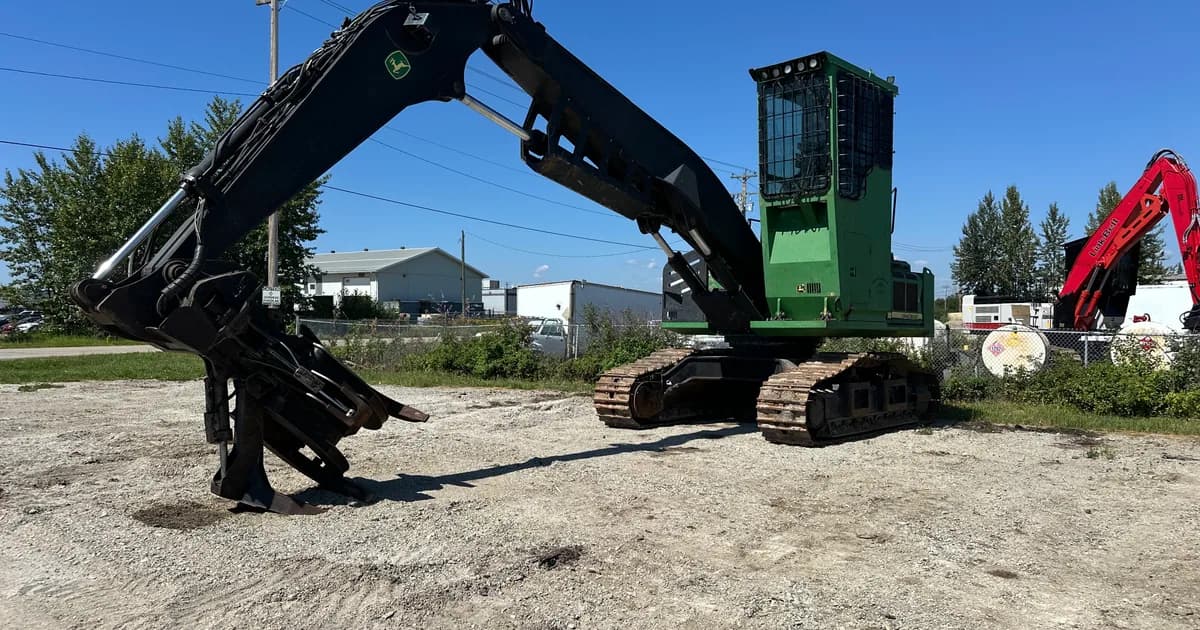
A contractor out of Slave Lake runs a Tigercat skidder and a mulcher. In January and February he is cutting under a foothills licensee. By spring breakup the bush is shut, so the same iron is out clearing a pipeline right-of-way for an oilfield outfit. Last year the 2023 fire season cost him weeks of access, and now the OSB mill up in High Level is winding down. His credit file is a 600-something with a couple of late payments from the year the oil work dried up. To a bank in Edmonton, that is a decline waiting to happen. To a lender who actually knows how Alberta works, it is a diversified operator going through a normal Alberta year.
That gap is the whole story of financing logging iron with bad credit in this province. Alberta is not BC and it is not Saskatchewan. Here the forest sits on top of the busiest energy landbase in the country, the seasons run on frozen ground, and the risks that scare a generalist underwriter — fire, a mill curtailment, an oil-price dip — are things a forestry-aware lender already prices. This guide is built around how Alberta actually works, and how to put a challenged-credit file in front of someone who can say yes.
Two Economies on One Landbase
Start here, because it is the thing that makes Alberta unlike anywhere else and the thing a bank gets wrong most often.
In most of Alberta's forest, the forest is not even the biggest industrial tenant. On Al-Pac's boreal FMA, the energy sector is the largest non-forestry activity — "many times larger than forestry" — and oil-sands production has grown roughly five-fold since the FMA was signed in 1991. Forestry and energy work the same ground under Integrated Land Management agreements that share roads and clearing, and oil-sands site clearing even feeds short-term fibre back into the mills.
For a contractor, that overlap is not an abstraction — it is the shape of the year. A large share of Alberta bush operators run their equipment on both sides: logging under a licensee when the ground is frozen, then oilfield pipeline right-of-way, lease-site, and seismic-line clearing through the rest of the year. Operators like Northern Lights Logging out of Slave Lake advertise exactly that dual capability.
Here is why it matters to your loan:
- Your revenue runs on two cycles, not one. When forestry is slow, oil clearing can carry you — and vice versa. Al-Pac's own reporting notes activity "slowed following the steep decline in oil prices since 2014," which is the same downturn that bruised a lot of contractor credit files. If your rough patch lines up with an oil-price crash, that is context a lender should hear.
- A generalist bank reads two income streams as inconsistency. Deposits from a forestry prime one month and an oilfield outfit the next, with quiet stretches between, looks unstable on a spreadsheet. A forestry-aware lender reads the same pattern as diversification — two customers instead of one.
- Document both. Oilfield-clearing contracts and invoices are bankable revenue too. Bring them. A file that shows winter logging plus shoulder-season energy work is stronger than one that only tells half the story.
Key takeaway: In Alberta, "what do you do in the off-season" is a financing question. Contractors who run their iron on both logging and oilfield clearing have a more resilient cash flow than the bank's model assumes — but only if you put both revenue streams in front of a lender who knows how to read them.
Boreal or Foothills: Where Your File Sits on Alberta's Map
The second thing a forestry lender wants to place is which part of Alberta's forest your revenue comes from. The province splits cleanly into two operating worlds, and they finance differently because their seasons, access, and mills differ.
The Northern Boreal
Winter / frozen-muskeg country
- Alberta-Pacific (Al-Pac) — ~6M ha FMA (one of the largest single tenures in North America), mostly muskeg; feeds North America's largest single-line pulp mill near Athabasca
- Tolko — High Prairie
- West Fraser / Vanderwell — Slave Lake area
- Mercer Peace River — Peace River pulp
Most harvest and hauling happens on frozen ground; access closes at breakup, so revenue concentrates December–March.
The West-Central Foothills
Longer season, higher ground
- West Fraser — Edson, Hinton
- Weyerhaeuser — Grande Prairie, Pembina Timberland (Drayton Valley)
- Millar Western — Whitecourt
- Canfor and regional quota holders
Firmer terrain extends the operating window, but foothills pine carries the province's mountain pine beetle exposure.
Al-Pac's tenure is the anchor of the northern picture: a net area of roughly six million hectares of northeastern boreal, bounded to the south by Athabasca, Boyle, and Lac La Biche and running up to include Fort McMurray. Only about 1.8 million hectares of it is actually harvestable — the rest is bog, fen, and muskeg — which is exactly why the majority of harvest and hauling happens when the ground is frozen. That single fact drives the winter-concentrated revenue pattern a lender needs to expect on a northern file.
Why this matters for a challenged-credit deal: a lender who can place you on this map already understands your season and your resale market before the credit conversation even starts. "I run for a foothills licensee out of Whitecourt" or "I subcontract in the Al-Pac boreal north of Lac La Biche" does more work on your file than the score does.
What's Shaking the Ground in 2026
The honest part. Alberta forestry is carrying three real headwinds right now, and a good lender prices them rather than fleeing them. Know them, because naming them yourself signals you understand your own operating reality.
Fire
2023: 2.2M haThe record 2023 season burned 2.2 million hectares — nearly ten times the five-year average and about 6.6% of Alberta's forest. Almost half of the province's 33 fire management units burned severely enough to trigger allowable-cut reductions, tightening how much timber contractors can move. A fire-season gap in your statements is an industry-wide event, not a sign you failed.
Mountain Pine Beetle
Foothills pineAlberta pine is more vulnerable to the beetle than BC's because it has not coevolved with it. Provincial populations fell 98% from their 2019 peak to 2023 and are now largely endemic, but it remains a real threat on the eastern-slopes and foothills pine — relevant if your cutblocks or your mill run on pine.
The High Level Curtailment
Spring 2026West Fraser is indefinitely curtailing its High Level OSB mill in spring 2026 (about 190 jobs), citing weak OSB demand — a market condition, not a fibre or beetle problem. If your work feeds OSB volumes, keep the down payment healthy and the term realistic so a soft market quarter doesn't break the payment.
None of these is a reason to sit out. Alberta still harvests about 26.3 million cubic metres a year against a legal ceiling near 29.5 million — there is room in the system — and the industry runs on roughly $12 billion of revenue and 40,000-plus jobs. The point is simply that a lender who knows the province factors fire, beetle, and market cycles into the structure of your deal instead of declining on them.
What Counts as Bad Credit on an Alberta Forestry File
Lenders bucket credit into rough tiers, and where you land sets the starting point, not the verdict:
- 680+ — Good to strong. Alberta-savvy banks and captive programs are realistic.
- 620–679 — Fair. Most private equipment lenders will work with you; some banks still will.
- 550–619 — Challenged. Private equipment lenders and forestry-aware specialty lenders are your path.
- Below 550 — Difficult but not closed. Down payment, deal structure, and the machine itself carry the file.
What makes an Alberta forestry file harder than general construction is the stack: specialized collateral, winter-concentrated revenue, remote operating areas, and now fire-year and market volatility — all on top of the score. A bank sees four risks at once and declines. A forestry lender sees the same four and prices them.
What Actually Moves an Alberta File
On a challenged-credit forestry deal, these carry more weight than a generalist underwriter expects — sometimes more than the score itself:
A documented contract — forestry or oilfield. A signed cutting or hauling agreement with a licensee (Al-Pac, West Fraser, Weyerhaeuser, Millar Western, Mercer, Tolko) is the strongest single credential. In Alberta, a documented oilfield-clearing contract counts too — it is real, recurring revenue. Bring whatever is signed.
Winter production history. Six to twelve months of business bank statements spanning a cutting season beats a three-month snapshot. Strong December-through-March deposits with a reserve-drawdown shoulder season is a healthy Alberta pattern, not instability — especially if oil-clearing revenue fills some of the gap.
Equipment-secured payment history. Clean history on prior equipment or log-truck loans carries weight even when unsecured debt drags the overall score. Alberta-aware lenders read that nuance.
You already own iron. A logger adding a processor to an owned skidder reads far better than a first-time buyer at the same score.
The machine itself. Major North American brands with reasonable hours and broad resale (skidders, log trucks) are easier to place than older European forwarders and harvesters, where parts and resale logistics in Alberta are thinner.
What It Costs — and a Real Alberta Deal
The ranges below are directional — set by lender type, machine, documentation, and borrower profile — not commitments. They reflect the June 2026 rate environment: the Bank of Canada held its policy rate at 2.25% on June 10, 2026 (prime 4.45%), and equipment loans price at prime plus a spread that widens as credit and machine age weaken.
| Borrower Profile | Expected Rate | Typical Down | Typical Term |
|---|---|---|---|
| Strong: 700+, 5+ yrs, signed contract | 7–10% | 10–15% | 5–7 yrs |
| Solid: 650–699, 2–5 yrs, stable work | 9–13% | 15–20% | 4–6 yrs |
| Challenged: 550–619, some history, partial docs | 13–18% | 20–30% | 3–5 yrs |
| Severely challenged: below 550, thin history | 17–22%+ | 25–35% | 3–4 yrs |
Specialized machines (bunchers, forwarders, processors) sit at the higher end of each tier; skidders and log trucks sit lower because resale is broader.
A realistic Alberta deal. Picture a used Tigercat 635E grapple skidder at $180,000, a 625 score, two winters cutting for a foothills licensee out of Whitecourt, a signed one-season agreement — and, critically, a second income: pipeline right-of-way clearing that runs the machine through the shoulder seasons.
- Down payment at 25%: $45,000
- Amount financed: $135,000
- Rate: 14% · Term: 48 months
- Approximate payment: ~$3,688/month
- Total interest over term: ~$42,000
If that skidder runs a full winter under contract at $40,000–$60,000 a month gross, and clears energy right-of-ways in the off-season, the math works comfortably at 14%. The cost of not having the machine — the lost season, the lost position with the licensee, the lost oilfield contract — dwarfs the interest premium. Model your own numbers with our payment calculator.
Key takeaway: Challenged-credit financing costs more, but a machine that earns on both the wood cycle and the oil cycle usually outruns the rate premium by a wide margin. Run the math on the deal you can access today, not on a prime rate you cannot.
Why an Edmonton Bank Says No When a Forestry Lender Says Yes
A common Alberta experience: walk a clean deal — solid machine, signed agreement, real revenue — into an Edmonton or Calgary bank, wait three weeks, get declined. Send the same file to a forestry-aware private lender and it can fund in a day or two. The deal did not change. The desk did.
Banks dislike stacked risk, and Alberta forestry stacks it high by default — specialized collateral, winter-concentrated revenue, remote ground, fire and market volatility, plus the two-income-stream pattern a generalist model cannot categorize. A lender who funds Alberta logging iron knows winter revenue is normal, that a skidder 300 km north of Lac La Biche is recoverable, that an oilfield-clearing contract is real revenue, and that a 2023 fire gap hit the whole province. They adjust rate, term, and down payment to match the risk and still fund the deal. Knowing which desk to send the file to is most of what a broker provides — and it protects your score, because one broker submission is a single credit pull instead of four bank declines.
Playing an Alberta File Right
A few moves consistently separate an approval from a decline:
Lead with a contract — and bring the oilfield one too. A signed forestry agreement is the most powerful credential on the file; documented energy-clearing work is a genuine second one. Name the licensee, the operating area, and the off-season work in your application. If nothing is signed yet, it is often worth waiting until it is.
Put down more than the minimum. Moving from 20% to 30% down can drop the rate by several points and widen the lender pool. If the machine earns strong winter revenue, borrowing less is almost always the right trade.
Start on a skidder or log truck if you're rebuilding. Broader resale, easier approval. Land the easier deal, build 12–18 months of clean payment history, then finance the specialized iron at better terms.
Explain the credit event in writing — and tie it to the cycle. If your score dropped because a prime paid late, because the 2023 fire killed weeks of volume, or because the oil-price dip pulled your energy work, put it in one short, factual note. Underwriters with authority to make exceptions respond to context.
Don't go silent on a late payment. Breakup, a fire shutdown, a mill curtailment, a late-paying prime — these happen here. A lender who knows Alberta will often arrange a temporary deferral if you call before the due date. Silence followed by a miss is what triggers collections — see our guide on equipment financing default.
Use one channel, not four. Multiple hard pulls in a short window can cost real score points — often the difference between approval and decline. A forestry-aware broker submits once, to the right desks, on a single pull.
Sources: Government of Alberta — Forest Management Agreement boundaries and Alberta's Forest Economy 2023; Al-Pac Stewardship Report 2015–2020; Alberta Forest Products Association; Alberta.ca — Mountain Pine Beetle strategy; West Fraser — OSB capacity reduction; CBC — 2023 wildfire and the lumber industry; BDC — Equipment Loans. West Fraser reports financials in USD. Rate, down-payment, and term ranges are directional market conditions as of June/July 2026 that float with prime, not quotes. Information current as of July 2026.
Sources: Government of Alberta; Alberta's Forest Economy 2023 — Government of Alberta; Al-Pac Stewardship Report 2015–2020 — Alberta-Pacific Forest Industries; Alberta Forest Products Association; Alberta.ca — Mountain Pine Beetle strategy — Government of Alberta; West Fraser; CBC — 2023 wildfire and the lumber industry — CBC News; BDC. Rate, term, down-payment and approval-timing figures are directional practitioner conventions current as of August 2026 — they move with the prime rate, vary by lender and by machine, and are not quotes or approvals. Equipment prices are asking prices rather than transaction prices. Tax treatment depends on your own contract and circumstances; confirm with your accountant.
Next Steps
If you are an Alberta logger with challenged credit and a machine you need — a used Tigercat skidder, a Cat 563 buncher, a John Deere 1210G forwarder, a Kenworth log truck — the fastest way to know where you stand is to get the file in front of lenders who handle Alberta forestry at your credit tier. Start with our financeability checker for a quick read, or submit your information to IronFinance and we will match you to the right lender. We work with forestry-aware lenders who understand the boreal-and-foothills tenure map, the winter-frozen operating season, the oil-and-gas overlap that shapes Alberta cash flow, and the realities of running iron from Slave Lake to Whitecourt to the Al-Pac boreal. If an Edmonton or Calgary bank has already declined the deal, our bank-decline guide walks through what changes when you move to specialized lenders.
For the broader national picture, see our national bad-credit logging guide. If you run across provincial lines, see the BC, Saskatchewan, and Manitoba versions. Financing a log truck specifically? Our log truck financing guide and how to start a logging truck business guide cover the truck-specific angles. For the down-payment mechanics on a challenged-credit file, start with the down payment guide.
Already own equipment, or eyeing a different machine?
Frequently Asked Questions
Can I finance logging equipment in Alberta with bad credit?
Yes. Specialized private lenders and forestry-aware brokers regularly approve Alberta logging contractors with challenged credit, especially when the file is tied to a cutting or hauling contract with an established licensee — Al-Pac, West Fraser, Weyerhaeuser, Millar Western, Mercer Peace River, or Tolko. The deal is tighter than a strong-credit file (larger down payment, higher rate, shorter term), but the door is not closed. Documented work — including oilfield clearing revenue — helps make the file bankable.
Why does oil and gas matter to an Alberta logging loan?
Because in Alberta the two industries share the same land. Energy is the largest industrial activity on the forest landbase — many times larger than forestry — and a lot of bush contractors run their iron on both: logging in winter and oilfield pipeline, lease, and seismic-line clearing the rest of the year. That means an Alberta logging contractor’s cash flow often tracks the oil-and-gas cycle as much as the wood cycle, which a forestry-aware lender reads as diversification and a generalist bank misreads as inconsistency.
Does it matter whether I work the boreal or the foothills?
Yes — it is one of the first things a forestry lender wants to place. The northern boreal is dominated by Alberta-Pacific (Al-Pac), whose roughly 6-million-hectare FMA is one of the largest single tenures in North America and is mostly frozen-muskeg country worked in winter. The west-central foothills run through West Fraser (Edson, Hinton), Weyerhaeuser (Grande Prairie), and Millar Western (Whitecourt). Which world your revenue comes from tells the lender how your season, your access, and your resale market actually work.
What down payment should I expect in Alberta with challenged credit?
Plan on roughly a quarter to a third of the purchase price on specialized forestry iron — feller bunchers, forwarders, processors — if your credit is below about 620. Skidders and log trucks often sit at the lower end because their resale market is broader. A signed cutting or hauling contract, documented oilfield-clearing revenue, strong bank statements through a winter cycle, or simply a larger down payment can all bring the requirement down.