
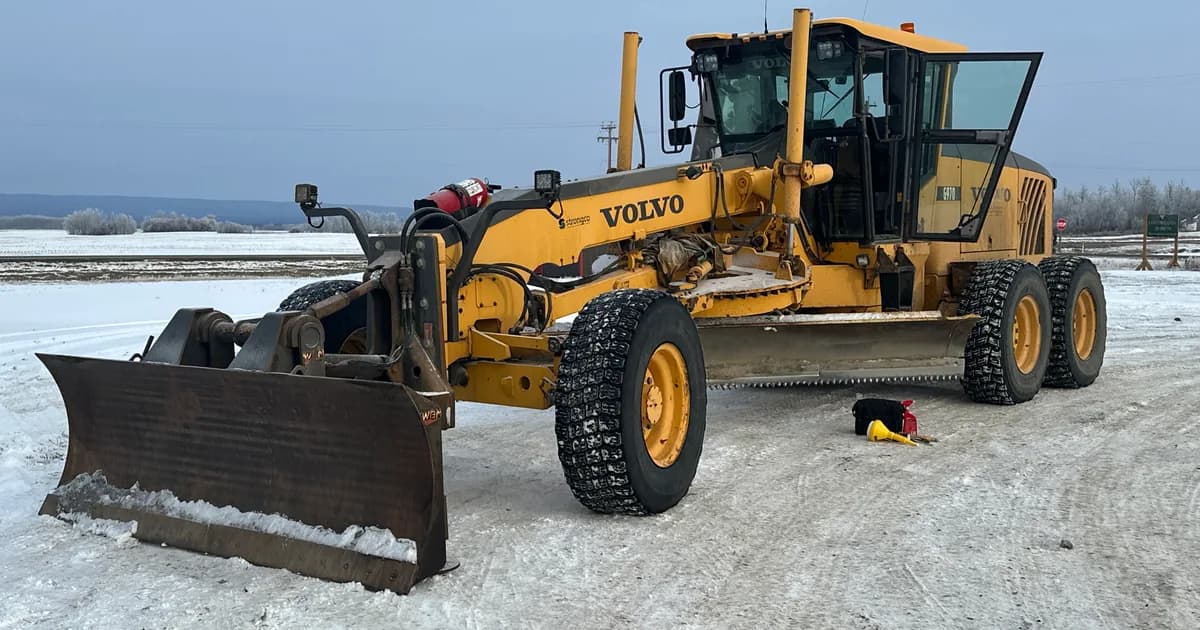
Heavy equipment financing is a strange kind of borrowing once you really look at it, and the strangeness is what makes it work in your favour. The machine you are trying to buy is three things at once: it is the thing you need, it is the lender's collateral, and it is the thing that earns the money to make the payment. A house you finance just sits there appreciating. A machine you finance goes out and bills hours. That triangle — asset, collateral, income generator, all the same object — is the reason a contractor a bank would never hand an unsecured dime can walk away with six figures of equipment financing.
I have placed deals for contractors who were genuinely surprised they qualified, because they were thinking about it like a personal loan — "will they trust me with the money." That is the wrong frame. The lender is not really betting on you in isolation. They are betting on a specific machine that holds its value, generating revenue, with you operating it. Once you understand that the iron is doing most of the heavy lifting in the lender's mind, the whole process stops feeling like begging and starts feeling like what it is: a structured transaction with a lot of moving parts you can actually control.
This guide walks the entire thing end to end — who lends the money and who each lender is right for, what they actually evaluate, how to structure the deal, what it costs in 2026, the tax write-off most contractors leave on the table, and the mistakes that quietly cost people thousands. Whether you are eyeing a new Cat 320 on a dealer lot or a ten-year-old Komatsu off a classifieds site, the path is the same.
How equipment financing actually works
Equipment financing is secured lending. The machine is the collateral. If the payments stop, the lender can repossess it and sell it to recover their money, and they register a security interest against the equipment (a PPSA registration) so their claim is on record until you have paid it off. The day the loan clears, that lien comes off and the machine is yours free and clear.
That security is the whole reason the terms are good. Because a real asset backs the loan, lenders stretch on credit, offer longer terms, and approve deals they would never touch unsecured. A $150,000 unsecured loan to a contractor with a 640 score is close to impossible. A $150,000 loan to the same contractor to buy a well-kept Cat 330 excavator is routine, because the lender knows that machine holds its value and can be resold if it ever comes to that.
The mechanics are simple. You find a machine. You apply. The lender sizes up you and the equipment. If approved, they fund the purchase — usually paying the seller directly. You make monthly payments over a term, commonly 36 to 84 months. At the end you own it (on a loan) or you exercise a buyout (on a lease).
Key takeaway: The machine secures the loan, so your credit score is one factor, not the verdict. A well-chosen piece of equipment with strong resale value can carry a deal that your credit alone never could.
The lenders, and who each one is for
Lenders are not interchangeable. Each has a different risk appetite, speed, and price. Knowing who is who keeps you from burning weeks — and a hard credit pull — at the wrong door.
| Lender | Typical Rates | Speed | Min. Score | Best For |
|---|---|---|---|---|
| Big Five banks (TD, RBC, Scotia, BMO, CIBC) | ~6–9% | 1–3 weeks | 680+ | Established businesses, clean books, best rate |
| Credit unions (Servus, Conexus, Vancity, Desjardins) | ~6.5–9.5% | 1–2 weeks | 650+ | Local businesses with an existing relationship |
| BDC (federal Crown lender) | Prime + a margin | 1–2 weeks | Good profiles | Long amortizations, interest-only startup periods |
| Captive finance (Cat Financial/Finning, Deere Financial/Brandt, Kubota Credit) | ~5–10%, plus promos | 3–7 days | 650+ | Buying that brand, especially new |
| Equipment finance & private lenders | ~9–18% | 24–72 hours | 550+ | Speed, flexibility, used iron, challenged credit |
| Brokers (IronFinance) | Whatever the matched lender offers | 1–3 days | Any | One application shopped to many lenders |
Banks have the cheapest money and the most patience-testing process. They want two-plus years of statements, clean tax filings, and a personal guarantee. If your books are tidy and you are not racing a deadline, a bank gets you the lowest rate. If you need to lock down a machine before someone else does this weekend, a bank will not move fast enough.
Credit unions behave like banks but bend more for members. If you have banked with Servus or your local credit union for a decade, their commercial team will sometimes flex on a deal the big banks reject outright.
BDC — the Business Development Bank of Canada, a federal Crown corporation — is the one most contractors forget. Its equipment loan does some genuinely useful things the chartered banks usually will not: it finances up to 125% of the purchase price of new or used equipment (the extra covers freight, installation, and training), it lets you pay interest only for up to the first 24 months while the machine ramps up, and it amortizes up to 12 years on the right asset. BDC is a prime-referenced lender — its variable rate is the prime rate plus a margin — and it offers fixed rates too. Those 125% and 12-year and 24-month figures are ceilings, not the default, but the postponement of principal is a real edge for a business buying a machine that takes time to start paying.
Captive finance arms are the lending divisions of the manufacturers, and they exist to move iron. In Canada that means Cat Financial through Finning, John Deere Financial through Brandt, plus Kubota Credit and Volvo Financial. They know their own equipment's value cold and run promotions — Finning, for instance, advertises zero-percent financing campaigns on qualifying Cat equipment in Canada from time to time. The catch is they finance their own brand, and the best promos are usually on new inventory. If you are buying from a brand dealer, always ask what their finance arm is running on that specific unit — sometimes it beats anything an outside lender will do.
Equipment finance companies and private lenders move fast — often a decision in 24 to 72 hours — and work across a far wider range of credit and business profiles. The trade is a higher rate. But speed and flexibility have hard dollar value: the profit from starting a contract on time usually dwarfs a couple of points of interest. For how these differ from banks, see our banks vs. private lenders guide.
Brokers do not lend their own money — they shop your deal across many lenders and place it where it fits best, on a single credit pull. A good one knows which lender approves which deal at which rate. That is exactly how we work at IronFinance: one application, many lenders, the best available terms.
What lenders actually look at
Your credit score gets the attention, but it is one input among several. Knowing the full list lets you build a stronger file.
Credit score and history. A 750 opens every door; a 620 closes the banks but leaves plenty of private lenders; below 550 your options narrow but do not vanish. More important than the number, lenders read the report — a missed secured payment (an equipment loan, a truck payment) is a far bigger flag than a three-year-old late credit card. Our credit score guide breaks down every tier, and if you are under 620, the bad credit financing guide covers what actually works.
Time in business. Two years is the convention most lenders use to separate "startup" from "established." Under two years, your options tilt toward private lenders who want more down. Past five years, your track record becomes an asset; past ten, lenders forgive the odd blemish.
Revenue and cash flow. If your business deposits $80,000 a month and you want to finance a $95,000 John Deere 333G track loader, the math is obviously comfortable, and the bank statements prove it — lenders typically want three to six months. Seasonal operators need to show the off-season does not break the payment; a good lender already understands why a snow contractor's December and August statements look nothing alike.
Existing debt. Lenders calculate how much of your income already goes to debt. Three equipment loans, two truck payments, and a maxed line of credit can push your ratio past comfort even with a strong score, because the new payment has to fit on top of all of it.
The equipment itself. Since the machine is the collateral, its brand, model, age, hours, and condition all matter. A low-hour Komatsu PC210 is excellent collateral — strong brand, deep resale market. A 14,000-hour off-brand excavator with no records is collateral most lenders will not touch. For the full picture on used machines, see our used heavy equipment financing guide.
Down payment. The more you put in, the less the lender worries about everything else. A 25% down payment is one of the strongest levers you have to offset a weak spot elsewhere in the file. Our down payment guide covers it in full.
The application, step by step
Here is what actually happens, start to finish.
1. Define the real total. Not just the sticker. Include freight, attachments (a thumb, a coupler, buckets), immediate repairs, and tax. A used Volvo A30G articulated truck might list around $400,000, but if it needs $15,000 in tires before it earns a dollar, your real number is higher. Be honest up front so you are not short at closing — and note that BDC's 125% structure exists precisely to roll some of those ancillary costs in.
2. Get it in writing. Lenders need documentation on the machine. From a dealer, a formal quote. From a private seller: year, make, model, serial number, hours, price, and seller contact, in writing. A screenshot of a classifieds ad is not enough — get a signed bill of sale or at least a confirming email. Our guide to financing a private-sale machine covers the rest of that paperwork trail.
3. Gather your financials. Established businesses: two years of statements or tax returns (T2s for corporations, T1s for sole proprietors), three to six months of bank statements, your business number and incorporation documents, and a void cheque. Newer businesses: add a personal financial statement and proof of industry experience, and expect a bigger down-payment conversation.
4. Apply — once. Go direct to a bank, credit union, or lender, or use a broker who submits to many on a single pull. Through IronFinance we usually need about 15 minutes of your time, then we do the legwork.
5. Underwriting. The lender pulls credit, reviews financials, and evaluates the equipment. Banks route it through committee (one to three weeks); private lenders often answer in one to three business days. Answer any follow-up fast — this is where files stall.
6. Read the offer like it owes you money. Rate, term, end-of-term buyout, documentation fees, admin fees, early-payout penalties. With multiple offers, compare total cost over the full term, not the monthly payment — a lower payment on a longer term can cost tens of thousands more in interest. Our rate comparison guide and payment calculator walk through it.
7. Sign, fund, work. You accept, the lender pays the seller (or reimburses you), and the machine goes on a trailer and starts billing hours.
Loan, lease, or rent-to-own
Three structures, each fitting a different situation.
Equipment loan (conditional sale). You borrow, you pay monthly, and at the end you own the machine outright. The lender holds a lien until you pay it off. Best when you plan to keep the machine long-term, it holds value well, or you want to build equity you can leverage later. Most contractors buying a Cat 320 or a PC210 they will run for eight to ten years take a loan.
Equipment lease. The finance company owns the machine during the term; you pay for its use, with a buyout at the end — often 10–15% of the original value, or a nominal dollar buyout on a capital lease. Payments are usually lower than a loan because you are not paying down the full value, and the tax treatment differs (more below). A lease fits equipment you cycle every three to five years — a skid steer you will run hard and trade up. Our lease vs. finance guide breaks down when each wins.
Rent-to-own. A rental that builds toward ownership. It costs more in total but qualifies more easily, which makes it the path for challenged credit or for getting working while you build payment history. Most common on smaller iron — mini excavators, compact track loaders.
Key takeaway: A loan builds equity for long-term holds. A lease keeps payments lower for equipment you will upgrade. Rent-to-own is the easiest to qualify for and the most expensive over time.
What it costs: rates and terms in 2026
Rates start with the macro picture. As of June 2026 the Bank of Canada has held its policy rate at 2.25% and the big banks' prime rate sits at 4.45%. Equipment financing prices off that prime, so the ranges below move with it — if prime shifts, these shift.
| Credit Tier | Score | Typical Rate | Typical Down | Typical Term |
|---|---|---|---|---|
| Excellent | 750+ | 6.5–9% | 0–10% | 48–84 months |
| Good | 680–749 | 8–11% | 10% | 48–72 months |
| Fair | 620–679 | 10–14% | 10–15% | 36–60 months |
| Challenged | 550–619 | 13–18% | 15–25% | 36–48 months |
| Rebuilding | Below 550 | 17–22% | 20–30% | 24–48 months |
These are directional ranges I see across lenders, not a published rate sheet and not a quote. A 660-credit buyer taking a captive promo on a new machine can beat the table; a 700-credit buyer with heavy existing debt financing a high-hour private-sale machine can land worse. Every file is individual.
On terms: newer equipment earns longer amortizations. A new PC210 can stretch to 72–84 months; a ten-year-old one is often capped near 48 months, because the lender does not want to be holding a 15-year-old machine when the loan finally clears. That is the age-at-payoff rule, and it quietly governs a lot of deals.
The tax piece most contractors underuse
This is where financed equipment earns its keep a second time, and it is the part people most often get wrong — including, right now, a lot of articles still quoting tax rules that expired. I am a financing specialist, not your accountant, so treat this as the map, not the territory, and confirm the specifics with your accountant before you file. But you should walk in knowing how it works.
When you finance a machine, you do not deduct the purchase price in year one. You deduct it over time through Capital Cost Allowance (CCA) — Canada's depreciation system — and you deduct the loan interest on top of that. Which CCA class your machine falls into sets the rate:
- Class 38 — 30%: the main one for heavy iron. Power-operated movable equipment designed to excavate, move, place, or compact earth, rock, concrete, or asphalt — excavators, dozers, loaders, graders, scrapers. (CRA)
- Class 10 — 30%: motor vehicles and general contractor's movable equipment. (CRA)
- Class 16 — 40%: freight trucks rated over 11,788 kg.
- Class 8 — 20%: the catch-all for machinery and equipment not specified in another class.
Truck-mounted equipment is where these classes blur. A hydrovac is a highway truck carrying a body built to excavate, and no CRA publication names it in either Class 38 or Class 10 — our hydrovac truck financing guide covers that and the other ways a two-part truck is financed differently.
Farm machinery is classed differently, and it catches people. Self-propelled farm equipment — tractors, self-propelled combines and forage harvesters — sits in Class 10 at 30%, while drawn implements fall to Class 8 at 20%. (CRA) So construction-equipment tax advice does not transfer to a farm purchase; our farm equipment financing guide covers the ag classes along with the FCC and CALA lending routes.
Here is the part that is genuinely current and worth real money in 2026. Normally CCA is a declining-balance deduction spread over years, and historically a "half-year rule" cut your first-year claim roughly in half. For equipment you buy and put to work now, a federal incentive changes that. The old $1.5-million immediate-expensing rule that let some businesses write off the full cost in year one has expired for 2026 purchases, and 100% first-year write-offs are reserved for manufacturing and clean-energy equipment — general construction iron does not get a full write-off. But the new Reaccelerated Investment Incentive (enacted via Bill C-15, Royal Assent March 2026) suspends the half-year rule and gives eligible equipment an enhanced first-year deduction — roughly three times the normal first-year amount — for machines available for use before 2030, phasing down after that. (CRA)
In plain terms: a machine you finance and put on a job in 2026 gives you a much bigger first-year tax deduction than its plain class rate suggests — and you are still deducting the loan interest separately. That is a real reason not to wait until December if the deal makes sense now. One more to watch: on September 15, 2026, Finance Canada proposed a permanent Productivity Mega Deduction — immediate expensing "for most depreciable property that is acquired on or after September 15, 2026." It is a proposal with draft legislation, not law yet, so ask your accountant how it would treat your purchase before you plan around it. (Finance Canada)
Lease vs. buy, on tax. If you lease instead of finance, you generally deduct the business-use portion of the lease payments rather than claiming CCA and interest. (CRA) Which comes out ahead depends on your numbers and your tax situation — see our lease vs. finance guide, and ask your accountant to run both.
Key takeaway: Financed equipment is deductible through CCA plus interest, and for 2026 the Reaccelerated Investment Incentive boosts the first-year deduction to about three times normal. These incentives change with every federal budget — confirm the current rule with your accountant, and never let the tax tail wag the buying decision.
Mistakes that kill deals
Every one of these is avoidable.
Shotgunning applications. Every hard pull dings your score a few points. Nine applications in a month can drop you 20–40 points — enough to bump you into a worse rate tier. Use a broker who does one pull and shops it, or be very deliberate about where you apply.
Chasing the monthly payment. A seven-year term at 12% on $150,000 is over $75,000 in interest — more than half the machine's value. A shorter term with a higher payment often saves a fortune. Compare total cost, not the monthly.
Skipping the inspection on used iron. The machine is the lender's collateral, so condition matters to them as much as to you. A few hundred dollars on an independent inspection protects you from a six-figure mistake and gives the lender confidence — and some require one anyway on older or private-sale machines. Details by age, hours, and credit are in the used heavy equipment guide.
Waiting until you are desperate. The worst time to finance is when you need the machine for a job that starts Monday. No negotiating power, bad terms, skipped due diligence. Get pre-qualified before you find the exact machine so you can move when the right one appears.
Ignoring the fees. Documentation fees ($500–$1,500), admin fees, appraisal fees, early-payout penalties worth months of interest — a great-looking rate can turn expensive once you add $2,000–$3,000 in charges. Ask about every fee up front.
Submitting an incomplete file. Nothing slows an approval like a lender chasing you for a missing statement. A complete application gets a faster decision and signals you are organized and serious.
When a broker is worth it
You do not always need one. Excellent credit, a long bank relationship, and a new machine with a captive program — you can probably handle that directly and do fine.
But a broker earns its keep when the deal is anything but textbook: credit under 680 and you do not know who will say yes; a used machine from a private seller with extra moving parts; wanting to compare offers without multiple applications; a business under two years old that needs startup-friendly lenders. The cost is usually built into the financing — the lender pays the broker a commission for bringing the deal — so in most cases you do not pay a separate fee. The real question is not whether you can afford a broker; it is whether you can afford to leave the right lender match to chance.
Key takeaway: A broker protects your score from multiple pulls, saves you time, and usually finds better terms — most valuable exactly when your credit, history, or the machine makes the deal less than straightforward.
Sources: Bank of Canada policy rate — Bank of Canada, June 10 2026; rate environment — Bank of Canada; BDC equipment loan terms — Business Development Bank of Canada; CCA classes and the Reaccelerated Investment Incentive — Canada Revenue Agency, classes of depreciable property and CRA T4002 business and professional income; captive promotional financing — Finning (Cat) Canada. Equipment asking prices from IronFinance equipment listings, Canadian dealer inventory, June 2026. Rate, down-payment, and term ranges are directional market conditions as of June 2026 that float with the prime rate — not quotes or guarantees. Tax treatment depends on your business structure and changes with federal budgets; confirm with your accountant. Your actual terms depend on your credit, the equipment, and the lender.
Sources: PPSA registration — Lexpert; Equipment loan — BDC; Prime rate plus a margin — BDC; Zero-percent financing campaigns — Finning; Bank of Canada; CRA — Government of Canada; CRA — Government of Canada; CRA — Government of Canada; CRA — Government of Canada; Bank of Canada. Rate, term, down-payment and approval-timing figures are directional practitioner conventions current as of August 2026 — they move with the prime rate, vary by lender and by machine, and are not quotes or approvals. Equipment prices are asking prices rather than transaction prices. Tax treatment depends on your own contract and circumstances; confirm with your accountant.
Ready to get started?
If you are looking at a machine and want a straight read on your financing options, that is what we do. Start with our financeability checker for a quick assessment, or go straight to the equipment-specific guides for excavators, dozers, and skid steers. Whether it is a new Cat 320 from the dealer or a ten-year-old Komatsu off the classifieds, the process starts the same way: tell us about the machine and your situation, and we come back with real numbers. Start your application here — about 15 minutes, no cost, no obligation.
Already own equipment, or eyeing a different machine?
Frequently Asked Questions
What credit score do I need to finance heavy equipment in Canada?
Most banks and credit unions want a score of 650 or higher, but equipment financing exists at every credit level because the machine itself is the collateral. Private and specialized lenders work with scores down into the 500s — you just pay a higher rate and put more money down below about 620. Your score is one input, not the whole decision.
How long does it take to get approved for equipment financing?
It ranges from about 24 hours with a private lender to two or three weeks with a bank. Most equipment finance companies and brokers can give you a conditional approval within one to three business days if your documentation is complete. The single biggest cause of delay is an incomplete file — missing bank statements or an unsigned equipment quote.
Can I finance used equipment in Canada?
Yes. Most lenders finance used equipment up to about 12–15 years old with reasonable hours, and what matters is the machine's age at the END of the term, not the day you buy it. Older or very high-hour machines move to specialist lenders, larger down payments, or shorter terms. Even BDC, the federal Crown lender, finances used equipment.
Do I get a tax write-off when I finance equipment?
Yes, but not the full price in year one. You deduct the machine over time through Capital Cost Allowance (CCA) — Canada's depreciation system — and you deduct the loan interest on top. For 2026 there's a bonus: a federal incentive (the Reaccelerated Investment Incentive) gives equipment put to work this year a much larger first-year deduction than normal. Confirm the current treatment with your accountant, because these rules change with every federal budget.