
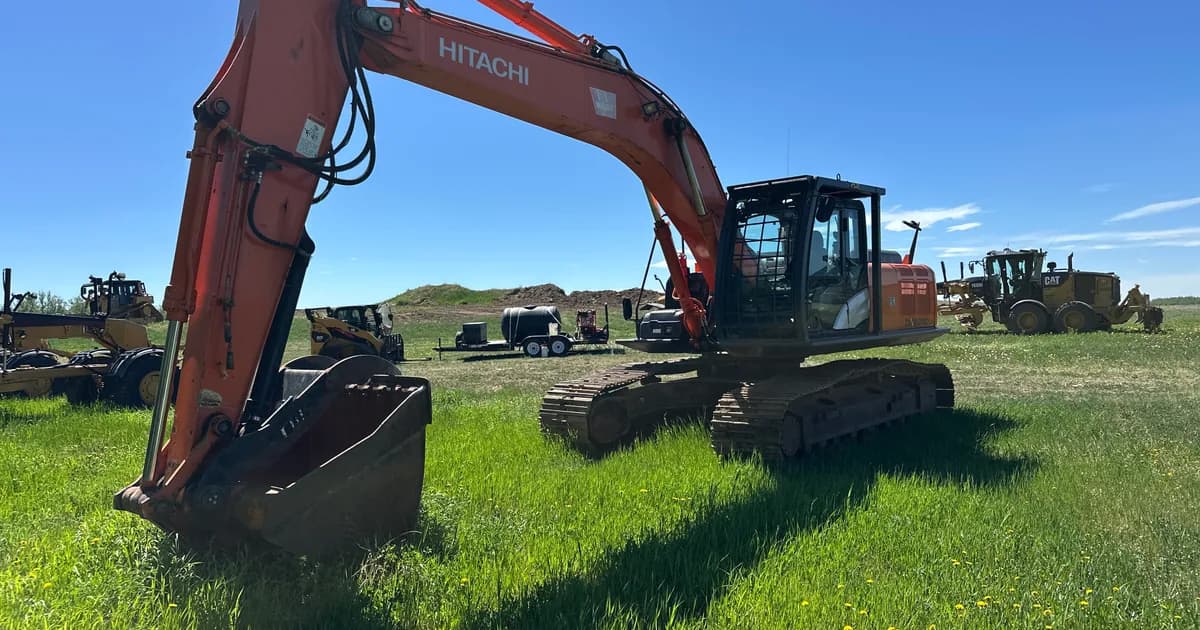
You have picked the machine — say a Volvo EC200 at $140,000 that opens up commercial work, or a low-hour Komatsu PC210 at $155,000 you found at a dealer. The monthly payment fits. Then the lender says they need 15% down, and now you are trying to find $21,000 without draining the operating account.
Here is a reframe that makes the whole down-payment question simpler. A lender does not really think in terms of your down payment. They think in terms of how much they are willing to advance against the machine — the loan-to-value. Your down payment is just the gap. If a lender will advance 85% of the value, you are putting 15% down. So the real question is not "how much do I need down" — it is "how much will this lender advance against this machine, given my profile." And that is a number you can move.
This guide covers the typical ranges, what pushes the number up or down, the lenders who will advance more than you would expect (sometimes more than 100%), the strategies that lower your out-of-pocket, and the real math of how the down payment affects your monthly cost.
Typical down payment ranges
The table below reflects what most Canadian lenders ask for across credit and equipment combinations. These are practitioner ranges — directional, not published rules — and individual lenders vary widely, which is exactly why shopping more than one matters.
| Scenario | Credit | Equipment | Typical Down | On a $150K Machine |
|---|---|---|---|---|
| Best case | 750+ | New, major brand | 0–10% | $0–$15,000 |
| Strong applicant | 680–749 | New or late-model used | 10% | $15,000 |
| Good credit, used | 680+ | Used, 5–10 yrs | 10–15% | $15,000–$22,500 |
| Fair credit, newer | 620–679 | New or 1–3 yrs | 10–15% | $15,000–$22,500 |
| Fair credit, used | 620–679 | Used, 5–10 yrs | 15–20% | $22,500–$30,000 |
| Challenged credit | 550–619 | Any | 15–25% | $22,500–$37,500 |
| Poor credit | Below 550 | Any | 20–30% | $30,000–$45,000 |
| Older / high-hour | Any | 12+ yrs or 10,000+ hrs | 20–30% | $30,000–$45,000 |
| New business (<2 yrs) | Any | Any | Add 5–10% to the above | Varies |
Key takeaway: Most equipment deals in Canada land in the 10–20% down range, with credit score and the machine's age and condition the two biggest factors deciding where you fall.
What drives the number
Understanding the factors lets you predict — and influence — what a lender will ask.
Your credit score. The single most impactful factor. A 760 on a Cat 320 might mean 10% or even zero down; the same machine at 580 might need 25%. It is straight risk math: a lower score signals higher default probability, and the lender offsets it by keeping their loan-to-value lower. On a $150,000 machine, the gap between 10% and 25% down is $22,500 in cash. Our credit score guide breaks down each tier.
Equipment age and condition. Newer equipment holds value and resells easily, so the lender will advance more against it. A new Cat mini excavator has a known value, a warranty, and strong demand — even if it depreciates 20% in year one, the loan stays covered at 10% down. A 12-year-old machine with 9,000 hours is closer to end-of-life with a thinner resale pool, so the lender protects itself with 20–25%. Within the same age bracket, condition and records matter too — a machine with complete service history and a clean inspection can move the requirement 5% or more.
Time in business. Lenders reward stability. Under two years, most add 5–10% to whatever they would otherwise want — a new contractor with a 700 score might need 15–20% where an established one needs 10%. (Our new-business financing guide covers this in depth.) Past five years, time in business becomes an asset that offsets other weaknesses.
Loan amount. Under $50,000, some lenders flex because their exposure is small. Over $250,000, they tighten — the dollars at risk justify wanting more of your money in the deal.
Lender type. Banks typically want 10–15% and do not bend much. Captive programs (Cat Financial via Finning, John Deere Financial via Brandt, Kubota Credit) sometimes run promotional reduced-down or zero-down offers to move new inventory. Private lenders range widely — some want 15–20% even on good credit, others do 10% or less on strong collateral. That spread is the whole argument for a broker. (See our banks vs. private lenders guide.)
Your relationship with the lender. Finance two or three machines through the same lender and pay on time, and the next deal often comes easier. Firsthand payment history is the best credit reference there is, and it frequently translates to a lower down payment.
The exception worth knowing: when you need little — or nothing — down
The "you need 10–20% down" rule has real exceptions, and they are worth knowing before you assume you are short.
BDC finances above 100%. The Business Development Bank of Canada — a federal Crown lender — will finance up to 125% of a machine's purchase price on its equipment loan, with the extra covering delivery, installation, and training. For a qualifying borrower that can mean zero down, or even rolling soft costs into the loan rather than paying them out of pocket. It also lets you pay interest only for up to the first 24 months while the machine ramps. BDC is not the right fit for every file, but if cash is the constraint, it is worth a call.
Captive programs run promotions. Manufacturer finance arms periodically advertise reduced-down or zero-percent offers on new equipment — Finning, the Canadian Cat dealer, runs zero-percent financing campaigns on qualifying machines from time to time. One caution: zero-percent and zero-down are different things, and the best promos are usually on new inventory for strong-credit buyers — always ask the dealer exactly what is running.
A government guarantee can lower what a lender needs. Because the Canada Small Business Financing Program has Ottawa share the lender's risk, a bank doing your deal under CSBFP may be comfortable with less of your money in it than on a conventional loan. If your bank is asking for a big down payment, ask whether they will structure it under CSBFP.
Strategies to reduce your down payment
If the required number is stretching your cash too thin, these work.
Trade in existing equipment. A machine you are replacing becomes your down payment — trade-in equity counts exactly like cash with most lenders. Trade a loader worth $28,000 on a bigger unit and you may need little or no additional cash. Know your realistic trade value first: used-equipment auction activity has normalized off the 2021–2023 peak, so check recent comparable results (Ritchie Bros., IronPlanet) rather than assuming peak-era values.
Add a co-signer. A co-signer with strong credit lowers the lender's risk, which lowers both the down payment and the rate. They take on full liability if you default, so it is not a casual ask — but for a spouse or partner confident in the payments, it can cut the requirement meaningfully.
Target newer, major-brand equipment. If you have flexibility, a newer Cat, Komatsu, Deere, Volvo, or Hitachi machine carries a lower down payment than an older one because the collateral is stronger. Do not overpay just to cut the down payment — but if two similar machines differ by 10% down because one is newer, factor that into the choice.
Work with a broker. Different lenders want different down payments on the same deal — one might require 20%, another 12%. On a $150,000 machine that gap is $12,000 that stays in your operating account. A broker like IronFinance matches your deal to the lender with the best combination of rate and down payment.
Show strong cash flow. Six to twelve months of bank statements showing healthy, consistent deposits can convince a lender to accept less down — especially effective when your revenue is strong but your credit score is not. The statements tell a story the score does not.
Buy in phases. Instead of one $250,000 machine with $50,000 down, two $125,000 machines bought a few months apart might need $15,000 then $12,500 — $27,500 total, spread out, after you have shown reliable payments on the first. More planning, but far less cash tied up at once.
The math: down payment vs. monthly payment
The trade-off matters because it hits your cash flow both upfront and over the term. Rates float off the 4.45% prime rate as of June 2026; this example uses 9%.
Financing a $150,000 used Cat 320 at 9% over 60 months:
| Down | Financed | Monthly | Total Interest | Total Cost to Own |
|---|---|---|---|---|
| 0% | $150,000 | ~$3,114 | ~$36,825 | ~$186,825 |
| 10% ($15,000) | $135,000 | ~$2,802 | ~$33,143 | ~$183,143 |
| 15% ($22,500) | $127,500 | ~$2,647 | ~$31,301 | ~$181,301 |
| 20% ($30,000) | $120,000 | ~$2,491 | ~$29,460 | ~$179,460 |
| 25% ($37,500) | $112,500 | ~$2,335 | ~$27,619 | ~$177,619 |
Going from 10% to 20% down saves about $311/month and roughly $3,700 in total interest — but it costs an extra $15,000 in cash today. Whether that is worth it depends on what the $15,000 would do elsewhere. If keeping it lets you take a job next month that nets $25,000, keep the cash and carry the slightly higher payment. If it would just sit idle, put it down and lower your long-term cost.
Key takeaway: More down always lowers your monthly payment and total interest — but it ties up cash that could earn more in your business. The right down payment balances financing cost against your cash-flow needs and opportunities.
The zero-down reality
Everyone asks, so here it is straight. Zero-down exists in Canada but is the exception, and it generally needs most of these to be true: a 700+ score (ideally 750+), three to five years in business, new or nearly-new equipment, a major brand with proven resale, a financing amount reasonable against your revenue, and often an existing lender relationship. The usual sources are manufacturer captive programs and BDC (which, as above, finances up to 125%). Some private lenders will do it for exceptional applicants on strong collateral.
For most contractors, some money down is the reality — and usually the better outcome anyway: lower payment, less total interest, faster equity, and no risk of going "underwater" (owing more than the machine is worth), which creates problems if you need to sell or trade before payoff. And the warning: a lender advertising zero-down to everyone regardless of credit is a red flag — the rate is likely punishing, there are hidden fees, or the terms have catches. Zero-down for qualified borrowers on strong collateral is legitimate; zero-down for all comers is usually too good to be true.
How down payment affects whether you get approved
This is the part contractors miss until they are mid-deal and getting declined: in borderline situations, your down payment is often the difference between a yes and a no.
Contractor with a 630 score, 3 years in business, financing a used Doosan DX225 for $95,000:
| Down | Approval Likelihood | Rate Range | Options |
|---|---|---|---|
| 5% ($4,750) | Very low — most decline | — | 1–2 aggressive private lenders, maybe |
| 10% ($9,500) | Low to moderate | 14–17% | A few private lenders |
| 15% ($14,250) | Moderate to good | 12–15% | Several private lenders compete |
| 20% ($19,000) | Good | 11–14% | Strong competition, better terms |
| 25% ($23,750) | Very good | 10–13% | Maximum options, best rates |
(Rate ranges are directional practitioner estimates, floating off prime.) The jump from 10% to 20% down here is $9,500 more cash — but it is also the difference between one or two reluctant lenders in the mid-teens and several competing lenders around 12%. That rate gap alone can save more than the extra $9,500 over the term. On a borderline file, the down payment quite literally decides the outcome.
When it gets complicated
Starting a new business. Expect 15–25% down regardless of personal credit — no business track record, revenue history, or client base yet. Personal assets, industry experience, and signed contracts can offset some of it.
Several machines at once. Most lenders want each financed separately, each judged on its own merits — staggering the purchases reduces the cash needed at any one point.
Private-seller equipment. Some lenders add about 5% on private sales versus dealer purchases — no warranty, less reliable documentation, harder to verify. Our used excavator guide covers private-sale nuances.
Seasonal businesses. Landscaping, snow removal, marine — concentrated revenue can prompt a higher down payment. A full year of bank statements showing you manage the seasonality well can bring it back down.
Sources: BDC equipment-loan financing terms (up to 125% of price) — Business Development Bank of Canada; captive promotional financing — Finning (Cat) Canada; CSBFP risk-sharing — Innovation, Science and Economic Development Canada; used-equipment value trends for trade-in pricing — RB Global / Ritchie Bros.; rate environment — Bank of Canada. Down-payment ranges and approval/rate estimates are directional practitioner conventions as of June 2026 that vary by lender and float with prime — not quotes or guarantees.
Sources: Finance up to 125% of a machine's purchase price — BDC; Zero-percent financing campaigns — Finning; Canada Small Business Financing Program — Innovation, Science and Economic Development Canada; Normalized off the 2021–2023 peak — Equipment World; Bank of Canada. Rate, term, down-payment and approval-timing figures are directional practitioner conventions current as of August 2026 — they move with the prime rate, vary by lender and by machine, and are not quotes or approvals. Equipment prices are asking prices rather than transaction prices. Tax treatment depends on your own contract and circumstances; confirm with your accountant.
Figure out your number
The only way to know exactly what a lender will require is to get specific — your credit, time in business, revenue, and the machine. Use our payment calculator to model how different down payments change your monthly cost, and our rate comparison guide to see how down payment interacts with your rate.
Reach out to IronFinance and we will tell you the actual down payment to expect for your deal — not a generic range, the real number based on your credit, your business, and the equipment. We work with lenders across the spectrum, from banks that do zero-down for premium applicants to private lenders who make deals work on tougher credit. Knowing your number ahead of time lets you plan and move with confidence when the right machine appears.
Already own equipment, or eyeing a different machine?
Frequently Asked Questions
Can I get equipment financing with zero down payment?
Yes, but it is the exception. Zero-down deals generally need strong credit (700+), a few years in business, and newer, major-brand equipment — and they most often come through manufacturer captive programs or BDC, the federal Crown lender, whose equipment loan finances up to 125% of price. Most contractors should plan on at least 10% down. If a lender advertises zero-down to everyone regardless of credit, treat it as a red flag.
Does a bigger down payment get me a lower interest rate?
Almost always. Going from 10% to 20% down can trim 1–3 points off the rate because the lender's loan-to-value is lower, so their risk is lower. It also cuts your monthly payment and total interest. For challenged credit, a larger down payment is often the single most effective lever you have.
Can I use a trade-in as my down payment?
Yes — most lenders treat equipment trade-in equity exactly like cash toward the down payment. The machine is appraised at fair market value and the equity applies to your new financing. Know your trade-in's realistic value first by checking recent auction comparables (e.g., Ritchie Bros.) before you negotiate.
Does the source of my down payment matter to a lender?
Yes, and it is a routine question rather than an accusation. A lender wants to see that the down payment is genuinely yours and not a second loan stacked behind theirs, because borrowed equity does not reduce their risk the way real equity does — your total obligation is unchanged. Expect to show where the funds came from. Trade-in equity, retained earnings, and accumulated savings are all straightforward; a fresh unsecured advance used as a down payment usually is not.
Can a bigger down payment rescue a file that was declined?
Only if the file failed on something a down payment addresses. More equity genuinely improves rate and approval odds on a deal that has already cleared the revenue and time-in-business gates, because it shrinks the lender's exposure. It does not buy past those gates — which is why a deal with 50% down can still be declined while one with 15% down is approved the same week. Find out which gate closed before assuming more cash is the answer.