
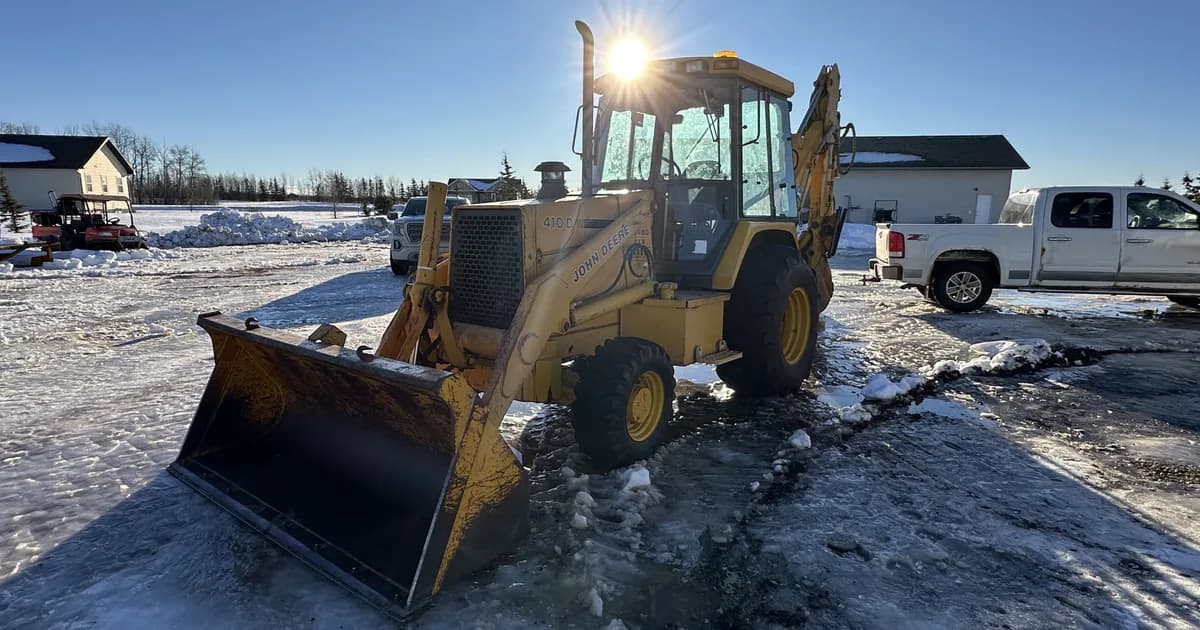
There is a paradox sitting at the centre of every sole proprietor's equipment deal, and most contractors do not see it until it bites them. Every spring, you and your accountant work hard to make your net business income as small as legitimately possible — write off the truck, the fuel, the tools, the home office — so you pay less tax. Then in the summer you walk into a lender to finance a $200,000 excavator, and they pull up that same tax return and lend against the exact number you just spent months shrinking. The tax efficiency that saved you in April is the thing working against you in July.
That paradox is really the whole story of financing as a sole proprietor, because as a sole proprietor, you are the business — there is no separate company for the lender to look at, only you and your personal financial record. This is not a disadvantage so much as a different game with different rules. Thousands of sole proprietors and owner-operators finance equipment in Canada every year. The ones who do it smoothly are the ones who understand how a lender reads a self-employed file, and who plan their income and paperwork accordingly. This guide walks through exactly that.
You are the business — and that cuts both ways
When you operate as a sole proprietor, there is no legal line between you and your business. The Canada Revenue Agency and BDC both put it plainly: the business and the operator are one and the same. For a lender, that means three things.
Your personal credit is your business credit. An incorporated company builds its own credit profile over time; a sole proprietorship cannot. When a lender evaluates your application, they pull your personal Equifax or TransUnion report — every credit card, car loan, and late payment factors in. (Our credit score guide covers how that number flows through to your terms.)
Your personal income is your business income. Lenders look at your T1 personal return and the T2125 — Statement of Business or Professional Activities — attached to it. The number that matters most is your net business income on Line 13500 (the gross goes on Line 13499). That is the reported-income paradox in action: the lower you have driven that figure to save tax, the less you appear able to afford. (One precision point, since it trips people up: Line 15000 on your return is your total income from all sources, not your business income — Line 13500 is the business number a lender zeroes in on.)
Your personal assets are your business assets — including the liability. Because there is no corporate veil, the risk extends to your personal property and assets. If you own a home, that is a positive signal to a lender even when it is not the collateral. But it also means that if the deal goes bad, your personal assets are on the hook (more on that below).
Key takeaway: As a sole proprietor, everything is personal — your credit, your income, your assets, and your liability. The lender sees you, not a company. Many sole proprietors actually present a stronger profile than a thin new corporation; the key is making your personal financial story legible.
What lenders want to see
Here is the documentation and the profile lenders prefer from a sole proprietor.
Personal credit report
Your score is the first filter. Rates float off the prime rate, which sits at 4.45% as of June 2026; treat these as directional, not quotes.
| Credit Score | Lender Tier | Typical Terms |
|---|---|---|
| 720+ | Banks, major lenders | Best rates (~7–9%), 10% down, longest terms |
| 680–719 | Banks / alternative | Good rates (~8–11%), 10–15% down |
| 650–679 | Alternative lenders | Moderate rates (~10–13%), 15–20% down |
| 600–649 | Private / alternative | Higher rates (~13–16%), 20–25% down |
| Below 600 | Private lenders only | High rates (~15–20%+), 25–35% down, shorter terms |
Beyond the number, lenders read the detail — a 660 with clean history and low utilization is viewed very differently than a 660 with recent collections and maxed cards.
Tax returns (T1 and T2125)
Most lenders want two years of personal returns and look at:
- Net business income (Line 13500). Your reported profit. If it is $40,000 and you want a $200,000 excavator at ~$4,500/month, the math does not work on paper. You need enough documented income to cover the payment comfortably — which is exactly why the reported-income paradox matters.
- Gross revenue trend (Line 13499). Growing, stable, or declining? Revenue climbing from $180,000 to $250,000 over two years is a far better story than the reverse.
- Consistency. Lenders prefer steady to lumpy. If your income swings, explain why — a big one-off project, seasonality, startup growth.
Bank statements
Three to six months show your real cash flow — deposits in, payments out, whether you manage money responsibly. They also reveal what tax returns do not: whether your actual cash flow is stronger or weaker than the return suggests.
Down payment source
Where the down payment comes from matters. Clean sources: cash savings, proceeds from selling equipment, equity in gear you own free and clear. Red flags: borrowed money (credit-card advances, a personal loan taken specifically for the down payment), funds that appeared recently with no clear source, or gifts (some lenders accept these with a gift letter; many are cautious).
Strategies to strengthen your application
Most sole proprietors' profiles are not perfect. Here is how to improve the odds.
Plan your reported income ahead of a big purchase
This is the sole proprietor's lever that nobody talks about. You cannot fabricate income — lenders only use documented, verifiable numbers — but you can plan. If you know a major equipment purchase is one or two years out, talk to your accountant about the trade-off between minimizing tax and showing enough net income on Line 13500 to support the financing. Sometimes paying a bit more tax in the year before you apply is what unlocks the machine that doubles your revenue. That is a planning decision, not an accounting trick.
Show the revenue the equipment will generate
Lenders want to know the machine earns its keep. For a Cat 320 excavator, show existing contracts that need it, your billing rate ($150–$250/hour is typical for an excavator), projected monthly utilization, and the math showing revenue clears the payment by a healthy margin. A one-page projection makes a real difference with alternative lenders who review deals by hand.
Put more money down
The most straightforward lever — it cuts the lender's risk and improves your loan-to-value.
| Down Payment | Effect on Approval | Effect on Rate |
|---|---|---|
| 10% | Standard, needs strong credit | Base rate for your tier |
| 15–20% | Improves borderline profiles | May trim 0.5–1% |
| 25–30% | Significantly improves odds | Can cut 1–2% |
| 35%+ | Near-certain with any income proof | Best rate for your tier |
See our down payment guide for how to get to a higher number.
Get a co-signer
If your credit or income falls short on its own, a co-signer with a strong profile bridges the gap — typically a spouse, family member, or partner who understands they take on full personal liability.
Start with a smaller purchase
Cannot qualify for the $300,000 excavator? Start with a $60,000 mini excavator or a $40,000 skid steer, pay it perfectly for 12–24 months, and build the track record that qualifies you for bigger iron. Many contractors built their fleets exactly this way, one machine at a time.
Clean up your credit first
If the score is the weak point, spend three to six months before applying: pay card balances below 30% of the limit, bring past-due accounts current, dispute report errors (free, by law), avoid new credit, and automate minimum payments. A 30–50 point gain can move you a tier and save thousands.
Two things every sole proprietor should set up
These are quick, cheap, and they strengthen both your tax position and your financing story.
Register for GST/HST at the right time. As a sole proprietor you must register for GST/HST once your worldwide taxable revenue (before expenses) exceeds $30,000 — measured over four consecutive calendar quarters, or in any single calendar quarter. Below that you are a small supplier and registration is optional — though registering voluntarily lets you claim input tax credits on your purchases, which is worth discussing with your accountant if you are about to buy equipment. Registering also gives you a business number, establishing your business in the federal system.
Run a separate business bank account. Even as a sole proprietor, keeping business income and expenses out of your personal chequing makes your income easy to document and signals professionalism — and after 12–24 months it gives any lender a clean financial record to review.
The personal-guarantee reality
Every sole proprietor equipment loan carries a personal guarantee — that is not negotiable, because you and your business are the same legal person. If the business fails and the equipment is repossessed and sold for less than you owe, you personally owe the shortfall (the deficiency balance): owe $100,000, machine sells for $70,000, you owe the remaining $30,000.
This is not unique to sole proprietors — even incorporated owners usually sign personal guarantees on equipment. But for a sole proprietor there is no corporate veil, so the exposure is automatic and complete: your home, savings, and other equipment can be on the line.
Key takeaway: A personal guarantee means your personal assets are potentially at risk if you default. That is not a reason to avoid financing — it is a reason to be realistic about what you can afford and to have a clear plan for how the equipment generates enough to cover the payments. Our equipment financing default guide walks through what actually happens when payments are missed.
Do you need to incorporate? (Usually not — and not for financing)
Some sole proprietors wonder if incorporating first improves their financing odds. Usually it does not. A brand-new corporation with no history and no credit profile is harder to finance than an established sole proprietor with good personal credit and documented income — the corporation has no track record and the lender knows it.
Incorporation helps over time (building corporate credit, holding assets separately, some liability protection — though personal guarantees largely negate that for equipment loans). If you are scaling up, adding employees, and accumulating machines, incorporating makes sense for many reasons. But do not incorporate solely to get a loan — it will not help immediately, and it adds cost and complexity.
And you do not need to incorporate to use federal help: the Canada Small Business Financing Program is open to sole proprietors, not just corporations — eligible borrowers include sole proprietors and partnerships with gross revenue of $10 million or less. Ottawa shares the lender's risk, which can turn a borderline file into an approval. (Two notes: farming businesses are served by a separate program — the Canadian Agricultural Loans Act, covered in our farm equipment financing guide, which guarantees 95% of the lender's loss and caps the floating rate at prime plus 1% — and as a sole-proprietor borrower you are personally liable for 100% of a CSBFP loan, consistent with everything else here.)
| Factor | Sole Proprietor | Incorporated |
|---|---|---|
| Financing based on | Personal credit and income | Corporate + personal (with guarantee) |
| Documentation | T1 + T2125 | T2 corporate return + T1 personal |
| Liability | Full personal liability | Limited (personal guarantee negates much of it) |
| Admin cost | Minimal | Roughly $1,000–$3,000/yr accounting and filing |
| Credit building | Personal credit only | Corporate credit builds over time |
| Tax planning | Limited | More options (salary vs. dividends, retained earnings) |
Common mistakes sole proprietors make
Applying with undocumented income. Cash work that is not reported cannot be used — lenders lend only against documented, verifiable income. This is the reported-income paradox again.
Not knowing their score before applying. Check first (it is a free, soft pull). Fix issues before collecting a decline — every application is a hard inquiry, and several declines in a short window can lower your score.
Overestimating affordability. The payment is one cost. Fuel, maintenance, insurance, and transport add up — a $5,000 payment plus $5,000 in operating costs needs the machine generating at least $12,000–$15,000/month to stay healthy.
Not shopping around. The first lender is rarely the best. Banks, credit unions, finance companies, and private lenders all differ — a broker shows you multiple options on a single application.
Waiting until it is urgent. Emergency financing puts you in a weak spot. Start two to four weeks before you need the machine so you can compare and negotiate.
⚠Key takeaway: Being a sole proprietor does not stop you from financing equipment — it just means your personal profile carries the weight. Keep your credit clean, document and plan your income, bring a reasonable down payment, and work with a lender or broker who understands self-employed borrowers.
Sources: Business and the operator are one and the same — Government of Canada; Extends to your personal property and assets — BDC; Small supplier — Government of Canada; Eligible borrowers include sole proprietors and partnerships — Innovation, Science and Economic Development Canada; CRA T4002 — Government of Canada; Bank of Canada. Rate, term, down-payment and approval-timing figures are directional practitioner conventions current as of August 2026 — they move with the prime rate, vary by lender and by machine, and are not quotes or approvals. Equipment prices are asking prices rather than transaction prices. Tax treatment depends on your own contract and circumstances; confirm with your accountant.
Get started on your equipment financing
Whether you are an owner-operator buying your first truck, an excavator operator going independent, or a landscaper scaling up, financing as a sole proprietor is a well-worn path — thousands of Canadians do it every year. The whole game is presenting your personal file well.
Sources: Sole-proprietorship tax treatment, Form T2125, and Lines 13499/13500/15000 — Canada Revenue Agency; equipment deductibility (CCA Line 9936, interest Line 8710, lease business-use portion) — CRA T4002; GST/HST $30,000 small-supplier threshold — CRA; sole-proprietor liability — BDC; CSBFP eligibility — Innovation, Science and Economic Development Canada; rate environment — Bank of Canada. Rate and down-payment ranges are directional market conditions as of June 2026 that float with prime — not quotes. Tax treatment depends on your situation; confirm with your accountant.
If you are ready to explore your options, reach out to IronFinance. Tell us the equipment and your situation, and we will match you with lenders who work with sole proprietors and owner-operators every day. We have seen every scenario, and there is almost always a path forward — no obligation, no nonsense, just a straight read on what is realistic for your deal.
Already own equipment, or eyeing a different machine?
Frequently Asked Questions
Do sole proprietors need to incorporate to finance equipment?
No. Incorporation is not required to finance equipment in Canada, and sole proprietors get equipment financing routinely. Because a sole proprietorship is not a separate legal entity, the lender evaluates you personally — your personal credit, your personal tax return, and your personal assets are the basis for the decision. Federal help like the Canada Small Business Financing Program is open to sole proprietors too.
What is the minimum credit score for a sole proprietor to finance equipment?
Most mainstream lenders want a personal credit score of at least 650. Scores of 600–650 can work with alternative lenders at higher rates and larger down payments; below 600 you are looking at private lenders or lease-to-own. Strong reported income and a solid down payment can partly offset a lower score.
Can a sole proprietor deduct equipment financing payments on taxes?
Not the payment itself, but its parts. On a financed purchase you deduct Capital Cost Allowance on the equipment (Line 9936 of your T2125) plus the interest portion of the loan (Line 8710) — not the principal. If you lease instead, you deduct the business-use portion of the lease payments. Everything is claimed at the business-use percentage. Confirm the specifics with your accountant.
Will financing equipment as a sole proprietor show up on my personal credit?
Very likely, and you should plan for it. Without a corporation there is no separate legal person to carry the debt, so the obligation and its payment history generally attach to you. That cuts both ways: it means the loan consumes some of your personal borrowing capacity, and it also means on-time payments build the personal credit history that improves your next deal. Keep a dedicated business account regardless — it makes revenue legible to a lender and simplifies everything at tax time.
What paperwork do sole proprietors get asked for that corporations do not?
Mostly evidence that the business exists and earns, since there are no corporate financial statements to hand over. Expect requests for your business bank statements, your T2125 and the net business income you reported, your GST/HST registration where applicable, and often a copy of the business registration itself. The reported-income question is the one that trips people up: aggressive deductions lower taxable income, and lenders read that reported figure.