
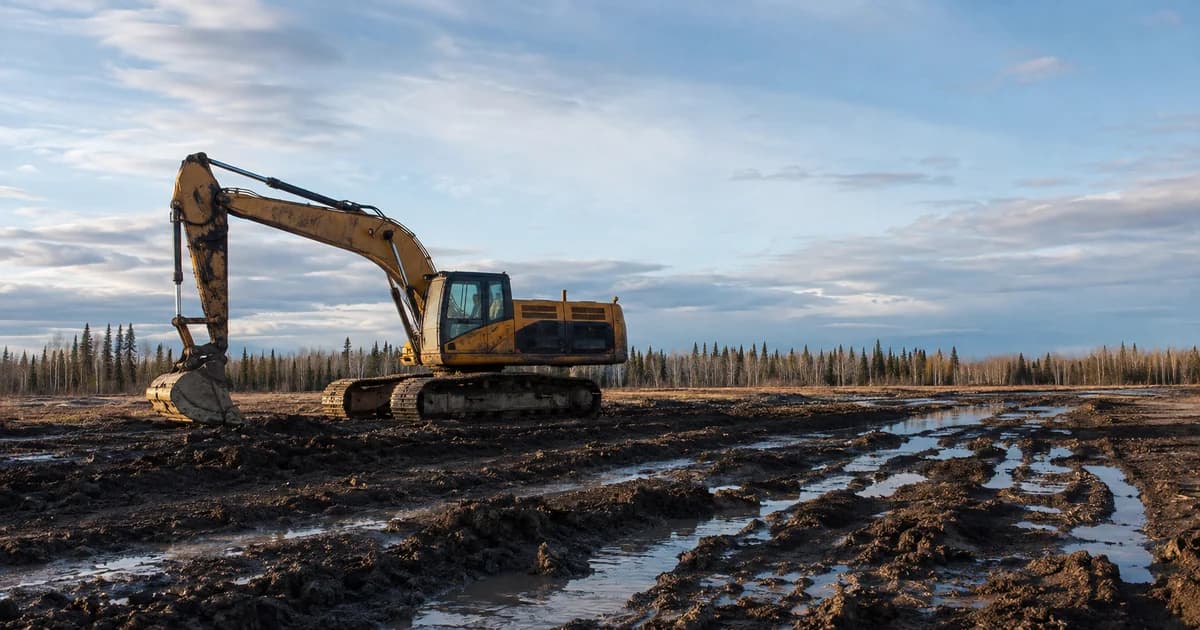
You are looking at a used excavator on a lot outside Grande Prairie. The asking price is $150,000, you have a pipeline right-of-way job starting in six weeks, and every article you have opened has told you Alberta equipment rates are somewhere between six and twenty-two percent. That is technically true and completely useless, because it is the range for the entire country.
Here is the part nobody puts in the headline: there is no Alberta rate. A lender quoting you in Grande Prairie is reading off the same sheet it uses in Mississauga. What actually changes when you finance a machine in this province is everything around the rate — what you hand over at signing, what it costs to register the lien, which lenders already understand your industry, and, most of all, the fact that your revenue year has a hole in it every spring that the lender is quietly pricing.
What Alberta Contractors Pay Right Now
The Bank of Canada held its policy rate at 2.25% on July 15, 2026 — the sixth consecutive hold — leaving prime at 4.45%, where it has sat since October 2025. Equipment lenders build off that base, then add for credit, machine age, and seller type.
| Credit Tier | Score Range | Typical Rate Range | Typical Down Payment | Common Lender Type |
|---|---|---|---|---|
| Excellent | 750+ | 6.5-8.5% | 0-10% | Banks, credit unions, captive finance |
| Good | 680-749 | 8-10.5% | 5-15% | Banks, credit unions, some private |
| Fair | 620-679 | 10-14% | 10-20% | Private lenders, some credit unions |
| Challenged | 550-619 | 13-18% | 15-25% | Private lenders |
| Rebuilding | Below 550 | 16-22% | 20-30%+ | Specialized private lenders |
See Your Likely Rate Range
Two questions, no credit pull. Get a directional rate range and the lender category your file is most likely to fit.
Pick a credit tier and equipment age to see your likely rate range.
If your score is under about 620, the file leaves the banks and moves to private equipment lenders. That is not a dead end — it is a different lane with different pricing. An approval at 15% that puts the machine on the job next month beats a decline at 8%.
Why the Rate Is National and the Postal Code Is Not
It is worth being blunt about this, because a lot of pages selling you a "Calgary equipment rate" will not be.
Equipment lenders price off the cost of money and the risk in your file. The cost of money is set nationally by the Bank of Canada. The risk is your credit, your time in business, the machine's age and hours, and the seller — dealer or private. None of those inputs are provincial. A 2019 Cat 320 with 4,200 hours bought from a dealer by a 690-score contractor prices the same in Lethbridge as it does in London, Ontario.
So when you search "equipment loan rates today Calgary," the honest answer is the national number — and you have it above. The useful question is not what does Alberta charge, it is what does Alberta change.
Three things, and they are worth real money.
What Drives the Real Cost Difference in Alberta
No provincial sales tax — the biggest genuine dollar difference. GST and HST are generally recoverable by a GST-registered business through input tax credits, so the 5% you pay in Alberta largely comes back. Provincial retail sales tax generally does not work that way: BC charges 7% PST, Manitoba 7% RST, and Saskatchewan 6% PST on equipment, and for most buyers that money is simply gone. Industry-specific exemptions do exist in those provinces and are worth checking before you assume the tax applies. Where it does, on a $150,000 machine that is roughly $9,000 to $10,500 of unrecoverable tax an Alberta buyer never pays — and it is cash that stays in your account at signing rather than being financed. Tax treatment depends on your registration status and what you are buying, so confirm your own position with your accountant.
Lien registration is cheap and fast. Every equipment lender registers a security interest against the machine under Alberta's Personal Property Security Act, through the Personal Property Registry. Alberta's registration is priced per year of term, and the government service charge is nominal — tens of dollars for a typical five-year registration, plus the registry agent's own fee. It is a line item on your closing costs, not a decision factor, but it is worth knowing what you are being charged for when it appears.
Alberta's own bank finances the industries Alberta actually runs on. ATB Financial delivers equipment financing and leasing through its partner Essex Lease Financial, and the categories it publishes tell you how the provincial lending market is shaped: alongside construction, manufacturing, and transportation, it lists forestry equipment — skidders, harvesters, feller bunchers — and oil field services equipment, naming drill rigs, pressure vessels, and hydraulic power units outright. A generalist national lender does not put drill rigs on its website. That difference matters when your file involves a machine a Toronto underwriter has never had to value.
The Alberta Calendar Your Lender Is Actually Pricing
This is the part that genuinely separates an Alberta equipment file from an Ontario one, and it has nothing to do with the interest rate.
Spring breakup shuts the work down, and the payment does not stop. As the frost comes out, Alberta imposes seasonal weight restrictions across the provincial highway network and on county and municipal roads. There is no single province-wide start date — the province monitors frost and thaw depth at roughly 70 frost-probe stations and rolls spring weights out progressively from south to north as the thaw moves up the province. In 2026 the southern zone, south of and including Township 28, went to spring weights on March 5. Under a ban, allowable axle weights drop sharply, and the level is set by whoever owns the road: a county ban can cut a gravel road to 75% of its normal allowance and some oiled roads to as little as 50%. Province-wide, heavy haul does not return to post-thaw weights until June 16, or summer weights until July 1.
For a contractor, that is not a technicality. It means your float cannot legally move your machine at full weight, your hauls get smaller or stop, and jobs that need heavy iron on secondary roads wait for the ban to lift. Your revenue thins for a stretch of weeks. Your equipment payment does not.
A lot of Alberta operators run two seasons, not one. In the Peace Country and across the northern half of the province, the same iron often works both sides of the year — logging and bush work when the ground is frozen, then oilfield lease, pipeline, and right-of-way clearing once it thaws. This is not a small corner of the province. The Athabasca–Grande Prairie–Peace River region accounts for 57% of Alberta's forestry operations and ranks first in the province for forestry employment, and northwestern Alberta produces 40% of Alberta's pulp, 64% of its panelboard, and 50% of its timber. Grande Prairie alone anchors four major operators — Weyerhaeuser, International Paper, Canfor, and West Fraser — on ground that sits over one of the busiest gas landbases in the country.
That produces bank statements with two different customers, uneven months, and quiet stretches between. A lender who knows Alberta reads that as diversification — two revenue streams instead of one. A lender who does not reads it as instability and prices it, or declines it.
Underwriters care about the shape of your year, not just the size of it. This is why two contractors with identical annual revenue and identical credit scores can get different terms. The one who can show what the spring gap looks like, and how it gets covered, is the easier file to approve.
Two Alberta Files, Side by Side
Rate tables tell you the range. They do not tell you why one file funds and a similar-looking one does not. These are worked examples — illustrative rather than a specific customer's file — built on the ranges and rules above, showing the two sides of the same machine class.
The file that funds
A 2018 John Deere 210G, 6,800 hours, listed by a dealer in the Peace Country at $172,000. The buyer is a numbered company three years into operating, clearing oilfield right-of-way from spring through fall and hauling under a forestry licensee once the ground freezes. Monthly deposits run in the mid-five figures and they run every month. The owner's credit sits around 655.
- Down payment: 15% — $25,800 cash, $146,200 financed
- Term: 60 months
- Rate: roughly 11.9%, which is mid-range for the 620-679 tier
- Payment: about $3,245 a month
- Structure: payments weighted to the working season, so breakup is not carrying a full payment against no revenue
Why it works is not the credit score. It is that there are three years of history, revenue arrives every month rather than in two lumps a year, the machine is a mainstream model with a deep resale market in Alberta, and the down payment is real money rather than a trade-in valued optimistically.
The file that does not
Same machine class — a 2016 Cat 320 with 9,400 hours, private sale, $118,000. The buyer registered the business four months ago, has not invoiced yet, and plans to use the machine partly for work and partly on their own acreage. Owner credit is 640, slightly better than the file above.
This one does not fund with us, and the score is not the reason:
- No operating history and no monthly revenue. There is nothing to underwrite. A projection is not income.
- Mixed personal use. Once a machine is partly a personal asset it stops being a commercial equipment file.
- Private sale with loose ends. Higher hours, no dealer invoice, and a lien search that has to come back clean before anyone funds it.
What would change the answer: six to twelve months of real deposits, the machine committed to business use only, and a larger down payment against the higher hours.
What We Can Finance — and What We Cannot
Being straight about this saves everyone a week. Here is what actually has to be true.
It has to be a business buying a business machine. Equipment financing is commercial lending. If the machine is for an acreage, a hobby farm, or personal projects, it is not a file we can place — regardless of credit. Business use is the threshold question, not a formality.
We underwrite off monthly income. The number that matters most is consistent monthly revenue landing in a business account. That is what a lender sizes a payment against. Strong revenue can carry a soft credit score a long way; a good score with no income behind it generally cannot carry a file at all.
A pre-revenue start-up is not a fit for us. If the business has no income history, we are not the right first call — our lender network wants to see the money coming in. That is our criteria, not a statement about the market: newer businesses do get equipment financed in Canada, through private lenders and federal programs, and the guide to financing for a business under two years covers those paths properly. Come back once there are deposits to show.
Time in business and income level set your terms, not just your approval. This is the part worth planning around. A longer operating history and higher monthly revenue move you toward a lower rate, a smaller down payment, and a longer term — all three at once. The same buyer with the same machine and the same credit score gets a materially better deal at year four than at year one. If your file is borderline, waiting two quarters and applying with stronger statements can be worth more than any rate shopping.
On new equipment, be honest about who wins. We do finance new machines — but if you are buying new from a franchise dealer, ask that dealer's own finance arm first. Manufacturer captives subsidize rates on their own iron to move it, and promotional programs well below market show up regularly on current-model equipment. That is genuinely hard for an independent lender to beat, and pretending otherwise would waste your time. Where a broker earns their keep is the rest of the market: used machines, private sales, higher-hour iron, seasonal operators, and files a bank or captive has already declined.
That last category is most of the Alberta market. If you are shopping used, you can browse the dealer inventory we track across Canada and filter by machine type — every listing there has a financing path behind it.
Lease Rates in Alberta
Roughly half the rate searching Canadian contractors do is about leasing, and Alberta is no different. Lease pricing sits in the same 6.5-22% band, but it is quoted differently and that is where people get caught.
A lease is usually quoted as a rate factor — a decimal multiplied against the machine's cost to produce a monthly payment. A factor is not an interest rate. It bakes in the residual value, so a low-looking factor can carry a high effective cost to own. Convert any factor to total payments plus buyout before you compare it to a loan.
| Lease Structure | What It Is | Monthly Payment | End of Term |
|---|---|---|---|
| $1-buyout (finance lease) | Acts like a loan — you own the machine for $1 | Highest, close to a loan | You own it outright |
| Fair-market-value (operating) | You use the machine, the lessor keeps residual risk | Lowest | Buy at market value, return, or upgrade |
One Alberta-specific term worth knowing: lenders commonly cap a lease by the machine's age plus the amortization. ATB's published agricultural equipment terms work exactly this way — a maximum 10-year lease, with the equipment's age plus the amortization period not exceeding 10 years, and up to 15 years combined for equipment listed in the Iron Solutions guide. Those specific numbers are ATB's ag rules rather than a universal construction standard — if you are actually buying farm iron, our farm equipment financing guide covers the FCC and CALA routes that price below anything in this table — but the mechanic is standard across the market: a 6-year-old machine will not get the same term as a new one, because the lender is matching the loan to the asset's remaining working life.
If you are weighing the two structures in depth, the lease-vs-finance guide works through the tax and balance-sheet side properly.
How to Structure an Alberta Deal Around Breakup
Tip 1: Ask for the payment schedule you actually need, before approval. Seasonal, skip, or step payment structures exist in the equipment finance market, and the time to ask is while the deal is being structured — not in April when the ban is on. A lender who has already approved a flat 60-month schedule has little reason to reopen it.
Tip 2: Time the purchase to the ban, not to the deal. A machine bought in February can sit through breakup making payments before it earns a dollar. If the work starts after the thaw, the cheapest month to take delivery may be the one that lines up with the job.
Tip 3: Show the spring gap instead of hiding it. Bring bank statements that span a full year, including the slow stretch. An underwriter who sees the gap explained up front prices it once. An underwriter who finds it later reprices the whole file.
Tip 4: Put your second revenue stream in writing. If your iron works oilfield clearing between logging seasons, document it — invoices, contracts, a letter from the prime. That is the evidence that turns "inconsistent deposits" into "diversified operator."
Tip 5: Keep the GST saving as working capital. The provincial sales tax you are not paying is real cash. Rolling it into a bigger down payment lowers your rate tier and your payment at the same time.
Mistakes That Cost Alberta Buyers Money
Shopping for an "Alberta rate" instead of the right lender category. The rate is national. The spread between a bank and a private lender on the same file is far larger than any regional difference could ever be, so the category you apply in is the decision that actually moves your number.
Financing the sales tax you do not owe. Buyers who moved from BC or Saskatchewan sometimes budget for provincial sales tax out of habit and finance the extra. You are borrowing money at 6.5-22% for a tax that does not exist here.
Signing a flat payment schedule for a seasonal business. A 60-month level payment on revenue that stops every spring is a covenant you will strain against every single year of the term.
Assuming a private-sale machine prices like a dealer machine. Private sales in Alberta are common and financeable, but they need more paperwork — serial number, proof of ownership, lien search, a real invoice — and they usually price worse. Budget for both — our guide to financing a private-sale machine covers that paperwork trail.
Treating a lease factor as an interest rate. It is the single most common way contractors end up paying more than they thought. Convert to total cost to own before you sign anything.
Sources: policy rate and prime — Bank of Canada, July 15, 2026 rate decision (policy rate held at 2.25%, sixth consecutive hold; prime 4.45% since October 2025); Alberta seasonal weight restrictions, frost-probe monitoring, and the post-thaw/summer season dates — Government of Alberta, road restrictions and bans overview; 2026 spring-weight start for the southern zone — WCS Permits, Alberta spring road bans; ATB equipment financing categories and Essex Lease Financial partnership — ATB Financial; ATB agricultural equipment amortization and lease age caps — ATB Financial; Alberta lien registration under the Personal Property Security Act — Government of Alberta, Personal Property Registry; Peace Region forestry share, production and major operators — County of Grande Prairie economic development and Alberta Regional Dashboard, Grande Prairie; provincial sales tax rates and the non-recoverability of PST/RST relative to GST input tax credits — PwC Worldwide Tax Summaries, Canada. Rates are directional market benchmarks as of August 2026 that move with prime — not quotes or approvals. Sales tax treatment depends on your registration status, where the equipment is delivered, and industry-specific exemptions; confirm with your accountant.
Getting a Real Number on Your Machine
The range on this page is the honest national answer, and it is as far as any article can take you — the number you actually get depends on your file, the machine, and the seller. If you are looking at a specific unit in Alberta, send us the details — the year, hours, and asking price — and we will tell you straight whether it is worth financing before you commit to anything.
When you are ready to move, start an application, or work through the full national loan and lease rate picture, the down payment guide, or — if your credit is the sticking point — what actually works with bad credit.
Already own equipment, or eyeing a different machine?
Frequently Asked Questions
What are equipment financing rates in Alberta right now?
As of August 2026, equipment loan rates in Alberta run 6.5% to 22% depending on credit tier: roughly 6.5-8.5% at 750+, 8-10.5% at 680-749, 10-14% at 620-679, 13-18% at 550-619, and 16-22% below 550. These are the same ranges a contractor sees anywhere in Canada. Equipment lenders price off the Bank of Canada policy rate — held at 2.25% on July 15, 2026, with prime at 4.45% — and off your credit file, the machine, and the seller. There is no separate Alberta rate card.
Are equipment loan rates in Calgary different from the rest of Canada?
No. A lender quoting a contractor in Calgary, Edmonton, or Grande Prairie works from the same rate sheet it uses in Toronto or Vancouver. Searching for a Calgary equipment rate returns the national rate, because that is the only rate there is. What genuinely differs in Alberta is the cost around the rate — 5% GST with no provincial sales tax, cheap lien registration — and the seasonal revenue pattern a lender is underwriting when it sets your term and payment schedule.
What are current equipment lease rates in Alberta?
Alberta lease pricing tracks the same 6.5-22% band as loans, but leases are usually quoted as a rate factor rather than an interest rate, which hides the residual. A $1-buyout finance lease prices close to a loan and you own the machine at the end. A fair-market-value operating lease carries a lower monthly payment because the lessor keeps the residual risk, and you buy, return, or upgrade at term. Always convert a factor to total payments before comparing it to a loan.
Can I get equipment financing in Alberta with bad credit?
Yes. Below about 620 the file moves from banks to private equipment lenders, and pricing typically lands in the 13-18% range for scores of 550-619 and 16-22% below 550, with down payments commonly 15-25% and 20-30%+ respectively. In Alberta specifically, documented revenue across both the oilfield and forestry sides of a contractor's year helps — a lender who understands the province reads two income streams as diversification, while a generalist underwriter can misread the same bank statements as inconsistency.
What do I need to qualify for equipment financing in Alberta?
Three things matter more than your credit score. First, it has to be a business buying a business machine — equipment financing is commercial lending, so a machine intended for an acreage or personal use is not a fit. Second, consistent monthly revenue landing in a business account, because that is what a lender sizes the payment against. Third, operating history: a pre-revenue start-up is not a fit for our lender network, though newer businesses with real deposits can be. Time in business and monthly income also set your terms, not just your approval — a longer history and stronger revenue move you toward a lower rate, a smaller down payment, and a longer term at the same time.
Do you finance new equipment in Alberta, or only used?
Both, but be honest about where an independent broker helps most. If you are buying a new machine from a franchise dealer, ask that dealer's own finance arm first — manufacturer captives subsidize rates on their own equipment to move it, and promotional programs well below market appear regularly on current-model iron. That is hard for an outside lender to beat. A broker earns their keep on the rest of the market: used machines, private sales, higher-hour equipment, seasonal operators, and files a bank or captive has already declined. In Alberta that describes most of the market.
Does Alberta's lack of PST actually save money on equipment?
Yes, and it is the largest genuine dollar difference in the province. GST and HST are generally recoverable by a GST-registered business through input tax credits, but provincial retail sales tax in BC (7%), Saskatchewan (6%), and Manitoba (7%) generally is not. Alberta charges no provincial sales tax at all, so on a $150,000 machine an Alberta buyer avoids roughly $9,000-$10,500 of unrecoverable tax compared with a buyer in those provinces, and ties up less cash at signing. Confirm your own position with your accountant.