
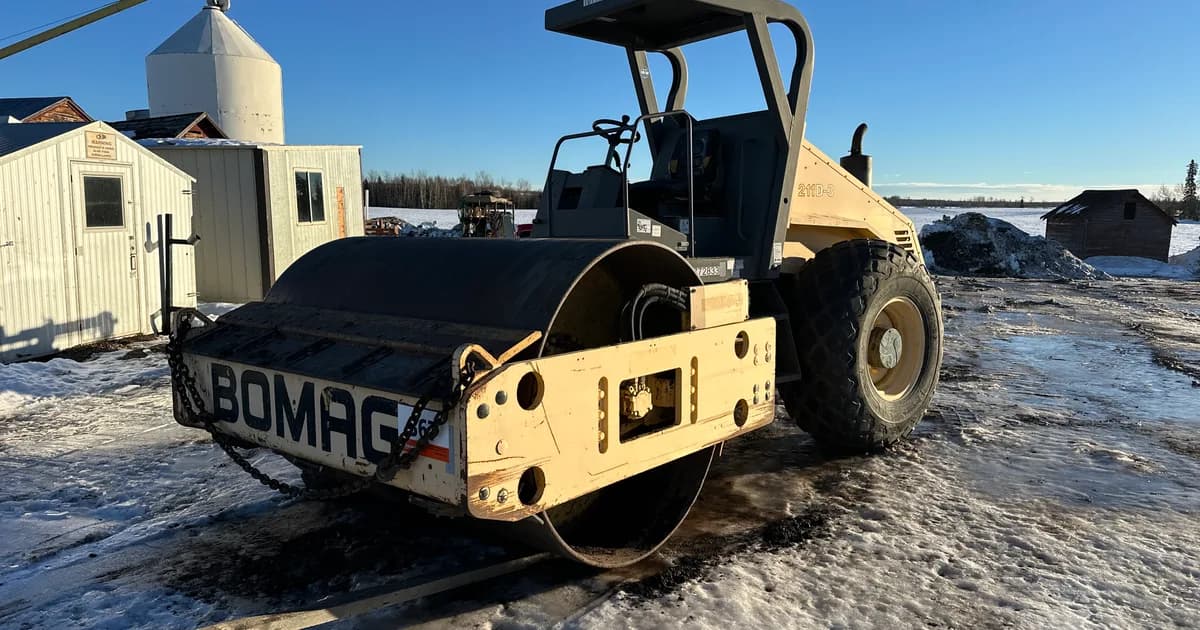
You found the machine on a Facebook group or through somebody who knows somebody. It is priced twenty percent under anything on a dealer lot, the seller is a contractor winding down, and the pictures look right. Then you call about financing and the questions change shape — serial number, seller's legal name, lien search, appraisal — and the deal that felt simple starts to feel like it is being audited.
It is not being audited. It is being underwritten as a different kind of transaction, and nobody explained that part. A private sale is not a discounted dealer purchase. It is a purchase where three jobs the dealer normally does — valuing the machine, guaranteeing the title, and taking the money — have quietly become the lender's problem, and therefore yours.
This page is about those three jobs. Our used equipment financing guide covers what age and hours do to a deal, and the down payment guide covers advance rates generally. Here is what specifically changes when there is no dealer in the middle.
The Appraisal Gap: Lenders Fund Value, Not Your Price
This is the one that ends private deals, and it has nothing to do with your credit.
A lender does not advance a percentage of what you agreed to pay. It advances a percentage of what the machine is worth — appraised or assessed market value. On a dealer deal those two numbers usually sit close together, because dealer retail is the market reference. On a private sale they can drift a long way apart in either direction.
Work the arithmetic once and you will never forget it. Say you agree to pay $125,000 and budget a 20% down payment — $25,000. The appraisal comes back at $105,000, and the lender advances 80% of appraised value:
- Lender advances 80% × $105,000 = $84,000
- Purchase price = $125,000
- Cash you actually need at closing = $41,000, not $25,000
Nothing went wrong with your application. The lender did exactly what it always does. But your down payment just grew by $16,000 with a week's notice, and that is the moment most private deals die.
It runs the other way too, and this is the part nobody sells you on. Buy genuinely below market — the estate sale, the contractor who needs it gone before month end — and 80% of a higher appraised value can exceed the percentage you expected against the price. Buying well is not just a saving on the sticker. It is a saving on the cash you have to find at closing.
Why "market value" is a range, not a number
Here is the part that makes appraisals feel arbitrary until you see the underlying data. We maintain a normalized mirror of Canadian dealer inventory — 19,030 currently sellable listings from 56 dealers across all ten provinces and Yukon — and it shows how wide one machine actually trades.
Take the tightest possible comparison: one make, one model, one model year, nine different dealers. Canadian dealers currently list 15 model-year-2018 Caterpillar D6T LGP dozers, and every one of them publishes its hour meter:
| Asking price | Hours | Province | Dealer |
|---|---|---|---|
| $210,110 | 7,710 | AB | AB Equipment Ltd |
| $273,000 | 9,220 | BC | JPH Equipment |
| $275,000 | 7,660 | AB | Optimum Equipment Solutions |
| $290,000 | 7,201 | BC | Finning Canada |
| $325,000 | 8,246 | SK | Korpan Tractor & Parts |
| $334,900 | 11,371 | AB | Semlers |
| $345,000 | 7,434 | AB | Pacesetter Equipment Ltd. |
| $345,000 | 7,552 | AB | Pacesetter Equipment Ltd. |
| $349,900 | 5,534 | AB | Semlers |
| $385,000 | 5,933 | BC | JPH Equipment |
| $395,000 | 6,260 | AB | JPH Equipment |
| $419,500 | 5,592 | BC | WeConsign Equip |
| $424,900 | 3,142 | AB | Semlers |
| $459,000 | 4,820 | AB | Pacesetter Equipment Ltd. |
| $495,000 | 6,275 | AB | PD Equipment |
Canadian dealer asking prices, IronFinance inventory mirror, August 2026. Quartiles: $290,000 / $345,000 / $419,500.
Look at the first and seventh rows. Two 2018 D6T LGPs, both at Alberta dealers, with 7,710 and 7,434 hours — a 276-hour difference on machines that have each done roughly 7,500 hours of work. They are asked at $210,110 and $345,000. That is a $134,890 gap between two machines an appraiser would call comparable.
And hours do not rescue you. The 11,371-hour machine at $334,900 is asked above the 7,201-hour machine at $290,000. Semlers alone lists one at 11,371 hours for $334,900 and another at 3,142 hours for $424,900 — 3.6× the hours for 1.27× the price, from the same dealer.
Condition, undercarriage life, attachments, service history, province and how badly a dealer wants the floor space all live inside that spread. An appraiser is not picking a number out of the air — they are picking a point inside a distribution this wide, and that is why their number and your number can differ by tens of thousands without either being unreasonable.
The same pattern holds at class level, across much larger samples: Canadian excavator listings (1,720 listings, 49 dealers) run a median of $126,000 with a quartile range of $74,900–$220,000; skid steers (1,040 listings, 40 dealers) sit at a median of $70,000 against $50,600–$89,000. There is no such thing as "the price" of a machine class. There is a distribution, and your deal is a point in it.
Key takeaway: Ask the lender early — before you commit — what advance rate they apply and whether it is against price or appraised value. If it is against appraised value, treat your down payment as a range, not a number, and hold back a reserve.
The Lien Search: The Cheapest Insurance in the Deal
A registered security interest generally survives a private sale — and the law is explicit about why. Buy a machine that has one and you can end up in possession of somebody else's collateral, with a secured party legally entitled to come and get it. You paid; the debt did not care.
The single legal difference between a dealer purchase and a private one
This is the part almost nobody explains, and it is the whole reason private sales carry title risk that dealer purchases do not.
Ontario's Personal Property Security Act s. 28(1) — and its equivalents across the common-law provinces — protects "a buyer of goods from a seller who sells the goods in the ordinary course of business," who takes them "free from any security interest therein given by the seller even though it is perfected and the buyer knows of it."
Read that carefully. The protection attaches to who the seller is, not to how careful the buyer was.
- Buy from a dealer — a business whose ordinary course is selling machines — and you take the machine free of the seller's security interests. Even perfected ones, and even ones you knew existed. The one carve-out in the section is narrow: you lose the protection only if you also knew that the sale itself breached the security agreement.
- Buy from a contractor selling their own machine — someone who is emphatically not in the business of selling equipment — and that protection does not apply at all. The security interest follows the iron to your yard.
That is the actual mechanism behind "private sales are riskier." It is not vibes, it is not lender caution, and it is not something a good price offsets. A dealer purchase has a statutory backstop. A private purchase has a lien search.
The search costs less than filling the fuel tank.
How to actually run the search
Every common-law province maintains a personal property registry under its Personal Property Security Act. Quebec runs a separate register, the RDPRM, under a different legal regime. You search that registry before money moves.
Search on both axes, because they do not overlap:
- By serial number or VIN — catches registrations filed against the machine itself.
- By the seller's exact legal name — catches general security agreements filed against the business, which can cover "all present and after-acquired personal property" and therefore capture a machine that has no serial-specific registration at all.
A search on one axis is not a search. A general security agreement against a numbered company will not show up under a serial number, and a serial-specific lien will not show up under a slightly misspelled corporate name.
What it costs
British Columbia publishes its fees, which makes it a useful anchor:
| BC Personal Property Registry | Fee |
|---|---|
| Search by client through the online registry | $7 |
| Search performed by registry staff | $10 |
| Combined PPR and Manufactured Home search | $15 |
| Registering a security interest | $5 per year (1–25 years) |
| Infinity registration | $500 |
Source: Province of British Columbia — Personal Property Registry Forms & Fees. An additional operator fee plus GST may apply to electronic transactions made outside government offices.
Fees differ by province and the mechanics differ too — Alberta, for instance, delivers registry services through authorized registry agents who set their own service charges, so confirm the cost with the agent rather than assuming a published government rate. The order of magnitude is the point: this is a sub-$25 check standing between you and a five- or six-figure problem.
What to do when the search comes back dirty
A hit is not a dead deal. It is the normal case on any machine that was itself financed, and equipment is a heavily financed asset class. It just has to be cleared at closing, not after:
- Get a written payout statement from the existing secured party.
- The payout is paid directly to that party out of the purchase funds.
- Only the balance goes to the seller.
- Confirm the discharge is registered before you treat the deal as done.
Do not pay the seller in full against a promise to clear it. A seller who intended to pay it off and then did not leaves the registration attached to a machine sitting in your yard. Your recourse is against a person who has already spent the money; the secured party's recourse is against the machine.
If the deal goes wrong later, the enforcement process is the one described in our default guide — in the common-law provinces, self-help repossession without a court order, then advance written notice before the machine can be sold (at least 15 days in Ontario; the period varies by province), a right to redeem up to that sale, and a commercially reasonable disposition. Quebec is materially different: security there is a hypothec under the Civil Code, there is no self-help repossession, a prior notice must be served and a statutory delay waited out (20 days for commercial movable property like equipment), and unlike the common-law provinces those protections cannot be waived in the contract.
What Lenders Want Before They Fund a Private Sale
The person operating a machine is not automatically the person entitled to sell it. Machines get sold by estates, by departing partners, by operators on behalf of an owner who has not agreed to anything, and occasionally by people with no claim at all.
What a lender will want, and what you should want regardless:
A photo of the serial plate. It has to match the bill of sale and the registry search. Three documents carrying three different numbers will stall the file, and a mismatch is usually a transcription error rather than fraud — but the lender cannot tell those two apart from your side of the phone, so it stops either way until you resolve it.
A photo of the hour meter running. On a late-model machine a dead or replaced meter is its own appraisal problem, and a lender will want it explained before it advances against the machine.
Proof the seller is the registered owner. The original purchase invoice, the discharge from their own financing, or corporate records where a company holds title. The registry search does not do this job — it reveals registered security interests, not title, so a clean search tells you nobody has a claim registered against the machine, not that the person selling it owns it.
A bill of sale carrying the serial number, the full legal names of both parties, the price, and the date. A price with no serial number attached to it is not a document a lender can lend against.
The seller's banking details for the funds transfer, which on a private sale go to an individual rather than a dealer account.
For a company seller, confirm the person signing can bind the company. For an estate sale, the executor needs authority to sell. Neither is exotic — both are slow if you start them after the offer instead of before.
How the Money Reaches a Private Seller
On a dealer deal the lender pays a business it likely already knows, against an invoice, and the machine is released. On a private sale it is wiring a meaningful sum to an individual, against a bill of sale, on your say-so.
That difference produces the timeline, and the timeline is what surprises people:
| Step | Dealer purchase | Private sale |
|---|---|---|
| Valuation basis | Dealer invoice, close to market reference | Independent appraisal or assessment |
| Title/lien check | Dealer clears it | You and the lender clear it |
| Payout of prior lender | Handled by the dealer | Arranged at closing, paid directly |
| Payment | To a known business account | To an individual, with verification |
| Typical timing | Can be same-day on an existing relationship | Days |
Almost every one of those rows is a document, not a decision. The credit answer is usually the fastest part of a private-sale file. What takes the time is the lien search coming back, the seller finding their original invoice, and an appraisal getting scheduled. Gather the machine and seller documentation before you apply and you compress the whole thing — most of the delay is a dependency the lender simply cannot start without.
So Is Buying Privately Actually Worth It?
Usually yes, with clear eyes about where the saving comes from and what it costs.
What you gain: a genuinely lower ask. A private seller carries no overhead, no reconditioning budget and no warranty reserve, which is most of the spread between the private price and dealer retail for a comparable machine.
What you give up: the machine as it sits, with no dealer warranty and no recourse if something is wrong in week two. Possibly an inspection and an appraisal you would not otherwise pay for. And exposure to the appraisal gap, which can demand more cash at closing than a dealer deal would have.
If you want a quick read before going further, the financeability checker takes the machine, its year and hours, the price, your down payment and a rough credit read, and tells you whether the shape of the deal makes sense — useful before you spend anything on a registry search or an inspection, let alone a deposit.
When a private sale is clearly the right call:
- The machine is mainstream, with a liquid resale market and a real auction record — so the appraisal is likely to land near the price.
- You have inspected it yourself or paid someone competent to.
- You have cash reserve beyond your planned down payment to absorb an appraisal gap.
- The seller can produce ownership documents without a three-week hunt.
Red Flags That Should Stop a Private Deal
The seller will not give you the serial number before you commit. There is no legitimate reason for this. The serial is what you search the registry against and what goes on the bill of sale — a seller who withholds it is withholding the one thing that would tell you whether they can actually sell the machine.
The hour meter is dead, replaced, or the seller is vague about it. On a late-model machine that is its own appraisal problem, and a lender will want it explained. Vagueness here is usually not innocent.
The lien search comes back with a registration and the seller still wants to be paid in full. Paying out the secured party directly is normal, easy, and costs the seller nothing they were not already going to lose. Resistance to it is the single loudest warning in a private sale.
The price is far enough below market that it is telling you something the photographs are not. Use the distribution above as your reference: a machine priced under the bottom of its own model-year range is either the best deal of your year or a problem, and a registry search costing tens of dollars plus an hour of inspection is what separates the two. On a six-figure machine that is the highest-return hour in the entire transaction.
Sources: buyer-in-ordinary-course rule and the ordinary-course/private-sale distinction — Ontario Personal Property Security Act, R.S.O. 1990, c. P.10, s. 28(1) (e-Laws), with equivalents in the other common-law provinces; personal property registry search and registration fees — Province of British Columbia, Personal Property Registry Forms & Fees (BC fees are published; Alberta deliberately carries no dollar figure here because Alberta delivers registry services through authorized registry agents who set their own service charges); PPSA enforcement, notice periods and the Quebec hypothec regime — our default guide and its underlying sources; dealer asking prices and the 2018 Cat D6T LGP cohort — IronFinance's normalized Canadian dealer-inventory mirror, queried 2026-08-23 (19,030 sellable Canadian listings from 56 dealers; the D6T LGP cohort is 15 listings from 9 distinct dealers across AB, BC and SK, with an hour reading on all 15). All pricing figures are dealer asking prices, not transaction prices, and reflect what sellers were asking in August 2026. Advance rates and appraisal percentages are directional practitioner conventions that vary by lender and by machine — not quotes or approvals. This page is general information about how these transactions are underwritten, not legal advice; PPSA and registry mechanics differ by province, and Quebec differs substantially.
Getting a Straight Read on the Machine You Found
Financing a private sale is not harder than a dealer deal in the way people expect. The credit decision is the same decision. What is different is that you have inherited the dealer's homework — establishing what the machine is worth, proving who owns it, and clearing whatever is registered against it — and the lender will not move until that homework is done.
Do it before you apply rather than after, and hold a cash reserve against the appraisal gap. Those two habits are the difference between a private purchase that closes in days and one that dies at the appraisal.
If the machine is farm equipment rather than construction iron, the lender set is different and generally cheaper — our farm equipment financing guide covers the FCC and CALA routes, and the annual-versus-monthly income question that decides most farm files.
If you have a specific machine and a specific price and you want a straight read on whether it will finance — including what our inventory data says comparable Canadian machines are actually asking — send us the details. Year, make, model, hours, price, province, and whether the seller is a company or an individual is enough to work with.
Already own equipment, or eyeing a different machine?
Frequently Asked Questions
Can you finance a private-sale equipment purchase in Canada?
Yes, and it is routine — but it is underwritten as a different transaction than a dealer purchase, not as a cheaper version of one. The three things that change are the valuation basis, the title risk, and the payment mechanics. A lender advances a percentage of what the machine appraises at rather than a percentage of what you agreed to pay, so a good private price does not automatically mean a bigger advance. There is no dealer standing behind the title, so the lender needs a lien search and proof the seller actually owns the machine. And the money has to reach a private individual rather than a dealer's account, which adds documentation and days. None of that stops the deal. All of it changes the timeline and the amount of cash you need at closing.
What is the appraisal gap in equipment financing?
It is the difference between the price you negotiated and the value a lender is willing to lend against — and it lands on you as cash. Lenders advance a percentage of appraised or assessed market value, not of the purchase price, so if you agree to pay $125,000 for a machine that appraises at $105,000 and the lender advances 80% of appraised value, it funds $84,000 and you bring $41,000 rather than the $25,000 you budgeted for a 20% down payment. The gap is invisible until the appraisal comes back, which is why it derails private deals more often than credit does. It cuts the other way too: buy well below market and the same percentage of a higher appraised value can mean less cash at closing.
How do I check a machine for liens before buying privately?
Search the provincial personal property registry — the PPSA registry in the common-law provinces, or the RDPRM in Quebec. Search by the machine's serial or VIN and by the seller's exact legal name, because a registration filed against a name will not surface on a serial search and vice versa. The cost is trivial: British Columbia publishes $7 for a client search through the online registry and $10 for one done by registry staff. Alberta runs its registry through authorized registry agents who set their own service fees, so confirm the price with the agent. The reason this matters more on a private sale than a dealer one is statutory: PPSA s. 28(1) lets a buyer who buys from a seller selling in the ordinary course of business take the goods free of the seller's security interests, even perfected ones the buyer knew about. A contractor selling their own machine is not selling in the ordinary course of business, so that protection does not apply and the registration follows the machine to you.
What happens if the seller still owes money on the equipment?
That is common and it is workable, but it must be handled at closing rather than afterward. The existing lender is paid out directly from the purchase funds and discharges its registration, and only the balance goes to the seller. What you must not do is pay the seller in full and trust them to clear the lien — if they do not, the registration stays attached to a machine you now possess, and the secured party can enforce against it. Get the payout statement from the existing lender in writing, pay that party directly, and confirm the discharge is registered before treating the deal as closed.
Why do lenders ask for more documents on a private sale?
Because there is no dealer in the middle absorbing the verification work. On a dealer deal the dealer has already confirmed ownership, cleared any prior security interest, issued a proper invoice, and collected tax correctly. On a private sale the lender has to do all of that itself, through you. Expect to supply a bill of sale with the serial number on it, proof the seller is the registered owner, a lien search result, photographs including the hour meter and the serial plate, and the seller's banking details for the funds transfer. It is not suspicion of you — it is the dealer's job landing on the file.
Is buying equipment privately actually cheaper?
Often on the sticker, and less often after everything is counted. A private seller has no overhead, no reconditioning cost and no warranty to reserve against, so the ask is usually below dealer retail for a comparable machine. Against that, you take the machine as it sits with no dealer warranty or recourse, you may need an inspection and an appraisal you would not otherwise pay for, and the appraisal gap can require more cash at closing than a dealer deal would. The saving is real. Treat it as a saving on the total cost of getting a working machine financed, not on the purchase price alone.
How long does private-sale equipment financing take in Canada?
Plan on days rather than the same-day turnaround a dealer relationship can sometimes produce, and the delay is almost never the credit decision. It is the lien search coming back, the seller producing ownership documents, an appraisal or inspection being scheduled, and the funds transfer to a private individual clearing. The single biggest thing you can do to compress it is gather the machine and seller documentation before you apply rather than after, because every one of those items is a dependency the lender cannot start without.