
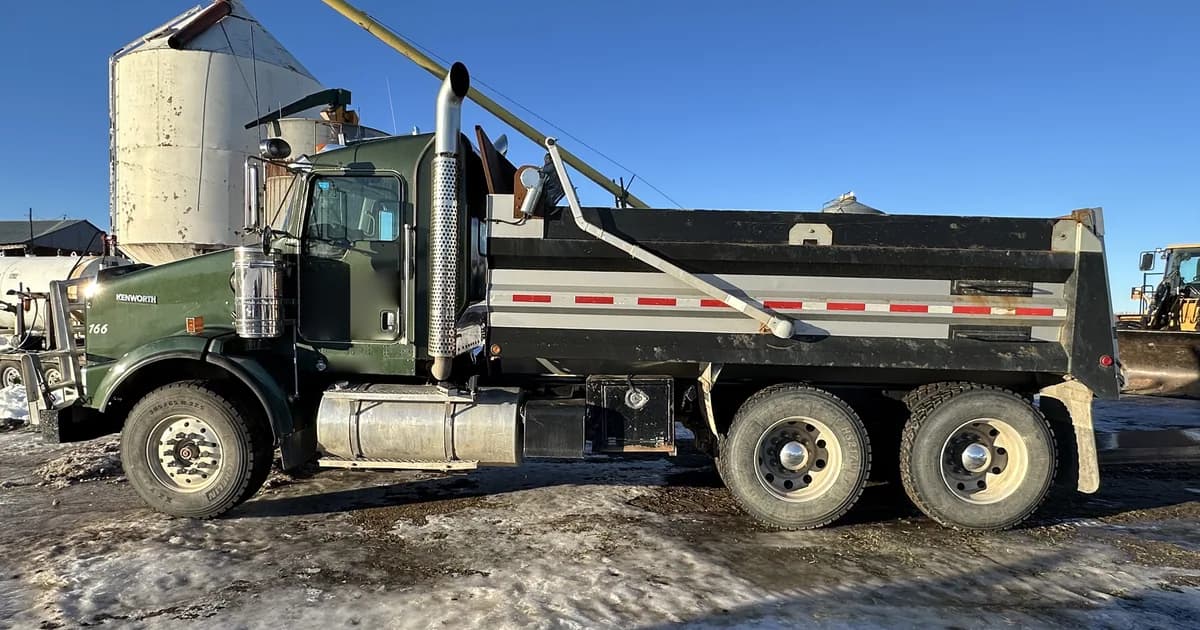
Two 2013 Cat CT660S tri-axle dump trucks are listed by Canadian dealers right now. The one in Alberta has 255,276 km, a recent drop-in engine and, its ad says, over $75,000 in recent work orders. It asks $155,000. The one in Ontario has 497,682 km, a SPIF lift steer axle and a heated 20-foot box — and an ad that says the engine is "running rough" and the emissions are "deleted." It asks $27,500. On the same Ontario lot, a 2014 International Paystar tri-axle with 399,382 km, axles rated 20/21/46, a pup hitch and an ad that calls it "legal for 23.8 tons" asks $85,000.
Same model, same model year, $127,500 apart. The year is not what separates them. What separates them is whether each truck can legally do the work — what it may carry, in the province where it will run — and that is also the number a lender is really financing.
Used Class 8 dump trucks listed by Canadian dealers in October 2026 ask a median of about $71,000, with the middle half between roughly $50,000 and $118,000. Financing one is routine. This guide is about the part that is not routine: why payload, not model year, drives what a dump truck earns, what it is worth, and how a lender reads your file because of it.
A Dump Truck Earns by the Tonne It May Legally Carry
An excavator earns by the hour it digs. A dump truck earns by what it moves, and what it may move is set by law, not by the truck.
There are three different weights on every dump truck. The first is the rated capacity — what the manufacturer built the axles for. Listings quote it: "20,000 lb front axle, 46,000 lb rears." The second is the legal limit — what your province allows that axle configuration to carry on a public road. The third is the seasonal limit — what the road allows during spring thaw. The rated number is the one in the ad. The legal number is the one you get paid on.
Legal payload sets revenue. Paid by the hour, the load or the tonne, a truck that may carry more earns more per trip. Ontario's own equipment rental schedule prices dump trucks by capacity class — and it says outright that "when a piece of equipment falls in between listed categories, with respect to weight or capacity, the lower rental rate shall apply." A truck that cannot carry the class's weight gets paid for the class below it.
Revenue is what the lender sizes the payment against. The underwriter reads your bank deposits, not the truck's spec sheet. A truck that legally hauls ten tonnes less per load produces smaller deposits for the same hours of work, and the payment has to fit inside them.
Legal payload also sets resale. The truck's value as collateral is what the next owner could do with it. A configuration that is legal to load heavily in your province has a deep resale market. One that is not has a thin one, and the appraisal follows.
Ontario shows this more sharply than anywhere else in Canada, because it rewrote its rules around it.
Ontario: Why "SPIF" Is Written Into the Listing
Ontario's weight rules for trucks are in Regulation 413/05 under the Highway Traffic Act — the "Safe, Productive, Infrastructure-Friendly" vehicle rules, which is where the letters SPIF come from. The regulation sets out "designated" truck configurations. A truck that meets the design rules for its configuration gets the configuration's weights. A truck that does not is "non-designated," and it gets a much lower gross weight cap.
| Ontario configuration | What it is | Maximum gross weight |
|---|---|---|
| Designated Truck 5 (SPIF tri-axle) | Front single axle, a self-steer liftable pusher axle, rear tandem drive axle | Actual front axle weight + 9,550 kg self-steer + 19,100 kg tandem drive (load-equalized, 1.8–1.88 m tandem spread) — up to 37,650 kg with a 9,000 kg front axle |
| Non-designated 4-axle truck | A tri-axle that does not meet the SPIF design rules | 27,000 kg (base length under 8 m), 28,000 kg (8 to under 12 m), 29,000 kg (12 m and over) |
| Designated Truck 2 (SPIF tandem) | Front single axle, rear tandem drive axle | Up to 28,100 kg (4.9 m base length or more), 19,100 kg on a dual-tire tandem drive |
| Non-designated 3-axle truck | A tandem that does not meet the design rules | 21,500 kg |
Sources: Ontario Regulation 413/05, Schedules 20 and 23 and Vehicle Weight Table 32.
The gap is the payload. An empty tri-axle weighs the same whether it is SPIF or not, so every kilogram of gross weight it loses comes straight out of the load. A SPIF tri-axle grossing 37,650 kg against a non-SPIF tri-axle capped at 27,000–29,000 kg is 8.65 to 10.65 tonnes less on every trip. Over a season, that is the difference between a truck that pays for itself and one that does not.
What makes a tri-axle SPIF. The regulation's design rules for a SPIF tri-axle include a self-steering lift axle, a front axle that carries "at least 23 per cent of the gross vehicle weight at all times," and a lift axle that "must not be deployed if the resulting weight on the axle is less than 4,000 kilograms." The truck must also "bear their original compliance labels" carrying the notation "SPIF."
The grandfathering is over, and the last permits are running out. Trucks built before July 1, 2011 kept their old, higher weights only "before January 1, 2021." Since then, a pre-July-2011 truck can carry the old weights only under a special permit, and no such permit is valid "for longer than 15 years after the year of its manufacture." For a truck built in the first half of 2011, that runs out at the end of 2026. An older non-SPIF tri-axle on an Ontario lot today is, for weight purposes, a 27,000–29,000 kg truck.
Read the label, not the ad. "SPIF" in a listing title is a seller's claim. The compliance label on the truck is the evidence, and it is what a lender or appraiser will ask for. If you are buying a tri-axle to work in Ontario, a photo of that label belongs in your application.
Alberta and BC: Same Truck, Different Ceiling
The western provinces set their limits by axle group rather than by designated configuration, and the numbers differ.
| Axle group | Alberta | British Columbia |
|---|---|---|
| Steer axle | 7,300 kg (trucks other than tridem-drive) | 9,100 kg |
| Tandem drive group | 17,000 kg (8 or more tires) | 17,000 kg |
| Tridem drive group | 23,000 kg | 23,000 kg (liquid load), 24,000 kg (fixed load) |
| Spring and seasonal limits | Set per road segment in each ban order — the current provincial list shows 90%, 75% and 50% sections | 100%, 70% or 50% of legal axle loading, posted on DriveBC |
Sources: Alberta Commercial Vehicle Dimension and Weight Regulation (AR 315/2002) and the Alberta road bans list; BC Commercial Transport Regulations (B.C. Reg. 30/78), Appendix B, and the CVSE Commercial Transport Procedures Manual.
An Ontario truck does not carry Ontario's rules west. Alberta's regulation defines a tridem axle group so that it "does not include a lift axle in the down position or a self steering axle." A SPIF tri-axle bought in Ontario and driven to Alberta is weighed under Alberta's axle-group limits, not Ontario's designated-truck chart. If you are buying east to work west, check the weights for the configuration in the province where it will earn.
Spring takes a slice of every western season. BC's procedures manual says the ministry "imposes seasonal weight restrictions usually during the spring," at 70% or 50% of legal axle loading on restricted roads. Alberta's bans are set road by road. A truck that legally hauls 17,000 kg on its tandem in August may haul a fraction of that on a banned road in April. Our Alberta equipment rates guide covers how a lender reads the road-ban months on your deposit history.
What the Work Pays: Ontario Publishes the Numbers
Most of what a dump truck earns is negotiated job by job, and nobody publishes it. One schedule is public, and it shows the payload mechanic in dollars.
Ontario's Ministry of Transportation publishes OPSS.PROV 127, a schedule of hourly rental rates for equipment hired on provincial contracts. The rates exclude the operator, and the ministry says each one "represents the cost of owning and operating the equipment," including fuel, repairs, depreciation, financing, insurance, overhead and profit.
| Rear dump (April 2024 schedule, latest final) | Capacity class | Hourly rate, no operator |
|---|---|---|
| Single rear axle | 12,000 kg | $83.20 |
| Tandem rear axle | 24,000 kg | $114.85 |
| Tri-axle | 32,000 kg | $134.35 |
| Tri-axle with stone spreader | 32,000 kg | $158.20 |
| Rear dump trailer — pony/pup | — | $23.10 |
| Rear dump trailer — tri | — | $27.80 |
A tri-axle earns about 17% more an hour than a tandem on this schedule. That is the extra legal payload, priced. A pup trailer is listed as a separate line, which is how a truck-and-pup earns more per hour than the truck alone.
These are a benchmark, not your revenue. They are what the province pays for hired equipment, and private hauling rates are set by the job. MTO posted a draft 2026 schedule in July 2026, and its published response to industry comments says the 2026 rates were recalculated for an average increase of 2.4% over 2025. We could not locate the final 2026 schedule, so the table above is the latest final edition. BC and Alberta have their own rate guides — the BC Road Builders' "Blue Book," published "in partnership with the provincial Ministry of Transportation," and the Alberta Roadbuilders' Equipment Rental Rates Guide, which Alberta Transportation pays from on its contracts — but neither publishes its rates online.
BC's hired-equipment program shows the same logic from the other side. To register a dump truck for ministry work, an owner must provide "tare slips from a provincial weigh scale (or Ministry approved private scale) and front axle capacity from the vehicle manufacturer." The province wants the empty weight and the axle rating because together they tell it what the truck can legally carry. A lender is asking the same question.
What Dump Trucks Ask in Canada Right Now
Here is every Class 8 dump truck from model year 2012 or newer in our dealer-inventory mirror today, Canadian listings only.
| Year | Truck | Configuration (as listed) | Province | Km | Asking |
|---|---|---|---|---|---|
| 2022 | Peterbilt 567 | Tri-axle, axles 20-20-46 | ON | 105,376 | $189,000 |
| 2015 | Western Star 4900SA | Tri-drive, 69,000 lb rears | AB | 472,900 | $185,000 |
| 2014 | Western Star 4900SA 8x6 | Tri-drive, 69,000 lb rears | AB | 465,000 | $175,000 |
| 2020 | Peterbilt 567 | Tri-axle, axles 20-20-46 | ON | 240,424 | $169,500 |
| 2013 | Caterpillar CT660S | Tri-axle | AB | 255,276 | $155,000 |
| 2013 | Freightliner Coronado SD | Tri-drive, 66,000 lb drives | BC | 560,350 | $130,000 |
| 2016 | Caterpillar CT681SG | Tandem, plow-equipped | AB | 308,000 | $127,500 |
| 2016 | Freightliner Coronado 122SD | Tandem (6x4) | AB | 785,257 | $125,000 |
| 2012 | Kenworth T800 | Tandem | AB | 856,562 | $119,150 |
| 2012 | Western Star 4900SB | Tandem | AB | 601,378 | $115,900 |
| 2018 | Kenworth | Tri-axle, SPIF, axles 20-20-46 | ON | 613,816 | $115,000 |
| 2015 | Kenworth T370 | Not stated | AB | 385,587 | $99,135 |
| 2014 | International Paystar | Tri-axle, SPIF, axles 20/21/46 | ON | 399,382 | $85,000 |
| 2016 | International 7400 SBA | Tandem (6x4) | AB | 331,652 | $73,135 |
| 2015 | Western Star 4900 | Tandem | AB | 562,280 | $65,150 |
| 2014 | International WorkStar | Not stated | AB | 399,253 | $64,135 |
| 2014 | International 7600 WorkStar | Tandem | BC | 200,250 | $59,000 |
| 2013 | Caterpillar CT660S | Tri-axle, SPIF lift steer; emissions deleted | ON | 497,682 | $27,500 |
Eighteen trucks from four dealers, measured 2026-10-05; no single dealer accounts for more than a third. Across all model years, the mirror holds 38 Class 8 dump trucks from six dealers (one dealer accounts for 14), with asking-price quartiles of $49,925, $71,143 and $118,338. Trailers, bare dump boxes, walk-behind dumpers, light-duty one-ton dump trucks and listings already sold at auction were excluded.
Three things in that table matter to a lender.
Configuration and age are tangled together. The tri-axles and tri-drives cluster at the top of the price range, but they are also the newer trucks. Do not read the table as "a tri-axle is worth $50,000 more." Read it as: in this sample, the configurations that can legally carry the most sit at the top of the price range.
Kilometres explain less than you would expect. A 2016 tandem at 785,257 km asks $125,000; a 2014 tandem at 200,250 km asks $59,000. Body, axle ratings, maintenance records and configuration are doing as much work as the odometer. That is why the configuration details belong in your application, not just the VIN.
The cheapest truck on the list is not a bargain. The $27,500 Cat is a SPIF tri-axle that its own ad says is running rough with its emissions deleted. In Ontario, that truck cannot legally work as listed. The section below explains why that matters for financing.
What Lenders Look At on a Dump Truck File
The order matters: pass/fail gates first, scored factors second, structure last. Why lenders check in that order has its own page — what a bank decline actually means. Here is how it plays out on a dump truck.
Revenue is a gate, not a factor. The underwriter sizes the payment against the deposits going into your business account. Our lender network currently looks for roughly $20,000 a month. Above that line the rest of the file gets weighed. Below it, the rest of the file does not get its turn, and a good credit score will not substitute for it. For a dump truck that works seven or eight months a year, total twelve months of deposits and divide by twelve — that is the figure the lender compares, and quoting your best month instead only delays the answer.
Who pays you matters almost as much as how much. Dump truck revenue can come from a haul broker, a single excavation contractor, an aggregate pit, a municipality or a province's hired-equipment list. If most of your deposits come from one of them, your deposit history is only as durable as that relationship. Name your main sources of work and roughly what share of revenue each represents before you are asked.
Can the truck legally do the work? A lender financing a truck you cannot legally run is financing a problem. In Ontario, a truck with a registered gross weight over 4,500 kg needs a Commercial Vehicle Operator's Registration (CVOR) and an annual inspection. In Alberta, a truck registered at 11,794 kg or more operating only within the province needs a Safety Fitness Certificate, and one registered above 11,794 kg needs an annual commercial inspection. In BC, a commercial vehicle licensed over 5,000 kg needs a National Safety Code certificate, and the inspection regulation gives a 12-month certificate only to vehicles licensed up to 17,300 kg — a heavier dump truck falls to the regulation's default six-month cycle, and dump trailers have long been inspected twice a year. If this is your first heavy truck, line up the operating authority before you need the truck to earn.
Then the truck — and its legal configuration. Make, model year, kilometres and engine hours, as on any truck. Then the things specific to a dump truck: axle configuration and ratings, registered gross weight, SPIF status in Ontario, the box and hoist, and the emission system. Our log truck financing guide explains why a working truck is read on both kilometres and engine hours, and the same applies here.
Credit is weighed after all of that. It moves your rate and your down payment. It rarely decides a dump truck file on its own. If yours is bruised, our bad-credit financing guide covers what actually moves on a challenged file.
Structure is negotiated last. Term, down payment and payment timing are the adjustable parts once the gates are cleared. Term is sized to the truck's age. BDC advertises equipment loans "repayable for up to 12 years" and says "BDC routinely finances used trucks," but no Canadian lender we could find publishes an age limit for commercial dump trucks. The nearest published rule is ATB Financial's for farm trucks — "The vehicle's age plus amortization period cannot exceed 10 years" — which shows the shape such rules take, but it does not apply to a construction truck. For current rate ranges by lender type, see how Canadian equipment loan rates compare.
Red Flags in a Used Dump Truck Listing
"Emissions deleted." Two of the seven Ontario dump trucks in our mirror say this in their ads. Ontario's Highway Traffic Act prohibits "removing, bypassing, defeating or rendering inoperative all or part of a motor vehicle's emission control system," with fines from $400 to $20,000, and BC requires heavy diesel vehicles on its highways to meet its diesel emission standards. A truck you cannot legally run is weak collateral. Price the cost of restoring the system into your offer, and ask before you count on financing it.
"SPIF" in the ad, but no label on the truck. In Ontario the compliance label carrying "SPIF" is the evidence. Without it, an Ontario tri-axle is a 27,000–29,000 kg truck, whatever the ad says.
An older non-SPIF tri-axle bought to work in Ontario. The transition to SPIF weights ended January 1, 2021, and the permits that let pre-July-2011 trucks keep their old weights cannot run past 15 years from the year the truck was built. Price it for what it can legally carry, not what it carried in 2019.
"True mileage unknown." A 2009 Ontario tri-axle in our mirror reads 20,255 km on its odometer with 20,321 engine hours, and its ad says the true mileage is unknown. When the odometer cannot be trusted, engine hours and maintenance records become the evidence, and an appraiser will value the truck more cautiously.
A rated weight presented as a legal one. "46,000 lb rears" is what the axles were built for. Your province decides what they may carry, and in Alberta and BC a tandem drive group is 17,000 kg on the road. Do the arithmetic on legal weights before you do it on revenue.
Buying privately from a company without a corporate bill of sale. Many dump trucks change hands between operators. If the truck is owned by a corporation, the bill of sale must come from the corporation. Our private-sale financing guide covers the appraisal gap and the lien search that apply to any private truck purchase.
How to Strengthen a Dump Truck Application
Tip 1: Send the legal configuration, not just the VIN. Axle configuration, axle ratings, registered gross weight and tare weight. In Ontario, add a photo of the SPIF compliance label. This is what lets an appraiser value the truck as the configuration it is.
Tip 2: Show twelve months of deposits as one figure. Total them, divide by twelve, and give both numbers. Dump trucks earn in the construction season, and the monthly average is what the lender compares against the floor.
Tip 3: Show who pays you. Your main sources of hauling work, roughly what share of revenue each represents, and how long you have worked for them. Haul tickets or invoices from your main customers answer the question before it is asked.
Tip 4: Have the operating authority and inspection in hand. Your CVOR, Safety Fitness Certificate or NSC number, and a current inspection. On a first heavy truck, it shows the lender the truck can go to work the week it is funded.
Tip 5: Model the payment before anyone pulls your credit. Age drives term and term drives payment. Try a 2014 and a 2020 truck side by side in our equipment payment calculator — the payment gap is usually larger than the price gap suggests.
Tip 6: Ask your accountant about Class 16 before you sign. A truck used in a business that includes hauling freight can qualify for Class 16 at 40%; otherwise it is Class 10 at 30%. The proposed Productivity Mega Deduction would apply to property acquired on or after September 15, 2026, but it is not yet law, and used property only qualifies if neither you nor a non-arm's-length person owned it before.
Sources
Every regulatory figure, rate and lender term on this page was read from its Canadian publisher and is quoted so you can check it. Where a question has no Canadian source — a dump truck down-payment standard, a commercial truck age limit, BC and Alberta hourly rates — we say so rather than borrow an American figure.
Ontario Regulation 413/05 — SPIF vehicle weights (verified 2026-10-05)
"Designated Truck 5 is a 4-axle truck with a front single axle, a self-steer liftable pusher axle and a rear tandem drive axle." "The front axle weight must be at least 23 per cent of the gross vehicle weight at all times."
Schedule 23 sets 9,550 kg on the load-equalized self-steer axle and 19,100 kg on the load-equalized tandem drive (1.8–1.88 m spread); Schedule 20 caps Designated Truck 2 at 28,100 kg; section 21 and Vehicle Weight Table 32 cap non-designated three- and four-axle trucks at 21,500 kg and 27,000–29,000 kg; section 22 ends the pre-July-2011 transition "before January 1, 2021"; section 34 limits the replacement permits to 15 years after the year of manufacture. Consolidated to the e-Laws currency date of September 30, 2026. — Ontario e-Laws, O. Reg. 413/05
Ontario Ministry of Transportation — OPSS.PROV 127 equipment rental rates (verified 2026-10-05)
"When a piece of equipment falls in between listed categories, with respect to weight or capacity, the lower rental rate shall apply."
Hourly rates are from the April 2024 edition, the latest final schedule — MTO, OPSS.PROV 127, April 2024. The 2.4% recalculation is from MTO's published response to industry comments on the 2026 draft — MTO, 2026 comments and responses.
Alberta — axle weights and road bans (verified 2026-10-05) Tandem group "exceeds 17 000 kilograms" (8 or more tires), tridem drive group "exceeds 23 000 kilograms," steer axle 7,300 kg for trucks other than tridem-drive, and the tridem definition that "does not include a lift axle in the down position or a self steering axle" — Alberta King's Printer, Commercial Vehicle Dimension and Weight Regulation, AR 315/2002. Road-ban percentages by segment — Alberta Transportation, road bans list.
British Columbia — axle weights and seasonal limits (verified 2026-10-05) Tandem drive "Max. 17 000 kg," tridem drive "Max. 23 000 kg (liquid load) Max. 24 000 kg (fixed load)," steer "Max. 9 100 kg (truck)" — BC Laws, Commercial Transport Regulations, Appendix B. Seasonal restrictions at "100% … 70% … 50% of legal axle loading" — CVSE, Commercial Transport Procedures Manual, Chapter 3. Inspection intervals — BC Laws, Motor Vehicle Act Regulations, s. 25.14.
BC and Alberta rate guides (verified 2026-10-05)
"The Blue Book Equipment Rental Rate Guide is published annually by the BC Road Builders and Heavy Construction Association, in partnership with the provincial Ministry of Transportation."
— BC Road Builders, Blue Book. The tare-slip requirement is from the Government of BC, Hired Equipment Program — owner-operator responsibilities. Alberta Transportation pays construction equipment "at the rates specified in the current edition of the Equipment Rental Rates Guide published by the Alberta Roadbuilders and Heavy Construction Association" — Government of Alberta, Payment Conditions.
Operating authority and inspections (verified 2026-10-05) Ontario CVOR for trucks "with a registered gross weight (RGW) or actual weight over 4,500 kg" — Government of Ontario, CVOR; Ontario annual inspection — Government of Ontario. Alberta Safety Fitness Certificate for "a truck or trailer … with a registered weight of 11,794 kg or more, operating solely within Alberta" — Government of Alberta; Alberta annual inspection — Government of Alberta. BC NSC certificate for "commercial vehicles licensed with a gross vehicle weight of more than 5,000 kg" — CVSE, National Safety Code.
Emission tampering (verified 2026-10-05)
"No person shall tamper, or cause or permit a person to tamper, by, (a) removing, bypassing, defeating or rendering inoperative all or part of a motor vehicle's emission control system"
Fines are "not less than $400 and not more than $20,000" — Ontario e-Laws, Highway Traffic Act, s. 75.1. BC's diesel emission standard for vehicles on a highway is in Division 40A of the Motor Vehicle Act Regulations.
Lenders' published terms (verified 2026-10-05)
"BDC routinely finances used trucks."
— BDC, How to finance a truck or trailer purchase, and up to 125% financing with repayment "of up to 12 years" — BDC, Equipment Loan. ATB's farm-truck rule — ATB Financial, Ag equipment financing and leasing.
Tax — CCA classes and the proposed Productivity Mega Deduction (verified 2026-10-05) Class 16(g) covers "a truck or tractor designed for hauling freight, and that is primarily so used by the taxpayer … in a business that includes hauling freight, and that has a 'gross vehicle weight rating' … in excess of 11,788 kg" — Justice Laws, Income Tax Regulations, Schedule II. The proposed deduction covers property "acquired on or after September 15, 2026" and excludes "certain vehicles in classes 10 and 10.1" — Finance Canada.
IronFinance first-party inventory data (measured 2026-10-05) The listing table, quartiles and dealer counts come from IronFinance's own normalized dealer-inventory mirror, restricted to Canadian listings priced in Canadian dollars, with dealer concentration disclosed. Quartiles are computed as statistical percentiles, not a hand-picked midpoint. Asking prices are not transaction prices.
What is convention rather than citation
Down-payment ranges, the order in which lenders check a file, the $20,000-a-month revenue threshold for our own lender network, and the way an appraiser discounts a truck with a weak configuration or an unreliable odometer are directional practitioner conventions as of October 2026, drawn from our experience placing equipment files — not a published rule, and not a quote or approval. No Canadian lender we could find publishes a down-payment standard or an age limit for commercial dump trucks, so this page gives neither as a rule. The OPSS rates are what Ontario pays for hired equipment, not a measure of private hauling rates. The six-month BC inspection cycle for heavier dump trucks is our reading of the regulation's default interval; confirm it with a BC inspection facility.
Tax treatment depends on your truck, your business and your circumstances, and the Productivity Mega Deduction is a proposal; confirm with your accountant. Weight limits are set by each province and change; check the current regulation and any seasonal restriction before you load. This is general information, not financial, tax or legal advice.
Getting a Straight Read on Your Dump Truck
Whether a dump truck file works comes down to four things: the truck's legal configuration in your province, its kilometres and condition, your twelve-month deposits, and who those deposits come from. With those in front of someone, it is a five-minute question — and a lot faster than finding out by applying three times.
Send us the listing — the truck, its axle configuration, your province, and your last twelve months of deposits — and we will tell you straight what the realistic structure looks like, whether the configuration will hold its value, and where the appraisal is likely to land. No credit pull, and nothing to commit to.
Ready to move? Start an application. Buying from another operator rather than a dealer? Read the private-sale guide first. Hauling with a vacuum body instead of a box? Our hydrovac truck financing guide covers the two-assets-on-one-title problem.
Already own equipment, or eyeing a different machine?
Frequently Asked Questions
How much down payment do I need to finance a dump truck in Canada?
No Canadian lender publishes a standard figure for dump trucks. As a practitioner convention, a strong file on a newer truck from a dealer usually sees roughly 10 to 20 percent down, and older trucks, private sales and thinner files move toward 20 to 30 percent. BDC, for comparison, advertises equipment loans covering up to 125 percent of the purchase price for qualifying borrowers. On a dump truck the down payment also absorbs anything that lowers what the truck can legally carry — a non-SPIF tri-axle in Ontario, for example, is worth less to a lender because it hauls less on every load.
Is it hard to get a loan for a dump truck?
Not if the file is built in the right order. Lenders finance used dump trucks routinely — BDC says plainly that it routinely finances used trucks. What makes a dump truck file hard is usually not credit. It is revenue: the underwriter sizes the payment against the deposits going into your business account, and our own lender network currently looks for roughly $20,000 a month. Above that line, credit, the truck and the down payment get weighed. Below it, they do not get their turn. Bruised credit moves you to specialist lenders and a larger down payment; it rarely decides a dump truck file on its own.
Does SPIF matter when financing a dump truck in Ontario?
Yes, a lot. Under Ontario Regulation 413/05, a SPIF tri-axle (a front axle, a self-steering lift axle and a tandem drive) may gross up to 37,650 kilograms when its axles are load-equalized and its front axle carries 9,000 kilograms. A four-axle truck that is not a designated SPIF vehicle is capped at 27,000 to 29,000 kilograms gross, depending on its length. Since the empty truck weighs the same either way, that is 8.65 to 10.65 tonnes less on every load. Less payload means less revenue per load and a smaller resale market, so check the SPIF compliance label on the truck itself before you agree on a price.
Can I finance a used dump truck with the emissions deleted?
Expect it to be very difficult, and in Ontario the truck cannot legally be run as listed. Ontario's Highway Traffic Act, section 75.1, prohibits removing, bypassing, defeating or rendering inoperative all or part of a motor vehicle's emission control system, with fines from $400 to $20,000. British Columbia requires heavy diesel vehicles on the highway to meet its diesel emission standards. A truck that cannot legally run in your province is weak collateral, and the cost of restoring the system belongs in your offer, not the lender's appraisal. Ask before you commit.
What CCA class is a dump truck in Canada?
It depends on how you use it. Class 16 (40%) covers a truck designed for hauling freight, primarily used in a business that includes hauling freight, with a gross vehicle weight rating over 11,788 kilograms. A dump truck that does not meet all of those tests falls to Class 10 (30%) as automotive equipment. Whether a contractor hauling their own fill and aggregate is hauling freight is not answered by any CRA publication we could find, so ask your accountant. Separately, the federal government proposed a Productivity Mega Deduction on September 15, 2026 that would allow immediate expensing of most property acquired on or after that date. It is proposed, not law.