
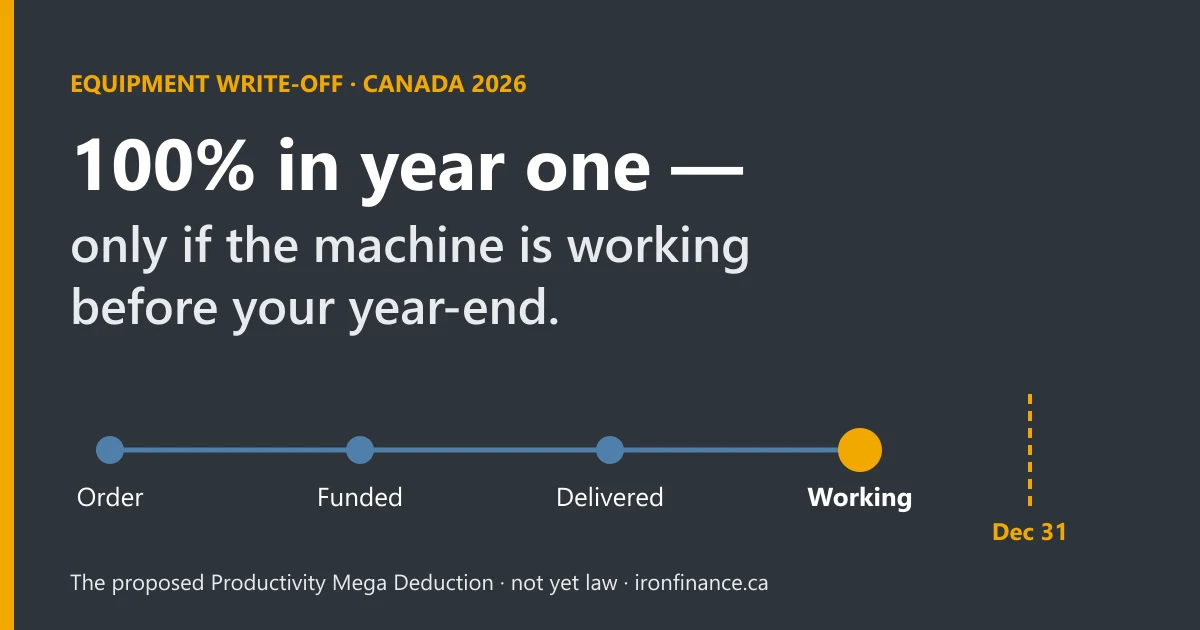
A contractor with a December 31 year-end signs for a $150,000 used excavator on December 10, pays the deposit the same day, and takes delivery on January 8. They believe they have bought this year's write-off. They have bought next year's.
That is not a technicality. It is how the Canada Revenue Agency counts, and it decides what the biggest change to equipment taxation in years is worth to you this fall. On September 15, 2026, Finance Canada proposed the Productivity Mega Deduction: a permanent 100% first-year write-off for most equipment acquired on or after that date. The write-off lands in the year the machine is available for use, not the year you sign, and it goes to whoever owns it.
Both of those are financing questions. The funding date decides which year you get the deduction. The structure of the deal decides whether you get it at all. This guide covers both. It is written for anyone buying equipment before a year-end, and it only cites Canadian law, because the "Section 179" articles that circulate every December describe an American rule that has never applied here.
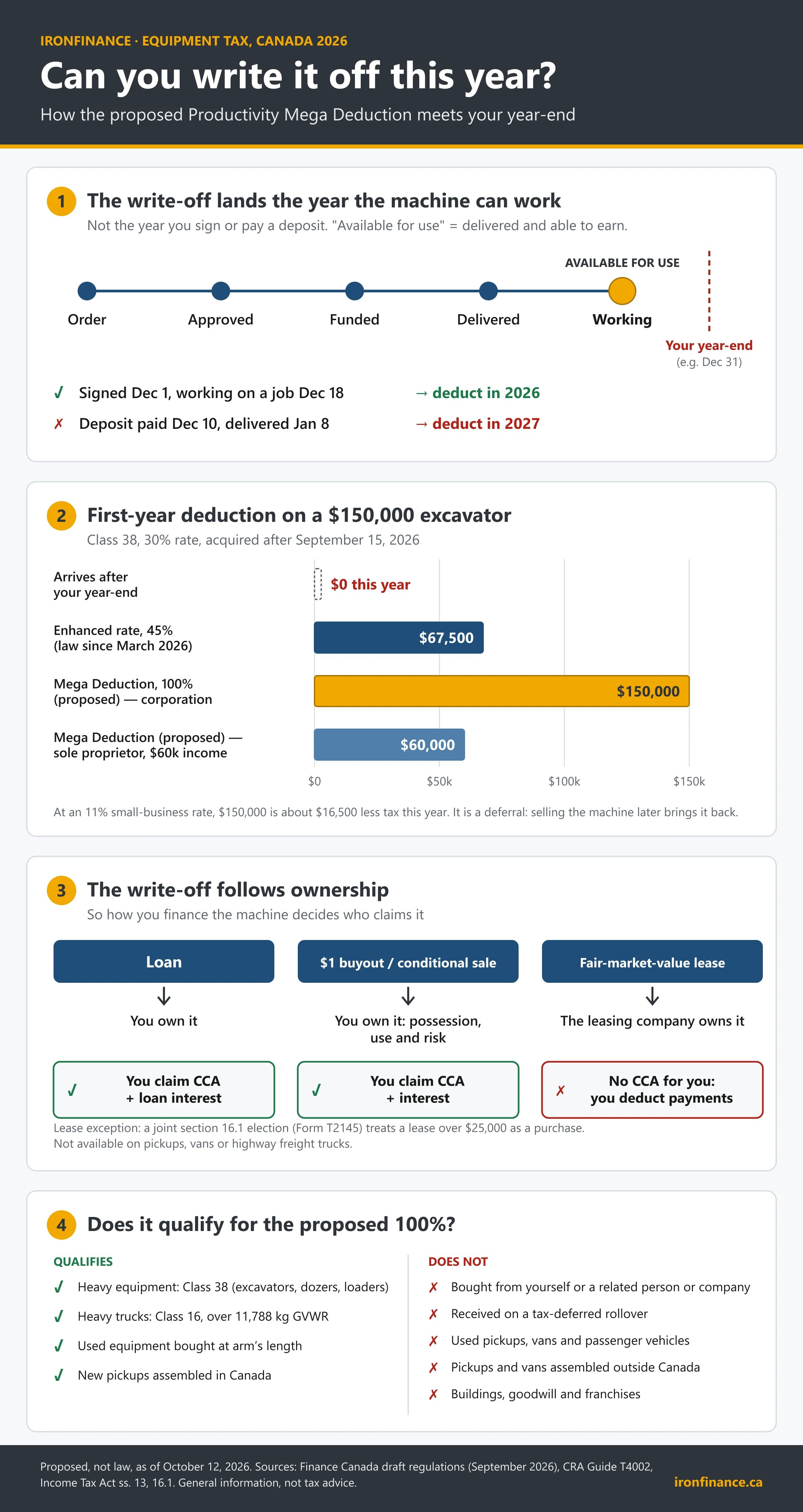
The whole guide on one page. Every figure in it is sourced or worked out below, and the proposal is not yet law.
The Write-Off Lands the Day the Machine Can Work
Signing is not buying, for tax purposes, and buying is not enough either. Two separate tests apply. First, when did you acquire the machine? Second, when did it become available for use? The proposed deduction needs both: acquired on or after September 15, 2026, and claimed only in the year it became available for use.
Acquired means you have the incidents of ownership. The CRA's capital cost allowance folio says property is acquired on the earlier of the date you get title and the date you have "all the incidents of ownership such as possession, use, and risk, even if the vendor retains legal title as security." A contract to acquire a machine in the future is not enough. For a machine ordered by make, model and serial number that has not been built yet, the folio says you acquire it "when the property has been produced."
Available for use means delivered and able to earn. The CRA's business income guide says equipment usually becomes available for use on the earlier of the date you first use it to earn income and the date it "is delivered or made available to you and is capable of producing a saleable product or service." Its own example settles the December question: a machine delivered in one fiscal period but not in working order until the next "cannot" be claimed until the next.
A machine that sits unused still starts eventually. If you acquire a machine and never put it to work, the Income Tax Act deems it available for use from the start of the first tax year that begins more than 357 days after the end of the year you acquired it. That rule exists so the deduction cannot be parked forever. It does not help a buyer trying to land the deduction in the current year.
Key takeaway: For a December 31 year-end, the question is not "can I sign by December 31?" It is "can the machine be funded, delivered and able to work by December 31?" Delivery depends on funding, and funding depends on how fast your file can be read.
Three Dates Decide Which Year You Get It
Every year-end purchase turns on the same three dates.
| Date | What it decides | Where the rule comes from |
|---|---|---|
| September 15, 2026 | Acquired on or after this date: eligible for the proposed 100% deduction. Before it: the enhanced first-year rate applies instead. | Finance Canada backgrounder and draft regulations (proposed) |
| Your available-for-use date | The tax year the deduction is claimed in. Delivered and capable of working, or first used to earn income. | CRA guide T4002, Chapter 4; Income Tax Act s. 13(27) |
| Your fiscal year-end | The cut-off. A machine ready to work one day after it is a next-year deduction. | Your own tax year |
The second date is the one you can move. The first is fixed by Finance and the third is fixed by your corporation or your calendar. The available-for-use date depends on approval, funding, the seller's paperwork and the delivery truck, and most of that is the financing.
What Makes a Machine Eligible for the Proposed Mega Deduction
The draft regulations define eligible property by exclusion: every capital cost allowance class qualifies unless it is carved out.
Heavy construction equipment qualifies. Class 38 covers what CRA calls "most power-operated movable equipment" used "for excavating, moving, placing or compacting earth, rock, concrete, or asphalt" — excavators, dozers, loaders, graders, skid steers. It is not on the excluded list.
Heavy trucks qualify. Class 16 covers a truck "designed for hauling freight" and primarily used in a business that includes hauling freight, with a gross vehicle weight rating over 11,788 kg. It is not on the excluded list. Our dump truck guide covers when a contractor's truck lands in Class 16 rather than Class 10.
Used equipment qualifies in an arm's-length deal. This is where several articles ranking for these searches are wrong. The draft does not require new equipment. Used property qualifies as long as it was not "previously owned or acquired by the taxpayer or by a person or partnership with which the taxpayer did not deal at arm's length," and did not come to you on a tax-deferred rollover. A used machine bought from a dealer or an unrelated private seller qualifies. One bought from your own holding company, your brother's company or a business you control does not.
Pickups and vans are the trap. The draft excludes an "excluded vehicle": a passenger vehicle, or a van or pickup of the kind the Income Tax Act carves out of its definition of automobile, that either "has been used for any purpose before it was acquired by the taxpayer" or "was assembled in a country other than Canada." Both conditions are separate tests. A used work pickup is out. A brand-new pickup assembled in the United States or Mexico is also out. Only a new, Canadian-assembled one is in. The draft does not define "assembled," so check the vehicle's assembly plant before counting on it.
Buildings and intangibles are out. The excluded list also covers most buildings (Classes 1 and 3 additions), franchises, licences and goodwill (Classes 14 and 14.1), and a short list of resource and pipeline property.
Anything excluded still gets the enhanced rate. Property that misses the Mega Deduction falls back to the reaccelerated investment incentive, enacted by Bill C-15 on March 26, 2026. It suspends the half-year rule and allows up to one-and-a-half times the class rate in the first year, for property acquired after 2024 that becomes available for use before 2030, then steps down until it ends for property available for use after 2033.
Manufacturing machinery has its own measure. Machinery used primarily to manufacture or process goods for sale sits in Class 53 or Class 43, and a separate full-expensing measure for it was introduced in Bill C-15. Our metalworking and fabrication equipment financing guide covers that route, and why construction work does not count as manufacturing.
The Write-Off Follows Ownership, So Your Financing Structure Decides Who Claims It
The deduction belongs to whoever owns the machine for tax purposes. That makes how you finance the machine part of the tax decision.
| How you finance it | Who claims the capital cost allowance | What you deduct |
|---|---|---|
| Bank or lender loan | You | CCA on the machine (100% in year one under the proposal) plus the interest on the loan |
| Conditional sale or $1-buyout agreement | You, from the day you have possession, use and risk | CCA plus the interest portion of the payments |
| Fair-market-value (FMV) lease | The leasing company | Your lease payments, as a business expense |
| Lease with a section 16.1 election | You, as if you had bought it with a loan | CCA plus deemed interest; not available on highway freight trucks, pickups, vans or property worth $25,000 or less |
A loan is the simple case. You own the machine from the day it is yours, and the lender's security interest does not change that. You claim the capital cost allowance and you deduct the interest separately.
A $1-buyout agreement is usually a purchase in disguise. The CRA folio's acquisition test applies "even if the vendor retains legal title as security … (as is commercial practice under a conditional sale agreement)." Our equipment leasing guide explains why Canada looks at the legal form of the contract, not its label. If the paperwork says lease but works as a conditional sale, have your accountant confirm which one it is before your year-end, not after.
An FMV lease gives the deduction to the lessor. The CRA says you "deduct the lease payments incurred in the year for property used in your business." The leasing company claims the capital cost allowance and, if the proposal passes, the 100% deduction. A good leasing company prices some of that into the rate. That is a negotiating point, not a reason to avoid leasing.
Section 16.1 converts a lease into a purchase, if both sides sign. The Income Tax Act lets a lessee and an arm's-length Canadian lessor jointly elect, on form T2145, to treat a lease of more than one year as a purchase. The lessee is then "deemed to have acquired the property from the lessor" at its fair market value, financed by a deemed loan. The election is not available where the leased property is worth $25,000 or less, or on "exempt property," which includes pickups, vans and trucks designed for hauling freight on highways. Heavy construction equipment over $25,000 qualifies. Whether an elected lease qualifies for the proposed Mega Deduction is not addressed in the draft. Ask before you count on it.
GST/HST timing follows the same split. On a purchase, the CRA allows a full input tax credit on capital property used more than 50% in your commercial activities, claimed once you have been invoiced, even before you have paid. On a lease, GST/HST is charged on each payment and recovered payment by payment. Our lease vs. finance guide runs the cash-flow side of that choice.
Corporation or Sole Proprietor: Same Machine, Different Write-Off
The draft does not treat every buyer the same.
A corporation gets the full deduction. For a corporation, or a partnership whose members are all corporations, the deduction is capped only by the cost of the machine. A $150,000 excavator available for use in a 2026 tax year is a $150,000 deduction under the proposal. If that pushes the corporation into a loss, the loss is a regular non-capital loss.
A sole proprietor is capped at business income. For anyone else, the deduction cannot exceed "the amount of income, if any, earned from the source of income that is a business" in which the machine is used. Finance's backgrounder says this restriction mirrors the one in the temporary immediate expensing rules announced in 2021.
And the draft blocks the fallback in the same year. A separate subsection says that if the deduction "is available in respect of an immediate expensing property" for a year, "the taxpayer may not deduct any other amount" of capital cost allowance on that property for the year. Read together, a low-income year can produce a smaller first-year deduction than the enhanced rate that is already law.
| A $150,000 Class 38 machine acquired after September 15, 2026 | First-year deduction |
|---|---|
| Arrives after your year-end | $0 this year |
| Enhanced first-year rate (law): 30% × 1.5 | $67,500 |
| Proposed Mega Deduction, corporation | $150,000 |
| Proposed Mega Deduction, sole proprietor with $60,000 of business income | $60,000, as drafted |
The unclaimed $90,000 stays in the sole proprietor's pool and is deducted at the regular 30% declining rate in later years. This is our reading of a consultation draft with no explanatory notes. It may change before it becomes law, and it is exactly the kind of detail to have your accountant check against your own numbers. It also connects to the paradox in our sole proprietor financing guide: the lower you push your net business income, the less a lender sees and, under this draft, the less of the write-off you can use.
What the Write-Off Is Worth: Year-One Tax by Province
A deduction is not a refund. It reduces taxable income, and what that saves depends on your tax rate. For a Canadian-controlled private corporation inside the small business limit, the rate is the federal 9% plus the province's lower rate.
| Province | Combined small business rate | Year-one tax reduced: enhanced rate ($67,500) | Year-one tax reduced: Mega Deduction ($150,000) | Difference in year one |
|---|---|---|---|---|
| British Columbia | 11.0% | $7,425 | $16,500 | $9,075 |
| Alberta | 11.0% | $7,425 | $16,500 | $9,075 |
| Saskatchewan | 10.0% | $6,750 | $15,000 | $8,250 |
| Manitoba | 9.0% | $6,075 | $13,500 | $7,425 |
| Ontario | 12.2% | $8,235 | $18,300 | $10,065 |
| Quebec | 12.2% | $8,235 | $18,300 | $10,065 |
| New Brunswick | 11.5% | $7,763 | $17,250 | $9,488 |
| Nova Scotia | 10.5% | $7,088 | $15,750 | $8,663 |
| Prince Edward Island | 10.0% | $6,750 | $15,000 | $8,250 |
| Newfoundland and Labrador | 11.0% | $7,425 | $16,500 | $9,075 |
Federal rate 9%. Provincial lower rates as published by the CRA and provincial governments for 2026: BC 2%, AB 2%, SK 1%, MB 0%, ON 3.2%, QC 3.2%, NB 2.5%, NS 1.5%, PE 1%, NL 2.0%. Ontario has proposed cutting its rate to 2.2% from July 1, 2026, prorated for straddling years. Quebec's reduced rate carries eligibility conditions and drops to 2.2% for tax years beginning after April 29, 2026. Assumes the corporation has at least $150,000 of taxable income at the small business rate.
It is a timing benefit, not extra money. Over the life of the machine you deduct its cost once, whichever rule applies. The Mega Deduction moves the whole deduction into year one. That has real value — on these numbers, roughly $7,400 to $10,100 more tax deferred in the first year than the enhanced rate — but it is not a $150,000 saving, and it is not a reason to buy a machine you do not need.
Selling the machine later brings some of it back. The CRA says that if you claim capital cost allowance and later dispose of the property, "you may have to add an amount to your income as a recapture of CCA." After a 100% deduction, the machine's tax value is zero, so a contractor who sells a fully expensed excavator for $90,000 three years later adds up to $90,000 back to income in that year. Contractors who trade up every few years should plan the trade, not just the purchase.
Year-End Mistakes to Avoid
Paying a deposit in December on a machine delivered in January. The deposit does not make the machine available for use. If the dealer cannot deliver before your year-end, the deduction moves to next year no matter when you paid.
Taking delivery of a machine that cannot work yet. A machine missing its attachment, waiting on a part or sitting at the dealer for pre-delivery inspection may not be "capable of producing a saleable product or service." The CRA's own example denies the claim until the machine is in working order.
Buying from a related company and expecting 100%. A used machine from your holding company, a family member's company or any business you do not deal with at arm's length is excluded from the proposed deduction. Our private-sale guide covers the other paperwork that matters when you buy from another operator.
Counting on the full write-off for a used or US-assembled pickup. Under the draft, it gets the regular capital cost allowance. Price the truck on that basis.
Signing an FMV lease and claiming the write-off yourself. Under an FMV lease, the leasing company owns the machine and claims the capital cost allowance. You deduct the payments. If you want the deduction, finance it, structure it as a conditional sale, or ask about a section 16.1 election before you sign.
Treating a proposal as law. The Mega Deduction is a consultation draft. Finance has not said when it will be tabled, and drafts change. Plan with your accountant on the assumption it passes as written, and know what your year looks like at the enhanced rate if it does not.
How to Get Funded Before Your Year-End
Tip 1: Count backwards from your year-end, not forwards from today. Work back from the date the machine must be able to work: delivery, funding, signed documents, approval, a complete application. A dealer machine on the lot moves fastest. A private sale adds an appraisal and a lien search. A machine on order depends on the factory. The later in the year you start, the fewer of those steps can slip.
Tip 2: Have your revenue figure ready before anyone asks. Our lender network currently looks for roughly $20,000 a month in deposits to the business account. The underwriter sizes the payment against those deposits, so revenue is a floor, not a factor. For a seasonal business, total twelve months of deposits and divide by twelve. A file that arrives with that number is read days sooner than one that has to ask for it.
Tip 3: Decide the structure with your accountant before you sign. Loan, conditional sale or FMV lease is a tax decision as much as a payment decision. Bring your accountant the quote before your year-end rush, not your T2 after it.
Tip 4: Keep the evidence of the available-for-use date. The delivery receipt, the date the machine was commissioned, and the first invoice or timesheet it earned on. If the CRA ever asks which year the machine started working, that is the answer.
Tip 5: Model the payment before anyone pulls your credit. The tax deferral is a one-time event; the payment is monthly for years. Run it in our equipment payment calculator first, and see how Canadian equipment loan rates compare for the current bands by lender type.
Tip 6: Do not let the deduction choose the machine. On the table above, the year-one tax difference between the proposal and the current law is under $10,100 on a $150,000 machine. Buy the machine your work needs, and let the timing be the bonus.
Sources
Every tax rule on this page is quoted from the Canadian statute, regulation or government publication it comes from, so you can check it. The Productivity Mega Deduction is a consultation draft, and no explanatory notes have been published for it, so where a point depends on our reading of the draft we say so.
Finance Canada — the proposed Productivity Mega Deduction (verified 2026-10-12)
"Immediate expensing allows taxpayers to fully deduct the cost of an investment in the year that it becomes available for use."
Applies to property "acquired on or after September 15, 2026"; used property qualifies only if "neither the taxpayer nor a non-arm's-length person previously owned the property" and it was not transferred on a rollover; rules "will apply to restrict the ability of individuals, and partnerships with members who are individuals, to create or increase a loss" — Finance Canada, backgrounder, September 15, 2026. The income cap, the same-year bar on other deductions (proposed Reg. 1100(0.1) and (0.2)), the used-property test and the "excluded vehicle" definition (proposed Reg. 1104(3.1)) are quoted from the draft itself — Finance Canada, Draft Legislative Proposals Relating to the Income Tax Act and Income Tax Regulations, September 2026. The van and pickup carve-out the draft refers to is paragraph (e) of the definition of "automobile" — Justice Laws, Income Tax Act, s. 248(1).
CRA — when equipment is acquired and available for use (verified 2026-10-12)
"the time the property is delivered or made available to you and is capable of producing a saleable product or service"
— CRA, Guide T4002, Chapter 4, which also carries the recapture wording. The acquisition test, conditional sales, and machines not yet built (¶1.28 and ¶1.31) — CRA, Income Tax Folio S3-F4-C1, General Discussion of Capital Cost Allowance. The 357-day rule — Justice Laws, Income Tax Act, s. 13(27).
The enhanced first-year rate that is law (verified 2026-10-12) The folio records that Bill C-15, enacted March 26, 2026, provides enhanced capital cost allowance for qualifying property acquired on or after January 1, 2025 that becomes available for use before 2034 (folio above). The "up to 3x normal rate" schedule for 2025–2029 and its step-down — Department of Finance, 2024 Fall Economic Statement, Tax Measures, Table 3; the "Productivity Super-Deduction" reinstating the accelerated investment incentive — Budget 2025, Chapter 1. The 1.5× factor is in the Income Tax Regulations, s. 1100(2). CRA's own accelerated investment incentive page has not been updated for Bill C-15, so we do not cite it.
CCA classes (verified 2026-10-12) Class 38 "most power-operated movable equipment … used for excavating, moving, placing or compacting earth, rock, concrete, or asphalt," Class 10 and 10.1 vehicles — CRA, Classes of depreciable property. Class 16's "gross vehicle weight rating … in excess of 11,788 kg" — Income Tax Regulations, Schedule II (above).
Leases (verified 2026-10-12) The lessee is "deemed to have acquired the property from the lessor … at a cost equal to its fair market value" — Justice Laws, Income Tax Act, s. 16.1; the $25,000 threshold and exempt property are in Income Tax Regulations s. 8200 and s. 1100(1.13) (above); the joint election form — CRA, Form T2145. Deducting lease payments, and the election's "more than $25,000" condition — CRA, Leasing costs.
GST/HST (verified 2026-10-12)
"If you use the capital personal property primarily (more than 50%) in your commercial activities, you can claim a full ITC."
— CRA, RC4022, General Information for GST/HST Registrants. Each lease interval is "a separate supply" — Justice Laws, Excise Tax Act, s. 136.1.
Small business tax rates (verified 2026-10-12) Federal "net tax rate is 9%" and the provincial lower rates — CRA, Corporation tax rates. Newfoundland and Labrador's cut to 2.0% for 2026 and Ontario's proposed 2.2% — CRA, What's new for corporations and the Ontario Budget 2026, Annex. Alberta's 2% — Government of Alberta, Tax and levy rates. Quebec — Revenu Québec, May 4, 2026.
What is convention rather than citation
The worked example, the per-province figures and the sole-proprietor comparison are our own arithmetic on a $150,000 Class 38 machine, checked twice, not a tax calculation for your business. The sole-proprietor result is our reading of how proposed Reg. 1100(0.1)(b) and (0.2) work together; with no explanatory notes published, an accountant may read it differently, and the final law may change it. The order of steps to fund before a year-end, and the $20,000-a-month revenue threshold for our own lender network, are practitioner conventions as of October 2026, not published rules or an approval.
Tax treatment depends on your business, your structure and your year, and the Productivity Mega Deduction is a proposal that may change or not pass. Confirm every figure with your accountant before you buy. This is general information, not financial, tax or legal advice.
Getting a Straight Read on Your Year-End Purchase
Landing a machine in this tax year comes down to three facts: your year-end date, the machine and where it is coming from, and your last twelve months of deposits. With those in front of someone, whether funding can land in time is a five-minute answer.
Send us the machine and your year-end date — dealer or private, the asking price, your province and your deposits — and we will tell you straight whether it can be funded and delivered before your year-end, and which structure keeps the deduction with you. No credit pull, and nothing to commit to.
Ready to move? Start an application. Weighing a lease instead? Read how equipment leasing works in Canada first.
Already own equipment, or eyeing a different machine?
Frequently Asked Questions
Can I write off 100% of equipment in Canada in 2026?
Possibly, but it is not law yet. On September 15, 2026, Finance Canada proposed a permanent Productivity Mega Deduction that would let a business deduct the full cost of most depreciable property acquired on or after that date, in the tax year the property becomes available for use. Heavy construction equipment (Class 38) and heavy trucks (Class 16) are not on its excluded list. What is law today is the enhanced first-year rate enacted in March 2026, which lets a Class 38 machine deduct 45% of its cost in its first year instead of the 15% the old half-year rule allowed.
Does buying equipment in December count for this year's taxes?
Only if the machine is available for use before your year-end. The CRA says property usually becomes available for use when you first use it to earn income, or when it is delivered to you and capable of producing a saleable product or service. Signing the contract or paying a deposit is not enough. The CRA's own example is a machine delivered in one fiscal period but not in working order until the next, and it says you cannot claim it until the next. A December deposit on a machine that arrives in January is a next-year deduction.
Does used equipment qualify for the Mega Deduction?
Under the draft rules, yes, in most arm's-length purchases. Used property qualifies as long as neither you nor anyone you do not deal with at arm's length owned it before, and it did not come to you on a tax-deferred rollover. A used excavator bought from a dealer or an unrelated private seller would qualify. One bought from your own holding company or a family member's business would not. Used pickups, vans and passenger vehicles are a separate case: the draft excludes them outright.
Can I claim the Mega Deduction on leased equipment?
Not on an ordinary fair-market-value lease, because the leasing company owns the machine and claims the capital cost allowance; you deduct the lease payments. A conditional sale or $1-buyout agreement is different. The CRA's capital cost allowance folio says you acquire property when you have possession, use and risk, even if the seller keeps legal title as security, which is the usual position under a conditional sale. A third route is a joint election under section 16.1 of the Income Tax Act, which treats a qualifying lease over $25,000 as a purchase. Whether an elected lease qualifies for the proposed deduction is not addressed in the draft, so ask your accountant.
Is a pickup truck eligible for the Mega Deduction?
Only if it is new and assembled in Canada. The draft excludes passenger vehicles and work pickups and vans in Classes 10 and 10.1 if they were used before you acquired them or were assembled outside Canada. A used pickup, or a new one assembled in the United States or Mexico, would get the regular capital cost allowance instead. Heavy trucks with a gross vehicle weight rating over 11,788 kilograms used in a freight-hauling business are Class 16 and are not on the excluded list.
Do sole proprietors get the full equipment write-off?
Not always. The draft caps the deduction for anyone who is not a corporation, or a partnership made up entirely of corporations, at the income earned from the business that uses the machine. A sole proprietor with $60,000 of business income who buys a $150,000 machine could deduct $60,000 under the proposal. The draft also says that when the deduction is available for a property, no other capital cost allowance can be claimed on it that year. Read together, that is less than the $67,500 the current enhanced rate would allow on the same machine. That is our reading of a draft with no explanatory notes, so have your accountant check it before you plan around it.