
You found the machine. A used fibre laser, the right bed size, a control your operators already know, priced fairly by a dealer two provinces over. The quote is one page. Then the rigger sends their quote, the electrician tells you the panel won't carry it, and the dealer mentions that the chiller, the fume extraction and the nozzle kit are separate. The machine was the easy part.
Canada has 7,929 fabricated-metal establishments with employees, 2,478 of them in the machine shop, turned product and fastener group, according to Statistics Canada counts published by Innovation, Science and Economic Development Canada for 2025. Most of them finance their machines the way any business does. What is different about a machine tool is not the loan. It is everything around the machine: the rigging and power it takes to start it, and the rigging and power it would take to move it again. Lenders price both.
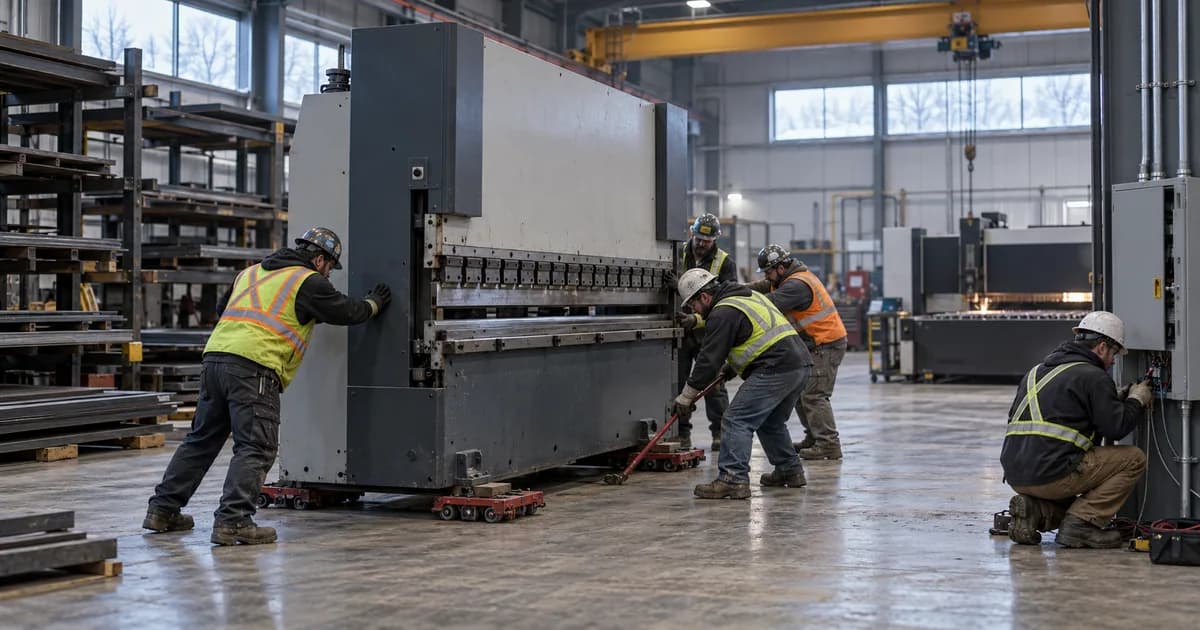
A Machine Tool Has to Be Unbolted Before Anyone Can Resell It
An excavator drives onto a trailer. A press brake does not. That one difference explains most of how a lender reads a fabrication equipment file.
Collateral is worth what it nets after it moves. A lender finances a machine on what it could recover if the loan went bad. For a self-propelled machine, that is roughly the auction price. For a machine tool, it is the auction price less disconnecting it, rigging it out of your building, trucking it and reinstalling it somewhere else. A lender does not need a published rule to see that the heavier and more specialised the machine, the more of its price disappears in that trip.
Standard machines hold value; special machines do not. A common brand and model with a widely used control has a deep pool of buyers. A machine built or modified for one product line has a shallow one. If a machine was customised for your work, the lender is financing something only a few shops could use.
The install is a cost you pay twice if you ever sell. Rigging, electrical work and foundations go into the building, not the machine. They earn their keep while you run it, and they are worth nothing to the next owner. That is why lenders treat them differently from the machine itself, and why the next section matters more than the rate.
The Install Is Not the Machine
Most equipment financing is sized to the equipment's price. Everything else on the project — what lenders and accountants call soft costs — is financed only where a lender chooses to finance it. Scotiabank put the problem plainly in its own commercial-banking advice: people "may struggle with the other expenses, such as site preparation, set-up and freight costs, which could be equal to the asset cost."
Here is how that plays out on one machine. The figures are illustrative, not a quote or a real customer's file.
| Cost line (illustrative) | Amount | What it is |
|---|---|---|
| Used 6 kW fibre laser, dealer price | $180,000 | The hard cost: the machine a lender can take back |
| Rigging, transport and placement | $9,000 | Getting it off the truck and onto your floor |
| Electrical: panel, disconnect, three-phase drop | $14,000 | Making your building able to run it |
| Installation, commissioning and training | $6,000 | Getting it to cut a saleable part |
| Chiller, fume extraction and nozzle kit hookup | $6,000 | The auxiliaries the quote listed separately |
| Whole project | $215,000 |
If the lender finances only the machine, the $35,000 of soft costs comes out of your cash, on top of whatever down payment the lender asks for on the $180,000. At 15% down, that is $27,000 plus $35,000: $62,000 out of pocket before the laser cuts its first part.
If the lender finances soft costs, the picture changes. BDC says its Equipment Loan covers up to 125% of the purchase price "to help cover extra expenses like shipping, installation and training." On a $180,000 machine, 125% is $225,000, more than the whole $215,000 project. Whether a particular file gets the full 125% is BDC's call, but the ceiling is published.
Key takeaway: Get every cost line on paper before you apply, and ask each lender which of them it will finance. Two offers at the same rate can leave you with very different amounts of cash.
Which Lenders Finance the Soft Costs
Three of Canada's larger lenders say outright that they finance more than the machine. None of them promises it on every file.
BDC. The Equipment Loan covers "up to 125% of the purchase price of new or used equipment," with the extra meant for "shipping, installation and training." BDC also says that if you qualify, "you may be able to postpone capital payments for up to 24 months at the start of the loan," followed by "a repayment period of up to 12 years." A capital-payment holiday matters on a machine tool, because the months between delivery and full production are the months with the least cash coming in. BDC lists "production line machinery," "automated equipment" and "robotics systems" among what it finances, and asks for 12 months or more of revenue.
RBC. RBC's equipment leasing page offers "up to 100% financing for the cost of the equipment you use in your business, including taxes and installation." On a lease, that can mean the install is inside the payment rather than in your cash. Our lease vs. finance guide covers how a lease is taxed differently from a loan.
Scotiabank. Its commercial-banking advice says: "we can provide financing for many of those 'soft costs,' to help preserve their working capital." That article dates from 2021, so treat it as a statement of how the bank thinks, and confirm the current terms with a banker.
Manufacturer and dealer programs. Several machine-tool builders run their own finance programs on new machines, sometimes in Canadian dollars. They exist to sell their own machines, so they are worth asking about on a new unit from a franchised dealer. They rarely help with a used machine, a different brand, or the electrician's bill. For how lender types compare on rate, see how Canadian equipment loan rates compare.
The Tax Year Starts When the Machine Can Make a Part
Shop machinery is not taxed like the iron in most of our guides, and the difference is worth knowing before you set a delivery date.
Manufacturing machinery has its own CCA classes. CRA puts machinery used in Canada "primarily in the manufacturing or processing of goods for sale or lease" in Class 53 at 50% when it was acquired after 2015 and before 2026, and in Class 43 at 30% otherwise. Earthmoving equipment such as excavators and dozers sits in Class 38. A press brake is not Class 38, whatever a contractor's accountant is used to.
Full first-year expensing for manufacturing machinery was proposed and introduced. Finance Canada's 2026 tax-expenditures report says the 2024 Fall Economic Statement "proposed to fully re-instate immediate expensing for manufacturing or processing machinery equipment (Class 53 and Class 43) acquired on or after January 1, 2025 and that becomes available for use before 2030," with a four-year phase-out after that. The same report says the measure was "introduced in Bill C-15," and that "as of December 31, 2025, this change has not been legislated." CRA records Bill C-15 as enacted on March 26, 2026, but CRA's own classes page still describes the new Class 53 treatment as "proposed changes." Treat full expensing on a 2026 machine as likely, not settled, and confirm it with your accountant before it drives your timing.
The proposed Mega Deduction sits on top. On September 15, 2026, Finance proposed a Productivity Mega Deduction for "most depreciable property that is acquired on or after September 15, 2026." It is a proposal, not law. Our year-end write-off guide covers how it works, which used machines qualify, and why a sole proprietor can get less from it than a corporation.
The year you get it is the year the machine can make a part. CRA's capital cost allowance folio gives an example that fits a fab shop exactly. A company's machinery was "delivered and installed in Year 1," but the production line went into service in Year 2. CRA's answer: because the machine "was capable of producing a commercially saleable product in Year 1," CCA could start in Year 1. Read the other way, a machine sitting on the floor waiting for power is not yet producing anything. The electrician's schedule can decide your tax year.
Construction is not manufacturing. The Income Tax Act says "manufacturing or processing does not include … construction." CRA's folio on manufacturing and processing adds that a shop making goods for another company under contract may still qualify, but that goods used to carry out a service "under a single contract for work and materials" are not considered manufactured for sale. A shop that cuts, bends and welds parts for sale is on firmer ground than one that fabricates and installs steel on site under one contract. Most fab shops do some of both. Ask your accountant how your mix is treated before you count on the manufacturing classes.
What Lenders Look At on a Fabrication Shop File
The order matters: pass/fail gates first, scored factors second, structure last. Why lenders check in that order has its own page, what a bank decline actually means. Here is how it plays out in a shop.
Revenue is a gate, not a factor. The underwriter sizes the payment against the deposits going into your business account. Our lender network currently looks for roughly $20,000 a month. Above that line the rest of the file gets weighed. Below it, the rest of the file does not get its turn, and a strong credit score will not substitute for it. If your work comes in big jobs, total twelve months of deposits and divide by twelve, and quote that figure, not your best month.
Who pays you matters almost as much as how much. A job shop that does most of its work for one manufacturer, one general contractor or one oil-and-gas customer has deposits only as durable as that relationship. Name your main customers and roughly what share of revenue each represents before you are asked. A spread of customers reads as a business; one large customer reads as a contract.
What the new machine does to the revenue. A lender will ask whether this machine replaces one you already run, takes work you currently send out, or opens work you do not do yet. Replacing an old machine or bringing outsourced work in-house is the easiest story to underwrite, because the revenue already exists. A machine bought for work you have not won yet is a forecast.
The machine itself. Brand, model, year, control, hours or cutting time where the control records it, and condition. Then the things specific to a machine tool: whether it is a standard configuration other shops could use, whether the control and its software come with it, and what tooling is included. A standard machine from a well-known builder is easier to finance than a special one, for the reasons in the first section.
Your certifications are evidence of your work. If you weld structural steel, Canadian Welding Bureau certification to CSA W47.1 decides which jobs you can bid. CWB's own page quotes the structural welding standard: "Fabricators and erectors responsible for welding structures fabricated or erected under this standard shall be certified by the Canadian Welding Bureau." A lender reads a current certification as a reason the revenue will continue.
Credit is weighed after all of that. It moves your rate and your down payment. It rarely decides a shop file on its own. If yours is bruised, our bad-credit financing guide covers what actually moves on a challenged file, and if the shop is under two years old, read financing for a newer business.
Government Money: When It Fits and When It Doesn't
Federal regional development agencies do fund shop equipment. The programs are built for growth projects, and most single-machine purchases will not fit them.
PrairiesCan (Alberta, Saskatchewan, Manitoba). The Business Scale-up and Productivity program "offers interest-free, repayable funding to incorporated businesses." The applicant guide lists capital costs such as "purchase of equipment and associated costs such as installation," with a minimum request of $200,000 and funding of "up to 50% of total eligible costs." The other half must come from a non-government source, such as your own cash or a lender. Applicants must be incorporated and in business in Canada for at least two years, and "priority will normally be given to companies with 20% year-over-year revenue growth."
PacifiCan (British Columbia). Its version of the same program offers interest-free repayable contributions of $200,000 to $5 million, but its page said "Not currently accepting applications" when we checked. FedDev Ontario lists its own Business Scale-up and Productivity stream as accepting applications, though that page was last updated in November 2024.
BDC's LIFT program. BDC offers loans of $350,000 to $5 million for productivity equipment, including "installation and integration costs," to Canadian businesses with at least $5 million in revenue, with preferential terms when the technology comes from Canadian suppliers.
What this means for one machine. Government funding is a fit when the machine is part of a larger, documented growth project and the shop is already growing. For a single used press brake or laser, an equipment lender is faster and asks less of you. The two can also work together: a lender can finance your half of an approved project.
Mistakes to Avoid When Financing Shop Equipment
Signing for the machine before you know what your building can run. A laser, a large press brake or a machining centre may need more electrical capacity than your shop has. Get the electrician and, if needed, the utility involved before you sign, because the power upgrade runs on their schedule, not yours, and it can decide both your start date and your tax year.
Financing the machine and paying for the install from your operating line. It works until a slow month. The install is a long-lived cost; paying it from short-term money squeezes your working capital in exactly the months the new machine is still ramping up. Ask for the soft costs to be financed with the machine.
Buying from a closing shop without a lien search. Machines from shops that are winding down are often still pledged to a lender. In Alberta, serial-number searches cover vehicles, trailers, boats, aircraft and farm tractors and combines, so a machine tool is normally searched under the seller's legal name. If the seller is a company, the bill of sale must come from the company. Our private-sale financing guide covers the search and the paperwork.
Assuming the control and software come with a used machine. Ask in writing what is included: the control, any software licences, the manuals and the tooling. A lender is valuing a working machine; one that needs a new licence or tooling before it can cut is worth less to them and to you.
Counting on the manufacturing tax rate for construction work. If most of your revenue is fabricate-and-install contracts, the manufacturing CCA classes may not apply the way you expect. Find out before the tax saving goes into your payment plan.
Comparing offers on rate alone. An offer that finances the soft costs at a slightly higher rate can leave you with tens of thousands more in working capital than a cheaper offer on the machine alone. Compare the cash you keep, not just the rate.
How to Strengthen a Fabrication Equipment Application
Tip 1: Send the whole project, itemised. The machine quote, the rigging quote, the electrical quote and the installation and training costs, each on its own line. It lets a lender say yes to the soft costs instead of guessing at them.
Tip 2: Show twelve months of deposits as one figure. Total them, divide by twelve, and give both numbers. Shop work is lumpy, and the monthly average is what the lender compares against the floor.
Tip 3: Show who pays you and what the machine changes. Your main customers, roughly what share of revenue each represents, and what the new machine does: replaces an old one, brings outsourced work in-house, or adds a capability. Recent invoices for work you currently send out are the strongest evidence a machine will pay for itself.
Tip 4: Include your certifications. Your CWB certification, quality-system registration or customer approvals. They are evidence the work continues.
Tip 5: Plan the commissioning date before the delivery date. The machine counts for tax from the year it can make a saleable part, and your payments may start before it does. Ask about a payment deferral if the install will take months; BDC publishes one of up to 24 months on capital.
Tip 6: Model the payment before anyone pulls your credit. Try the machine alone and the whole project in our equipment payment calculator, so you know what each version of the offer costs you each month. Already own machines outright and need cash for this one? A sale-leaseback on paid-off equipment is another route.
Sources
Every lender term, tax rule and program detail on this page was read from its Canadian publisher and is quoted so you can check it. Manufacturer finance programs are named here but not cited, because the ones we found are published by US entities.
BDC — Equipment Loan and LIFT (verified 2026-10-19)
"Our Equipment Loan covers up to 125% of the purchase price of new or used equipment" "125% of the purchase price of your equipment to help cover extra expenses like shipping, installation and training." "If you qualify, you may be able to postpone capital payments for up to 24 months at the start of the loan. This can be followed by a repayment period of up to 12 years."
The equipment list ("production line machinery," "automated equipment," "robotics systems") and the 12-month revenue minimum are on the same page — BDC, Equipment Loan. LIFT loan sizes, the $5 million revenue threshold and the inclusion of "installation and integration costs" — BDC, LIFT: productivity and advanced equipment.
RBC — equipment leasing (verified 2026-10-19)
"up to 100% financing for the cost of the equipment you use in your business, including taxes and installation"
— RBC Royal Bank, Equipment Leasing
Scotiabank — soft costs (published 2021-09-14, verified 2026-10-19)
"Often people only think of the equipment itself, but they may struggle with the other expenses, such as site preparation, set-up and freight costs, which could be equal to the asset cost. They might assume they have to use cash for these expenses, but we can provide financing for many of those 'soft costs,' to help preserve their working capital"
— Scotiabank, Knowledge Centre
CRA — CCA classes and available-for-use (verified 2026-10-19)
"Include in Class 53 with a CCA rate of 50% eligible machinery and equipment that is acquired after 2015 and before 2026 (that would generally otherwise be included in Class 29) to be used in Canada primarily in the manufacturing or processing of goods for sale or lease." "Include in Class 43 with a CCA rate of 30% eligible machinery and equipment used in Canada primarily to manufacture and process goods for sale or lease that are not included in Class 29 or 53."
— CRA, Classes of depreciable property. The Company B example ("capable of producing a commercially saleable product in Year 1") and the record that Bill C-15 was enacted on March 26, 2026 — CRA, Income Tax Folio S3-F4-C1, General Discussion of Capital Cost Allowance.
Finance Canada — full expensing for manufacturing machinery and the Mega Deduction (verified 2026-10-19)
"The 2024 Fall Economic Statement proposed to fully re-instate immediate expensing for manufacturing or processing machinery equipment (Class 53 and Class 43) acquired on or after January 1, 2025 and that becomes available for use before 2030, with a four-year phase out for property that becomes available for use after 2029 and before 2034. This measure was reconfirmed in Budget 2025 and introduced in Bill C-15"
— Finance Canada, Report on Federal Tax Expenditures 2026, Part 4. The Mega Deduction's "acquired on or after September 15, 2026" scope — Finance Canada, September 15, 2026.
What counts as manufacturing or processing (verified 2026-10-19)
"manufacturing or processing does not include (a) farming or fishing, (b) logging, (c) construction"
— Justice Laws, Income Tax Act, s. 125.1(3). Contract manufacturing (¶1.5) and the single-contract-for-work-and-materials rule from Will-Kare Paving (¶1.7) — CRA, Income Tax Folio S4-F15-C1, Manufacturing and Processing. That folio is written for the manufacturing and processing profits deduction; how it carries over to the CCA classes is a question for your accountant.
Government programs (verified 2026-10-19) PrairiesCan: "interest-free, repayable funding to incorporated businesses" and the 20% growth priority — PrairiesCan, Business Scale-up and Productivity; the $200,000 minimum, "up to 50% of total eligible costs" and "purchase of equipment and associated costs such as installation" — PrairiesCan, applicant guide. PacifiCan's "Not currently accepting applications" — PacifiCan, funding overview. FedDev Ontario's intake status (page dated 2024-11-18) — FedDev Ontario, Business Scale-up and Productivity.
Industry counts (2025 data, verified 2026-10-19)
"For this industry, 5,446 of establishments are non-employers or indeterminate and 7,929 have one or more employees."
— ISED, Canadian Industry Statistics, NAICS 332, from Statistics Canada data; the machine shop, turned product, and screw, nut and bolt group (NAICS 3327: 2,478 with employees) — ISED, NAICS 3327.
CWB certification and lien searches (verified 2026-10-19) The CSA W47.1 requirement as quoted on CWB Group, CSA W47.1 company certification. Alberta's serial-number search list — Government of Alberta, Find a personal property registration.
What is convention rather than citation
The worked example's cost lines and its 15% down payment are illustrative, not a quote, a rule or a real customer's file. The way a lender discounts a machine tool for the cost of moving it, and prefers standard machines to special ones, is how collateral is generally valued, not a published rule; no Canadian lender we found publishes an advance rate for machine tools. The order in which lenders check a file and the $20,000-a-month revenue threshold for our own lender network are directional practitioner conventions as of October 2026, not a quote or approval.
Tax treatment depends on your machine, your work and your circumstances. Full expensing for manufacturing machinery and the Productivity Mega Deduction are each described by their own publishers as proposals or changes in progress; confirm both with your accountant. Program terms and intake windows change; check the program page before you plan around it. This is general information, not financial, tax or legal advice.
Getting a Straight Read on Your Shop Equipment
Whether a fab shop file works comes down to four things: the whole project cost, not just the machine; your twelve-month deposits; who those deposits come from; and what the machine changes about your work. With those in front of someone, it is a short conversation, and a lot faster than finding out by applying three times.
Send us the quote: the machine, the install costs you know about, your province, and your last twelve months of deposits. We will tell you straight what a realistic structure looks like and which lenders are likely to finance the soft costs. No credit pull, and nothing to commit to.
Ready to move? Start an application. Want a quick read on the deal first? Try the financeability check. For the bigger picture on lenders, terms and the application itself, start with how to finance heavy equipment in Canada.
Already own equipment, or eyeing a different machine?
Frequently Asked Questions
Can I finance installation, rigging and tooling along with a CNC machine?
Often, but not with every lender, so ask before you apply. BDC says its Equipment Loan covers up to 125 percent of the purchase price of new or used equipment to help cover extra expenses like shipping, installation and training. RBC advertises equipment leasing of up to 100 percent of the cost of the equipment, including taxes and installation. Scotiabank has written that it can finance many of those soft costs. A lender that sizes the deal to the machine's price alone leaves the rigging, the electrical work and the tooling to come out of your cash, on top of the down payment.
What CCA class is a CNC machine or press brake in Canada?
If it is used in Canada primarily to manufacture or process goods for sale or lease, CRA puts it in Class 53 at 50 percent when acquired after 2015 and before 2026, and in Class 43 at 30 percent otherwise. Finance Canada proposed restoring full first-year expensing for Class 53 and Class 43 machinery acquired on or after January 1, 2025 that becomes available for use before 2030, and introduced it in Bill C-15. CRA's own classes page still describes the measure as a proposed change, so confirm the treatment with your accountant. Separately, the proposed Productivity Mega Deduction would cover most property acquired on or after September 15, 2026. Shop machinery is not Class 38, which is for earthmoving equipment.
Does a custom fabrication shop count as manufacturing or processing for tax purposes?
Sometimes, and the line matters. The Income Tax Act says manufacturing or processing does not include construction. CRA's folio on manufacturing and processing says a company that makes goods for another company under contract may still qualify, but that goods used to carry out a service under a single contract for work and materials are not considered manufactured for sale. A shop that cuts and bends parts for sale is on firmer ground than one that fabricates and installs steel on site. Ask your accountant how your mix of work is treated before you count on the manufacturing rate.
Can I finance a used machine bought at an auction or from a shop that is closing?
Yes. BDC says its Equipment Loan covers new or used equipment. A used machine tool from a closing shop needs two extra checks. First, search the personal property registry for liens: in Alberta, serial-number searches cover vehicles, trailers, boats, aircraft and farm tractors and combines, so a press brake or a CNC is normally searched under the seller's legal name. Second, if a company owns the machine, the bill of sale must come from the company. Our private-sale financing guide covers both.
Are there government programs that fund equipment for a machine shop?
Yes, but they are built for growth projects, not a single used machine. PrairiesCan's Business Scale-up and Productivity program offers interest-free, repayable funding to incorporated businesses, with a minimum request of $200,000, up to 50 percent of eligible costs, at least two years in business, and priority normally given to companies growing revenue 20 percent a year. PacifiCan's version of the program was not accepting applications when we checked. BDC's LIFT program targets businesses with at least $5 million in revenue. For one press brake or one used laser, ordinary equipment financing is the realistic route.
How much revenue does a fab shop need to finance equipment?
BDC lists 12 months or more of revenue as a minimum for its Equipment Loan. Our own lender network currently looks for roughly $20,000 a month in deposits into the business account. That figure is a floor, not a factor: the underwriter sizes the payment against your deposits, so above it the rest of the file gets weighed and below it the rest of the file does not get its turn. If your work is lumpy, total twelve months of deposits and divide by twelve.