
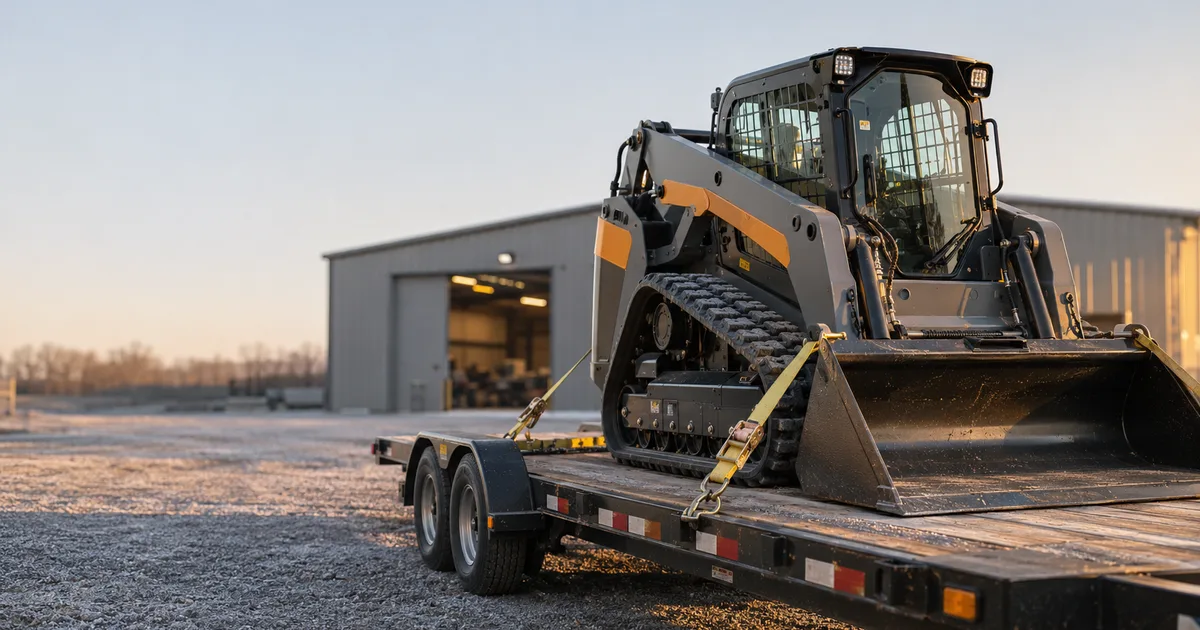
Your customer has picked the machine, shaken on a price and asked how the payments work. You send the deal to the manufacturer's finance program and it comes back declined. The machine is still in your yard, and the sale is now a credit question that you do not control.
Equipment vendor financing in Canada is financing arranged through you, at the point of sale, from one of three places: the manufacturer's captive finance company, a program you are signed up to, or an independent finance company, often through a broker. Whichever lender takes the file, your quote becomes part of it. The buyer's legal name, the serial number, the itemized price and a total that reconciles decide what gets financed and how fast you get paid. A clean quote cannot rescue a weak borrower, but a messy one can stall a strong one.
This guide is written for dealers and sales reps. If you are the buyer, our guide to financing heavy equipment in Canada covers the whole process from your side.
Three Ways a Dealer Sale Gets Financed in Canada
| Route | Who lends | What it is built for | Where it usually stops |
|---|---|---|---|
| Captive finance program | The manufacturer's own finance company | New machines of its own brand, strong credit, promotional rates | Older or other-brand machines, newer businesses, bruised credit |
| Dealer-enrolled program | A Crown corporation or bank that dealers sign up to, such as FCC for farm equipment | Its own sector or customer type, applied for at the dealership | Customers or equipment outside that sector or credit box |
| Independent finance company | A non-bank lender, often reached through a broker | Files the first two decline: used and older iron, challenged credit, specialized machines | Below its revenue floor, or when the machine cannot be valued |
The captive is the fastest and often the cheapest when the file fits. BDC's own advice to buyers is that "the deals on new equipment are generally very compelling when you're dealing with the manufacturer's finance company," because the manufacturer subsidizes the rate to move its machines. That is also why the captive's box is narrow: the subsidy exists to sell new units of its own brand to customers who will pay.
Dealer-enrolled programs fill a sector. FCC's Dealer Financing Program is the clearest Canadian example: a farmer buying new or used equipment from a participating dealer can get zero down on loans under $100,000, 10% down under $500,000, and terms up to 10 years, applied for at the dealership. Outside agriculture, banks run similar vendor programs for their dealer partners.
The captives are real Canadian lenders. Among them are John Deere Financial Inc., Caterpillar Financial Services Limited, Kubota Canada Ltd.'s retail finance division and VFS Canada Inc. (Volvo Financial Services). The wider industry is large: the Canadian Finance & Leasing Association reports $410 billion in assets financed in 2024, and counts manufacturers' finance companies, independent leasing companies and banks among its members.
The independent lender is where most declined files go. BDC is plain about why that route exists: "Manufacturers of unique or specialized equipment often don't have in-house financing companies," and on used equipment, vendor finance companies "typically charge higher interest rates and finance a lower percentage" of the cost. An independent lender prices those risks instead of declining them. It costs more than a promotional captive rate, and it is usually the difference between a sale and no sale.
Your Quote Is the First Page of the Credit File
A buyer thinks of your quote as a price. A lender reads it as a document. It is the only paper in the file that describes the collateral, and it is the figure every other number in the approval is checked against.
Three dealer-side files that have reached us since August show how much rides on it. All three are real; the details that would identify the businesses are left out.
- A new compact loader, referred by a franchised dealer's sales rep. The quote was clean and the machine was new, which removed most of the work a used or private-sale file needs: no appraisal gap, no lien search on the seller, no title question. The file turned entirely on the borrower. The rep's question was whether a stronger-credit partner could sign as guarantor in place of the owner with the weaker score. Lenders generally want every significant owner signing regardless of score, so a guarantor swap usually changes the rate, not who has to sign.
- A used European fiber laser, above $400,000, referred by a distributor. The buyer had been declined by two lenders. Reassembly on the buyer's shop floor was included in the invoice price. That is a soft cost inside the price of a machine, and whether a lender will finance it is a question to ask before the file goes in, not after. Our metalworking equipment guide covers which lenders publish soft-cost terms.
- A used scissor lift bought from a dealer, where the figures did not reconcile. The application showed a price of $28,350, a $3,000 down payment and $27,300 to finance. $28,350 less $3,000 is $25,350, so $1,950 was unexplained: taxes, a fee, or a typo. A lender will not approve a number it cannot trace back to the invoice, so the first question back to the buyer had to be which figure was right.
None of the three was about the dealer doing anything wrong. Each shows that the quote is read line by line, by someone who has never seen the machine.
What Lenders Look For on a Dealer Quote
The buyer's exact legal name. If the buyer is a corporation, the quote and the invoice go to the corporation, spelled the way it appears on its registration, not to the owner personally and not to a trade name. When the name on the invoice does not match the borrower on the credit application, the lender sends the paperwork back before it funds.
The serial number or VIN, year and hours. The serial number is how the lender registers its security interest against the machine, and the year and hours are how it decides the term. On a new unit, give the serial number as soon as one is assigned. On a used unit, give the actual hour meter reading, not "approx."
Price, taxes and every other charge on its own line. Freight, installation, attachments, extended warranty, documentation fees and GST, HST or PST should each be a separate line. Some lenders finance some of those charges and not others; itemizing lets them say yes to the parts they finance instead of declining the bundle. It helps the buyer too: the CRA counts "site preparation, delivery, installation, testing or other costs incurred to put the property into service" as part of a machine's capital cost, so their accountant needs those lines whether or not the lender finances them.
Whether it is a sale or a lease. The tax lands differently. On a conditional sale the GST/HST applies to the sale itself, up front. On a lease of more than three months, the CRA treats the agreement "as a series of separate supplies," so the tax is charged on each payment instead. The quote should match the structure the customer is actually signing.
The deposit, and whether it has been paid. A deposit already paid to you is part of the buyer's down payment, and the lender will want to see it on the invoice. A deposit "due on delivery" is not yet a down payment.
The trade-in, with its lien payout. If a trade-in is part of the deal, show its agreed value and, if it is financed, the payout owed to the lender that holds it. A trade-in with an outstanding loan is equity only after that loan is paid. Search the trade for registered liens before you value it, the same way a lender will.
The tax on the trade-in, done the right way for this buyer. When the buyer is a GST/HST registrant trading in a business machine, the CRA treats it as two separate sales: you charge tax on the full price of the machine you sell, and the buyer charges tax on the trade-in. Only when the person trading in does not have to charge tax, usually because they are not a registrant, do you charge tax on the net amount, the price less the trade-in allowance. The CRA's own example is equipment: new machinery sold for $50,000 with a $20,000 trade-in, tax charged on the full $50,000. Get the method wrong and the tax line, and with it the amount financed, is wrong.
The seller's legal name. The invoice should come from your dealership's legal entity, with your GST/HST registration number. On a consignment or brokered unit, say so; a lender will ask who holds title.
A total that reconciles. Price, less deposit and trade-in equity, plus taxes and financed charges, equals the amount financed. If it does not, the file waits until someone explains the difference.
How a Lender-Funded Sale Closes
1. Approval. The lender approves the customer for an amount, a term and conditions. The conditions are where the remaining work is: a down payment, a guarantor, proof of insurance, sometimes a site inspection on a large or specialized unit.
2. Documents. The lender sends the finance or lease agreement to the customer to sign. Your final invoice, matching the approval, goes to the lender at the same time.
3. Delivery and acceptance. The customer takes the machine and signs a delivery and acceptance form confirming that it arrived and is what they bought. This is the trigger for most lenders to release funds, and it is the step that protects both of you: the customer is confirming the machine, and you are getting paid for it.
4. Registration. The lender registers its security interest against the machine, and the clock starts when the customer takes possession. Outside Quebec, a lender financing the purchase holds a purchase-money security interest under the provincial Personal Property Security Act, which ranks ahead of the customer's existing lenders if it is registered within 15 days after the customer obtains possession: section 33(2) in Ontario, section 34 in Alberta, British Columbia and Saskatchewan. In Quebec, a reservation of ownership on equipment bought for a business must be published in the Register of Personal and Movable Real Rights (RDPRM), and it counts against third parties from the date of the sale only if it is published within seven days (Civil Code article 1745; articles 1847 and 1852 apply the same seven days to leasing and to leases over a year). That is why a lender wants the delivery date on the paperwork and does not like surprises about it.
5. Funding. The lender pays you, usually by wire or EFT, for the amount financed. The customer's down payment comes to you from the customer directly.
Do not release the machine before step 5 is confirmed unless you are prepared to carry the receivable yourself. A signed approval is not money.
When the Captive Says No
A captive decline tells you the file does not fit the captive's program. It does not tell you the customer cannot be financed. Captive programs are built around new units, strong credit and the manufacturer's promotional budget; a used machine, a business under two years old or a past credit problem can push a perfectly bankable customer outside them.
Ask why it was declined. Lenders check a file in an order: revenue and time in business are usually pass-or-fail gates, credit and the machine are scored, and the structure is negotiated last. Our page on what a bank or captive decline actually means walks through that order. The reason for the decline tells you which gate closed, and which lender is worth trying next.
Find out what the customer's business deposits each month. For the independent lenders we place with, the floor today is roughly $20,000 a month into the business account, because the underwriter sizes the payment against those deposits. Above that, the rest of the file gets weighed. Below it, the rest of the file usually does not get its turn. That figure is our own lender network's current minimum, not an industry standard.
Expect a different price, not a refusal. An independent lender may ask for more down or charge a higher rate than the captive's promotion. For most customers who were declined, the comparison that matters is not that rate against the promotional rate, it is that rate against not buying the machine. Our equipment payment calculator shows a customer what the difference is per month.
Mistakes to Avoid on a Lender-Funded Sale
Writing the price up to cover the down payment. Raising the invoice so that the lender's advance covers the buyer's down payment, or showing a deposit that was never paid, misstates the deal to the lender. It is the fastest way to lose a lender relationship, and it can be fraud. If the customer needs a smaller down payment, say so, and let the lender decide.
Invoicing the owner instead of the company. A quote made out to the owner, on a machine the corporation is buying, has to be redone before funding. Ask for the legal name at the quote stage.
Releasing the machine on an approval. Approvals carry conditions. Until the lender confirms funding, the machine is your inventory.
Forwarding the customer's information without consent. The Office of the Privacy Commissioner of Canada puts it directly: individuals expect that information they give one organization "will not be shared with another without their knowledge and consent." Get the customer's permission in writing before you send a name, a phone number, bank statements or a credit application to a broker or lender, or have the customer send it themselves.
Promising the customer an approval. Nobody can promise an approval before a lender has read the file. Tell the customer what you are doing, not what the lender will decide.
How to Get a Declined Customer a Second Look
Send the quote and the decline reason together. A broker or independent lender can tell in one read whether the file is worth pursuing, but only if it knows why the first lender said no.
Have the customer gather three to six months of business bank statements. Deposits decide most second-look files, and having the statements ready saves a full round of back-and-forth.
Know the ownership. Who owns the business, and in what shares. Lenders usually want every significant owner on the file, and it is better to know that before the documents stage than at it.
Say what the customer can put down. A larger down payment is the single most useful thing a borderline customer can offer, and it is better stated up front than discovered.
Let the customer make the first contact, or get their permission. It keeps you clear on privacy, and a customer who calls in themselves is already committed to the deal.
Sources
Every source on this page is Canadian, and each was read from its publisher on 2026-11-16.
BDC: what vendor financing is good at, and where it stops (verified 2026-11-16)
"Manufacturers of unique or specialized equipment often don't have in-house financing companies."
"The deals on new equipment are generally very compelling when you're dealing with the manufacturer's finance company," and vendor finance companies "typically charge higher interest rates and finance a lower percentage of the cost of used equipment," are from the same article. — BDC, Pros and cons of vendor financing for equipment purchases
Farm Credit Canada: Dealer Financing Program (verified 2026-11-16)
"Zero down payment for loans under $100,000"
The 10% tier under $500,000, terms up to 10 years and applying at the dealership are from the same page. — FCC, Equipment financing
Purchase-money security interests: the 15-day registration window (verified 2026-11-16)
"perfected before or within 15 days after, (i) the debtor obtained possession of the collateral"
— Ontario: Personal Property Security Act, R.S.O. 1990, c. P.10, s. 33(2). The same 15 days, for collateral other than inventory, is in British Columbia's Personal Property Security Act, R.S.B.C. 1996, c. 359, s. 34, Alberta's Personal Property Security Act, RSA 2000, c. P-7, s. 34 and Saskatchewan's Personal Property Security Act, 1993, s. 34.
Quebec: publication in the RDPRM within seven days (verified 2026-11-16)
"the reservation may be set up against third persons from the date of the sale provided the reservation of ownership is published within seven days."
— Civil Code of Québec, art. 1745. Articles 1847 (leasing) and 1852 (leases of more than one year) carry the same seven-day rule.
Canada Revenue Agency: GST/HST on leases and trade-ins (verified 2026-11-16)
"When you rent or lease goods for a period of more than three months, the agreement is treated as a series of separate supplies"
The two-transaction trade-in rule for registrants, the net-amount rule for non-registrants and the $50,000 machinery example are from the same guide. — CRA, RC4022 General Information for GST/HST Registrants. The statutory rule is Excise Tax Act s. 153(4).
Canada Revenue Agency: what counts as capital cost (verified 2026-11-16)
"site preparation, delivery, installation, testing or other costs incurred to put the property into service"
— CRA, Income Tax Folio S3-F4-C1, ¶1.45
Office of the Privacy Commissioner of Canada: consent to share (verified 2026-11-16)
"Individuals expect that the personal information they provide to one organization will not be shared with another without their knowledge and consent."
— OPC, Guidelines for obtaining meaningful consent
Canadian Finance & Leasing Association: industry size and membership (verified 2026-11-16) The $410 billion in assets financed in 2024 is from CFLA's "by the numbers" page in its 2025 Annual Report; the membership description is from About CFLA.
Captive finance company names John Deere Financial Inc. is named on Deere's Canadian credit application; VFS Canada Inc. in its Canadian privacy policy; Kubota Canada Ltd.'s retail finance division on kubota.ca. Caterpillar Financial Services Limited is named as the Canadian lender on Caterpillar's own pages, which are published by its US parent, so it is named here without a link.
What is convention rather than citation
The order in which lenders read a file, the $20,000-a-month figure (our own lender network's current minimum, not an industry standard), the documents lenders commonly ask for before funding, the delivery and acceptance step, and the point that lenders usually want every significant owner signing are directional practitioner conventions as of November 2026, drawn from our experience placing equipment files. Each lender sets its own conditions. The three dealer-side files are our own, with identifying details removed. Nothing here is legal or tax advice.
Getting a Straight Read on a Dealer-Referred File
If you have a customer the captive declined, send us the quote and what you know about the decline. We will tell you straight whether there is a lender for it, what it is likely to need, and how long it should take.
Send us the deal or call or text Darrell at 1 (780) 830-8726. If the customer wants to start on their own, they can apply here.
Already own equipment, or eyeing a different machine?
Frequently Asked Questions
What is vendor financing for equipment in Canada?
Vendor financing is financing arranged at the point of sale, through the dealer. It comes in three forms: the manufacturer's own finance company (the captive), a Crown or bank program that dealers sign up to, such as FCC's Dealer Financing Program for farm equipment, and an independent finance company the dealer works with, often through a broker. In every case the lender pays the dealer and the customer makes the payments.
Why do captive finance programs decline customers that other lenders approve?
Because a captive is built to sell its own brand's new machines to strong credit, and its best rates are subsidized by the manufacturer for exactly that. BDC notes that manufacturers of specialized equipment often have no in-house finance company at all, and that vendor finance companies typically charge more and finance a lower percentage on used equipment. A file outside the captive's box, such as an older machine, a newer business or bruised credit, is often still financeable by an independent lender that prices the risk instead of declining it.
What should a dealer quote include for equipment financing?
The buyer's exact legal name, the serial number or VIN, the year and hours, the price with taxes, freight, installation and other charges on separate lines, any deposit already paid, any trade-in with its lien payout, and the seller's legal name. Above all, the numbers have to reconcile: the price, less the deposit and trade-in, plus taxes and fees, has to equal the amount being financed.
When does the dealer get paid on a financed equipment sale?
Usually after the documents are signed and the customer confirms the machine has been delivered and accepted. Lenders commonly ask for a signed delivery and acceptance form, the final invoice and proof of insurance before they release funds to the dealer. Releasing the machine before the lender confirms funding puts the dealer's own money at risk.
Can a dealer send a customer's information to a broker or lender?
Only with the customer's consent. The Office of the Privacy Commissioner of Canada says organizations generally need meaningful consent to collect, use and disclose personal information. In practice, the simplest route is to have the customer send their own information, or to get written permission before you forward a name, a phone number or a credit application.