
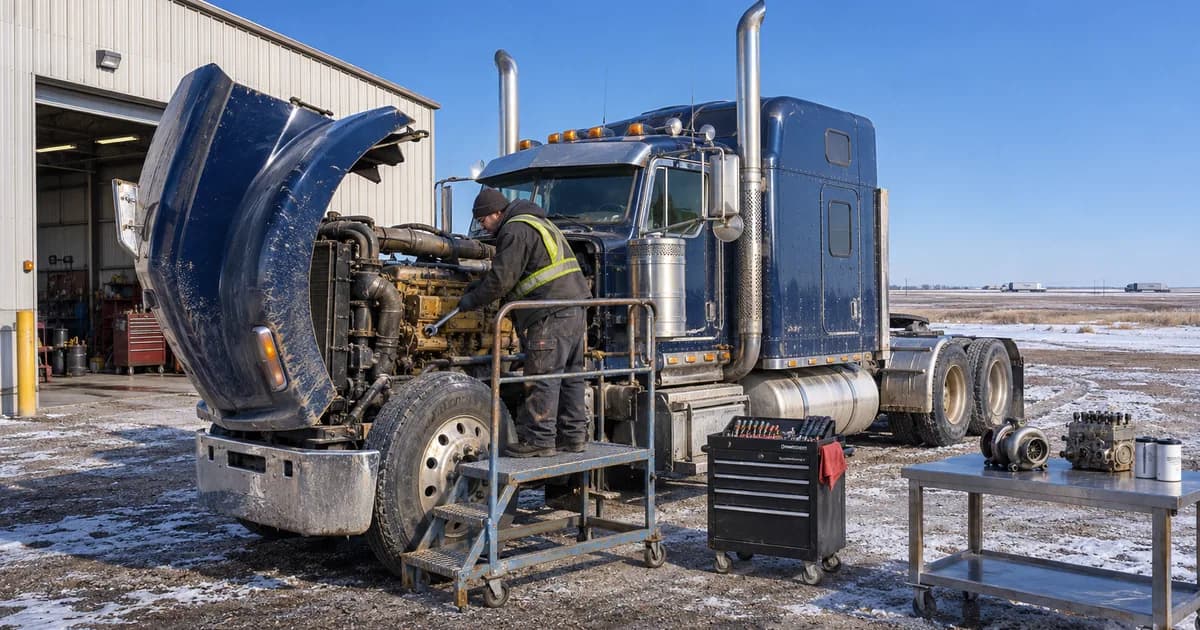
Five 2019 Peterbilt 389s are listed by Canadian dealers right now. One with 512,033 km and a fresh in-frame asks $229,900. One with 986,925 km and an engine rebuild asks $98,150. One with 1,169,909 km and an ad that says "Deleted Emissions" asks $139,900.
Same model, same model year, $131,750 apart, and the kilometres do not line up neatly with the price. What separates them is how much truck each one has left, and what it will cost to keep it earning — which is also what a lender is trying to work out.
A semi truck is not like the rest of the iron we finance. A highway tractor can use up 100,000 kilometres or more of its life every year, including the years you are still paying for it. Financing one is routine. This guide is about the part that is not: where the truck will be when the last payment comes due.
A Highway Tractor Uses Up Its Own Collateral
Here is how many kilometres used tractors in our Canadian dealer data have averaged per year, worked out from each listing's odometer and model year.
| Cab, as listed | Listings | Dealers | Middle half, km per year | Median, km per year |
|---|---|---|---|---|
| Sleeper | 169 | 12 | 60,400–143,100 | about 105,000 |
| Day cab or not stated | 53 | 9 | 41,600–84,100 | about 56,000 |
A rough estimate: odometer ÷ (2026 − model year + 0.5). Rebuilt engines and replaced odometers do not show up in it. Measured 2026-11-02.
The term decides where the truck ends up. Take a 2017 to 2019 tractor at the median for that group, about 734,000 km. At 105,000 km a year it passes 1.05 million km at the end of a 36-month term, 1.15 million at 48 months and 1.26 million at 60 months.
The truck is still working collateral at those numbers, but less of it. Of the 222 used tractors in our data with a stated odometer, 54 have already passed a million kilometres. They are for sale, and they ask less.
| Model years 2018–2022, by odometer | Listings | Dealers | Median ask | Middle half |
|---|---|---|---|---|
| Under 500,000 km | 23 | 6 | $184,900 | $139,900–$232,400 |
| 500,000–800,000 km | 38 | 7 | $122,250 | $76,588–$179,900 |
| 800,000–1.1 million km | 28 | 6 | $108,450 | $87,900–$135,013 |
| Over 1.1 million km | 10 | 3 | $64,950 | $49,150–$103,900 |
Asking prices, not transaction prices, measured 2026-11-02. Small groups: one dealer holds 60% of the top-kilometre row and 52% of the bottom-kilometre row. Newer trucks also sit in the lower-kilometre rows, so this mixes age with kilometres.
So a lender has two curves to compare. Your loan balance falls on a schedule. The truck's value falls with the odometer. A term that lets the second run ahead of the first is the one an underwriter wants to shorten, and it is also the one where you could owe more than the truck would sell for.
No Canadian lender we could find publishes a kilometre limit for highway tractors. BDC's advice is the closest thing to a rule: "Consider the useful life of your vehicle and match your amortization period with it." Run the arithmetic for your own truck and your own annual kilometres before you pick a term.
The Rebuild Falls Inside Your Term
Fifty-nine of the 260 tractor ads in our data mention a rebuild, an in-frame or an overhaul of some kind, which tells you how normal this is. Two give a clear figure for the engine, and a third shows the driveline can cost nearly as much:
- A 2015 Kenworth T880: "Engine rebuilt Nov-22 at 9,799hrs 318,840 kms. $61,968."
- A 2008 Peterbilt 388: "Rebuild cost: $50,000."
- A 2007 Western Star 4900EX: "Work order Sep 2022 at 22,271HRS $48,837 New Transmission, Flywheel, Clutch and motor mounts."
Those are three ads, not a price list. But they give you the size of the number, and it is the reason a fresh in-frame shows up in a listing headline. Engine work is one reason the 2019 Peterbilts above do not line up by kilometres alone. Spec and each dealer's pricing clearly play a part too.
Budget for it per kilometre. A $60,000 rebuild spread over five years at 105,000 km a year is about $0.11 per kilometre. Set beside the payment table below, that is roughly half of what the truck payment costs on a 60-month term. If the rebuild lands in your term and you have not set that money aside, you are carrying a repair bill and a truck payment in the same months. BDC puts it plainly: "You need to have repairs budgeted in your vehicle purchase."
What to ask the seller. When was the engine last rebuilt, at what kilometres and hours, by whom, and is there an invoice and a transferable warranty? We could not find a Canadian source we would trust for a rebuild interval, so ask your dealer or engine manufacturer about that specific engine.
What a Payment Looks Like Per Kilometre
Owner-operators are paid by the kilometre or the load, so the monthly payment only means something once it is in the same units. This table uses a $98,000 truck, about the median ask for a 2017 to 2019 tractor, with 15% down and $83,300 financed. It assumes 8,750 km a month, which is 105,000 km a year.
| Term | Km at last payment* | At 10% | At 15% | At 20% |
|---|---|---|---|---|
| 36 months | about 1.05 million | $2,688 ($0.31/km) | $2,888 ($0.33/km) | $3,096 ($0.35/km) |
| 48 months | about 1.15 million | $2,113 ($0.24/km) | $2,318 ($0.26/km) | $2,535 ($0.29/km) |
| 60 months | about 1.26 million | $1,770 ($0.20/km) | $1,982 ($0.23/km) | $2,207 ($0.25/km) |
*Starting from 734,000 km. Illustrative rates, not quotes. Excludes taxes, fees and insurance.
Term moves this number more than rate does. At 15%, going from 60 months to 36 adds about $0.10 per kilometre. On a 60-month term, going from 10% to 20% adds about $0.05. That does not make rate unimportant: the longer term still costs more in total interest, and it takes the truck further before you own it. But it is why a lender can often fit a payment by adjusting the term, and why a very short term on an older truck can fail even at a good rate.
Get a true rate before comparing offers. Some truck leases are quoted as a payment or a factor, with first and last payments up front, a purchase option at the end and sometimes a broker fee added to the amount financed. Each of those changes what you really pay, and a specialty lease can reach the high teens or more once they are counted. Our guide to lease rates and loan rates shows how to convert one to the other, and how Canadian equipment loan rates compare has the ranges by lender type.
Trucks of the same age are not priced alike. Among 2016 to 2021 trucks in our data, aerodynamic models such as the Cascadia, VNL, T680 and 579 ask a median of $39,900 (24 listings, 6 dealers), while traditional conventionals such as the 389, W900 and T800 ask $122,400 (76 listings, 8 dealers). The aero group has somewhat higher kilometres, 873,000 against 759,000 at the median, and the mirror comes from heavy-equipment dealers rather than fleet-truck sellers, so do not treat that gap as a market price. It does show why make and model belong in the conversation, not just the year.
What Tractors Ask in Canada Right Now
| Model years | Listings | Dealers | Median ask | Middle half | Median km |
|---|---|---|---|---|---|
| 2023 and newer | 31 | 6 | $199,900 | $167,500–$247,450 | 459,309 |
| 2020–2022 | 53 | 8 | $127,150 | $99,999–$179,900 | 701,250 |
| 2017–2019 | 63 | 10 | $98,150 | $49,995–$157,400 | 733,715 |
| 2014–2016 | 34 | 6 | $112,565 | $46,900–$129,900 | 840,612 |
Highway tractors in our dealer-inventory mirror, Canadian listings priced in Canadian dollars, measured 2026-11-02. Across all years the mirror holds 260 tractors from 15 dealers, and four dealers account for 224 of them. Dump, mixer, tank, roll-off and straight trucks were excluded by keyword, so a few vocational tractors remain. Median km counts only listings that state an odometer.
Read the 2014 to 2016 row carefully. Its median is higher than the newer 2017 to 2019 row, which reflects which trucks and dealers happen to be in the sample rather than older trucks being worth more. Our equipment value tool can give you a second read on a specific truck.
What Lenders Look At on a Semi Truck File
The order matters: pass/fail gates first, scored factors second, structure last. What a bank decline actually means explains why lenders check in that order. Here is how it plays out on a tractor.
Revenue comes first, and on a truck it is net of chargebacks. Our lender network currently looks for roughly $20,000 a month going into the business account. At 8,750 km a month, that is about $2.29 per kilometre in actual deposits. If your carrier takes fuel, insurance, plates or trailer rental off your settlement before paying you, the deposit is what is left, not the rate on your contract. Check your own statements before quoting a figure.
Who pays you matters almost as much as how much. A leased-on owner-operator may have one carrier behind every deposit, so the file is only as durable as that contract. Have the signed agreement ready, along with how long you have run for that carrier and what it can deduct. We could not find a federal or provincial rule in Canada that sets what an owner-operator contract must contain, so read yours closely.
Are you really running a business? Ottawa has been inspecting "Driver Inc." arrangements. A federal Labour Program briefing note from February 2026 says "worker misclassification is illegal. All workers are presumed to be employees unless proven otherwise," and describes incorporated drivers who "typically operate the transport carriers' vehicles and exercise little to no control over their work." Owning your own truck is on the right side of that line, but it does not settle it. The Labour Program's example of an independent contractor owns her truck, pays its operating costs, advertises her business, works for various clients, negotiates a flat rate per trip and can hire her own helpers. If you are buying a truck to run for one carrier under that carrier's direction, talk to your accountant or a lawyer before you sign. Those examples are written for federally regulated carriers.
Can the truck legally go to work? In Ontario, a truck with a registered gross weight over 4,500 kg needs a Commercial Vehicle Operator's Registration (CVOR). In Alberta, a truck registered at 11,794 kg or more operating only within the province needs a Safety Fitness Certificate. In BC, a commercial vehicle licensed over 5,000 kg needs a National Safety Code certificate. Federally regulated drivers who keep daily logs must use a certified electronic logging device, which Transport Canada has required since June 12, 2021, with an exemption for vehicles "manufactured before model year 2000."
Then the truck. Year, make, model, kilometres and engine hours, as on any working truck. Our log truck financing guide explains why a working truck is read on both. For a tractor, add the engine history and the emission system.
Credit is weighed after all of that. It moves your rate and your down payment. Many lenders in this market want a personal guarantee, so your personal credit counts even if a corporation is buying. If yours is bruised, our bad-credit guide covers what actually moves on a challenged file. If you are new to this, financing for a newer business covers what stands in for operating history.
Structure comes last. Term, down payment and first and last payments are the adjustable parts once the gates are cleared. BDC warns that "Loans that cover 100% of the purchase often end up being more costly," and says equipment loans can run up to 12 years, though that top end should not be assumed for an older highway truck.
Red Flags in a Used Tractor Listing
"Deleted" emissions. Thirty-one of the 260 tractor ads in our data, from three dealers, use the word. Ontario's Highway Traffic Act prohibits "removing, bypassing, defeating or rendering inoperative all or part of a motor vehicle's emission control system," with fines from $400 to $20,000, and BC requires heavy diesels on its highways to meet its diesel emission standards. A truck you cannot legally run is weak collateral. Price the restoration into your offer and ask about financing before you commit.
An odometer nobody will stand behind. One dealer's listings give the reading under the label "kilometer - not verified," on 66 of the 260 tractors. Another ad, for a 2008 Peterbilt 388, says "437,287 km showing on odometer (est 800,500 km total)." Those may be honest disclosures, but they leave the verifying to you. Compare the odometer with the engine hours and the service records.
Kilometres with no engine history. Past about a million kilometres, a truck with no record of engine work is an open question, and a truck with a rebuild invoice is a much easier one. An appraiser will read them differently, and so should you.
A low price with a problem in the ad. One 2008 day cab in our data asks $20,000 and says "Twisted Frame" in its own listing. Read the whole ad before you get attached to the price.
A private seller that is a company. Expect a lender to want the current registration and the registered owner clearly identified on a private sale, and the bill of sale should come from the company if the company owns the truck. In Ontario, a "heavy truck (empty weight of 2,200 kg or more)" can be sold without a Used Vehicle Information Package, so do not count on getting one. Our private-sale guide covers the lien search and the appraisal gap.
How to Strengthen a Semi Truck Application
Tip 1: Send the kilometre math with the file. Current odometer, your annual kilometres and where the truck lands at the end of the term you want. It answers the underwriter's first question before it is asked, and it shows you have already thought about the truck's life.
Tip 2: Send your settlement statements, not just the contract rate. Three to six months of settlements alongside your bank deposits show what actually reaches the account after deductions. Total twelve months of deposits and divide by twelve if your work is seasonal.
Tip 3: Document the engine. Rebuild invoices, the shop's name, the kilometres and hours at the rebuild, and any warranty that transfers.
Tip 4: Get the vendor paperwork right. BDC says banks "will ask for a quote signed by the vendor and the buyer" with "all relevant vehicle information (model, serial number, mileage etc.)." On a new truck, expect a lender to ask for the New Vehicle Information Statement. On a private sale, expect it to ask for the current registration.
Tip 5: Have your authority and insurance lined up. Your CVOR, Safety Fitness Certificate or NSC number, plus an insurance quote. A truck that can go to work the week it funds is an easier file.
Tip 6: Compare two trucks before anyone pulls your credit. Try a newer truck and an older one side by side in our equipment payment calculator, then divide each payment by your monthly kilometres.
Tip 7: Ask your accountant about Class 16 before you sign. A truck used in a business that includes hauling freight can qualify for Class 16 at 40%; otherwise it is generally Class 10 at 30%. Our year-end write-off guide covers the timing rules and the proposed Productivity Mega Deduction, which is not yet law.
Sources
Every regulatory figure and lender statement on this page was read from its Canadian publisher. Where a question has no Canadian source we could find — a kilometre limit, a rebuild interval, a rule for owner-operator contracts — we say so rather than borrow an American figure.
BDC — How to finance a truck or trailer purchase (published 2025-03-03, verified 2026-11-02)
"BDC routinely finances used trucks." "Consider the useful life of your vehicle and match your amortization period with it"
The 100%-financing, repair-budget, signed-quote and 12-year statements come from the same article. — BDC
Employment and Social Development Canada — driver misclassification (verified 2026-11-02)
"worker misclassification is illegal. All workers are presumed to be employees unless proven otherwise."
— Question Period Note, February 12, 2026. The independent-contractor example, which concludes "These factors support that Claudie is an independent contractor," is from the Labour Program's awareness kit.
Transport Canada — electronic logging devices (verified 2026-11-02)
"As of June 12, 2021, the Regulations have made ELDs mandatory."
— Transport Canada, ELD handout for motor carriers and drivers
Government of Ontario — Used Vehicle Information Package (verified 2026-11-02) The exemption for a "heavy truck (empty weight of 2,200 kg or more)" — Government of Ontario
Operating authority (verified 2026-10-05) Ontario CVOR for trucks "with a registered gross weight (RGW) or actual weight over 4,500 kg" — Government of Ontario. Alberta Safety Fitness Certificate for "a truck or trailer … with a registered weight of 11,794 kg or more, operating solely within Alberta" — Government of Alberta. BC NSC certificate for "commercial vehicles licensed with a gross vehicle weight of more than 5,000 kg" — CVSE.
Emission tampering (verified 2026-10-05) Fines are "not less than $400 and not more than $20,000" — Ontario e-Laws, Highway Traffic Act, s. 75.1. BC's diesel emission standard is in Division 40A of the Motor Vehicle Act Regulations.
Tax — CCA classes and the proposed Productivity Mega Deduction (verified 2026-10-05) Class 16(g) covers "a truck or tractor designed for hauling freight" over 11,788 kg gross vehicle weight rating — Justice Laws, Income Tax Regulations, Schedule II. The proposal — Finance Canada.
IronFinance first-party inventory data (measured 2026-11-02) Listing counts, quartiles, kilometre estimates and quoted ads come from IronFinance's own normalized dealer-inventory mirror, Canadian listings priced in Canadian dollars, with dealer counts disclosed. Medians and quartiles are computed as statistical percentiles. Asking prices are not transaction prices. Odometers are as advertised and are not verified by us. The mirror covers heavy-equipment dealers rather than fleet-truck sellers, so it leans toward conventional and heavy-spec trucks.
What is convention rather than citation
The order in which lenders check a file, the $20,000-a-month threshold for our own lender network, what we say about first-time buyers, down payments, personal guarantees, settlement statements, the vehicle paperwork lenders ask for, how an appraiser reads a truck's engine history and where specialty lease pricing can land are directional practitioner conventions as of November 2026, drawn from our experience placing equipment files. They are not a published rule, a quote or an approval. Tax treatment depends on your truck and your business, and the Productivity Mega Deduction is a proposal. Labour classification turns on your own facts. This is general information, not financial, tax or legal advice.
Getting a Straight Read on Your Semi Truck
Whether a tractor file works comes down to four things: the truck's kilometres and engine history, the term you need, what actually reaches your account each month, and who it comes from. With those in front of someone, it is a short conversation.
Send us the listing — the truck, your province, your annual kilometres and your last twelve months of deposits — and we will tell you straight what structure looks realistic and where the appraisal is likely to land. No credit pull, and nothing to commit to.
Ready to move? Start an application. Buying a vocational truck instead? Read our dump truck or log truck guides.
Already own equipment, or eyeing a different machine?
Frequently Asked Questions
Is it hard to finance a semi truck in Canada?
Not if the truck, the term and the revenue line up. BDC says it routinely finances used trucks. What makes a highway tractor file hard is usually one of three things: a term that runs the truck well past a million kilometres, deposits that do not reach the lender's floor (our lenders look for roughly $20,000 a month), or a first-time buyer with no operating history. Bruised credit moves the rate and the down payment, and it rarely decides the file alone.
What credit score do I need to buy a semi truck in Canada?
There is no single minimum that applies across lenders. As a practitioner convention, banks and manufacturer finance arms want strong scores, equipment finance companies work through the middle, and specialist lenders take lower scores with more money down. Lenders in this market also lean on the personal guarantee, so your personal credit counts even when a corporation buys the truck. Revenue is checked ahead of credit, so a good score will not carry deposits that fall below the floor.
What is a good interest rate for a semi truck in Canada?
A good rate is one you have converted to an all-in annual figure. Our rate guide shows tiers from the single digits for strong bank files to the low 20s for rebuilding credit, and an older or high-kilometre truck pushes a file upward. Some truck leases are quoted as a payment or a factor instead of a rate, and first and last payments, a purchase option and any broker fee all change the true cost. In our experience, a specialty lease can reach the high teens or more once those are counted. Ask for the all-in number.
How much is a monthly payment on a semi truck?
On a $98,000 truck, about the median ask for a 2017 to 2019 tractor in our data, with 15% down, the payment is about $1,982 a month over 60 months at an illustrative 15%, or $2,888 over 36 months. At 8,750 km a month, that works out to about $0.23 and $0.33 per kilometre. Choosing the term moved the cost per kilometre more than a five-point rate change did in our example. These are not quotes and they leave out taxes and fees.
Can a first-time owner-operator get semi truck financing?
Yes, but it is the hardest version of this file because there are no deposits to read. Expect a lender to look for your years behind the wheel, a signed contract or letter from the carrier you will run for, a larger down payment, and a newer truck on a shorter term. Line up your operating authority and insurance before you need the truck to earn. No Canadian lender we could find publishes a standard for first-time buyers, so treat this as convention.
What CCA class is a semi truck in Canada?
Usually Class 16 at 40%, if it is a truck or tractor designed for hauling freight, primarily used in a business that includes hauling freight, with a gross vehicle weight rating over 11,788 kilograms. A truck that misses those tests generally falls to Class 10 at 30%. The Productivity Mega Deduction that Finance Canada proposed on September 15, 2026 could allow immediate expensing, but it is a proposal, not law. Confirm your own position with your accountant.