
You have been hauling logs for someone else and it is time to own your own rig. Or maybe you run a logging operation and need to add a truck to your fleet instead of relying on contract haulers. Either way, financing a logging truck in Canada has its own set of considerations that are different from financing a regular highway tractor or a piece of heavy equipment.
Log trucks live a hard life. They run loaded on logging roads, deal with extreme weather, and operate in conditions that would destroy a standard highway truck in a few seasons. Lenders know this, and it shapes how they evaluate log truck deals.
Here is what you need to know to get your log truck financed.
Log Truck Brands and What They Cost
The Canadian logging industry is dominated by a few truck brands that have proven they can handle the work. Lenders have strong preferences for these brands because they hold value and have established dealer networks.
Kenworth T800 and T880
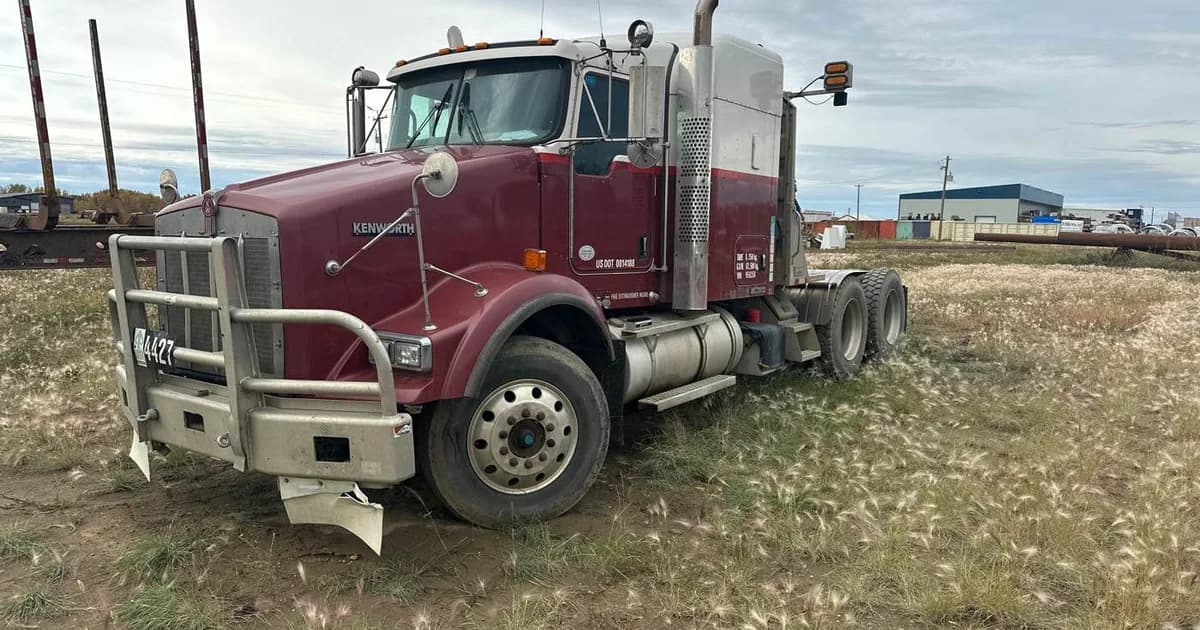
The Kenworth T800 has been the backbone of Canadian log hauling for decades. The newer T880 is gradually replacing it. These trucks are built for off-highway and vocational work with heavy frames, set-back axles, and configurations designed for log bunks and trailers.
| Age | Typical Mileage/Hours | Price Range (Rigged) |
|---|---|---|
| New (2025-2026) | 0 | $280,000-$380,000 |
| 2022-2024 | 50,000-200,000 km | $220,000-$310,000 |
| 2019-2021 | 200,000-450,000 km | $150,000-$240,000 |
| 2016-2018 | 400,000-700,000 km | $90,000-$160,000 |
| 2013-2015 | 600,000-900,000 km | $55,000-$100,000 |
To put real Canadian numbers on this, here is a snapshot of live BC dealer listings in mid-2026 (International Machinery Sales, Maple Ridge, BC): a 2021 Kenworth T800 tri-drive day cab, ~447,000 km with a Cummins X15, listed at $174,500 CAD; a 2018 Kenworth T880 tri-drive, ~425,000 km, at $121,500 CAD; and a 2019 T880 tri-drive, ~459,000 km, at $109,500 CAD. These are heavy-vocational, log-haul-capable tri-drive chassis (double frame, lockers) rather than fully rigged trucks with bunks and scales, so a finished log rig will run higher — but they anchor what the underlying truck costs in the Canadian market.
Peterbilt 367 and 567
Peterbilt trucks are popular in logging, particularly in western Canada. The 367 was a logging favourite for years, and the 567 is its current replacement. Similar pricing to Kenworth, with strong resale values — recent BC dealer listings put 2022 Peterbilt 367 day cabs around $130,000 CAD, and in the national market the 567 spans roughly $60,000 to $283,000 CAD depending on age and configuration.
Western Star 4900
The Western Star 4900 series has a loyal following among log haulers, especially in BC. Built in Portland, Oregon (formerly in Kelowna, BC), these trucks are engineered for heavy vocational work. Pricing is comparable to Kenworth and Peterbilt.
Key takeaway: Stick to Kenworth, Peterbilt, or Western Star for the easiest financing path. These brands have the strongest resale values and the widest lender acceptance. International, Mack, and Freightliner are also used in logging but may face slightly more lender scrutiny for this specific application.
"Rigged" pricing in the table above includes the truck, log bunks, and basic configuration for log hauling. Trailers (jeep and pole trailer combinations) are often financed separately or as part of the package. A complete log truck and trailer setup can run $350,000-$500,000+ new.
What Lenders Evaluate on Log Trucks vs. Equipment
Log truck financing falls somewhere between traditional truck financing and equipment financing. Here is what lenders focus on.
Mileage vs. Hours
Unlike heavy equipment where hours are the key metric, trucks use both mileage and engine hours. Logging trucks complicate things because they accumulate engine hours faster relative to mileage than highway trucks. A log truck might show 400,000 km but 12,000 engine hours because of time spent idling at loading sites, crawling on logging roads, and waiting at the mill.
Lenders who understand logging know to evaluate both numbers. A truck with 300,000 km and 8,000 engine hours has been working harder than a highway truck with 300,000 km and 5,000 engine hours.
The ranges below are a working rule of thumb, not a lender rate sheet — the important point is that there is no universal maximum-kilometre cutoff on a commercial truck. Approval turns on evidence and how the deal is structured, not a single odometer number. What is close to a hard rule: as a truck approaches roughly one million kilometres, most lenders will want to see a documented engine rebuild invoice before they finance it. That is not a dealbreaker — a rebuild on these engines typically runs about $26,000 to $53,000, and the rebuild itself is often financeable.
| Metric | Lender Comfort Zone | Gets Cautious | Difficult to Finance |
|---|---|---|---|
| Mileage | Under 300,000 km | 300,000-600,000 km | Over 600,000 km |
| Engine hours | Under 8,000 | 8,000-12,000 | Over 12,000 |
| Age | Under 5 years | 5-8 years | Over 8 years |
Truck Condition and Maintenance
Log trucks take a beating. Frame cracks, suspension wear, transmission problems, and differential issues are common in trucks that have been running logging roads for years. Lenders who know the industry will ask about:
- Engine condition. Has the engine been rebuilt or is it original? A rebuilt engine with documentation can actually be a positive for financing because it means the truck has had major maintenance investment.
- Frame integrity. Frame cracks are common on logging trucks and expensive to repair. A truck with documented frame repairs or no frame issues is more attractive.
- Transmission and drivetrain. Logging applications are brutal on transmissions, especially for trucks running steep terrain. An 18-speed Eaton Fuller or an Allison automatic that has been recently serviced gives lenders comfort.
- Safety equipment. Log trucks need to meet federal and provincial safety standards. A current CVIP (Commercial Vehicle Inspection Program) or equivalent provincial inspection is often required before a lender will fund the deal.
Your Hauling Experience
Lenders want to know you are not going to destroy their collateral. A driver with 5+ years of log hauling experience is a better risk than someone transitioning from highway trucking. If you are new to log hauling specifically, having worked in the logging industry in another capacity (equipment operator, landing hand, etc.) helps demonstrate industry knowledge.
Seasonal Revenue Challenges
Log hauling in Canada is inherently seasonal. Spring breakup can shut down operations for 4-8 weeks across much of the country. Fire season can halt hauling. Mill curtailments can reduce demand. Winter-only operations in northern regions concentrate all revenue into a few months.
Lenders address this in several ways.
Stronger cash-flow scrutiny. A logging lender looks harder at whether your revenue can carry the payment through the off-season than a highway-trucking lender would. Expect them to want evidence that a shortened hauling season still leaves room to service the debt — the exact coverage ratio a given lender uses is not published and varies by lender and deal.
Seasonal payment structures. Some lenders offer payment plans where you make larger payments during cutting season and reduced, skipped, or zero payments during spring breakup. This is not standard — you have to ask for it, and not all lenders offer it. Farm Credit Canada (a Crown corporation), John Deere Financial's forestry program, and several specialized forestry/equipment lenders advertise seasonal, step-up, or skip-payment schedules. A broker who works in the forestry space knows which lenders do.
Cash reserve expectations. Some lenders want to see a cushion of reserves before they will fund a log truck deal, so you can make payments through the slow season without defaulting. There is no fixed number every lender applies — the point is to show you have planned for the months when the trucks are parked.
Key takeaway: Before applying for log truck financing, make sure you can demonstrate that your cash flow covers 12 months of payments even if your hauling season is only 8-9 months. Bank statements showing reserve management are powerful documentation.
For a broader view of logging equipment financing including skidders, bunchers, and processors, see our complete logging equipment financing guide.
Owner-Operator Considerations
Many log truck drivers are owner-operators — they own their truck and haul under contract for a logging company or directly for a mill. Financing as an owner-operator has specific challenges.
Personal credit is everything. As a sole proprietor or small-company owner-operator, your personal credit is the primary underwriting factor. Lenders will pull your personal credit report and use it as the basis for the decision. Our guide for sole proprietors goes deeper on this topic.
Contract documentation matters. A signed hauling contract with a reputable logging company or mill is one of the strongest things you can include in your application. It shows the lender exactly how much revenue you expect and from whom. Even a letter of intent or a verbal commitment documented in writing helps.
Revenue per load economics. Lenders who understand log hauling know the economics. A typical log truck in BC might haul 4-6 loads per day at $80-$150 per load depending on distance and terrain. In Ontario, loads might be shorter but more frequent. Show the lender that the math works — that your gross hauling revenue covers the truck payment, fuel, insurance, maintenance, and still leaves a living.
Here is a basic owner-operator economics breakdown for a log truck. Treat these as illustrative planning figures, not verified market rates — per-load pay and loads per day swing widely by haul distance, terrain, and mill. For a genuine anchor, BC's Truck Loggers Association published all-found operating rates (what it costs to run the truck, before the operator's own income) of roughly $147 to $183 per hour in its 2019/2020 rate model, declining with truck age — dated now, but a real Canadian reference point for the order of magnitude.
| Revenue/Cost Item | Monthly Estimate |
|---|---|
| Gross hauling revenue (20 working days, 5 loads/day, $100/load avg) | $10,000 |
| Fuel | $3,500-$5,000 |
| Truck financing payment | $2,500-$5,000 |
| Insurance (truck + liability) | $800-$1,500 |
| Maintenance reserve | $1,000-$2,000 |
| Tires reserve | $300-$600 |
| Licensing, permits, scales | $200-$400 |
| Net before income/personal draws | $500-$1,700 |
The margins are tight on a single truck. This is why lenders want to see strong revenue and low personal overhead before financing a log truck for an owner-operator. If the margins shown above look thin, remember that these are conservative estimates — many haulers run more loads per day or command higher rates. But it illustrates why lenders scrutinize log truck deals.
Insurance Requirements
Log truck insurance is more expensive than standard highway truck insurance, and lenders require proof of insurance before releasing funds.
Minimum coverage. Most lenders require at minimum $2 million liability coverage. Some require higher limits depending on the province and the roads you will be operating on.
Equipment-specific coverage. The truck, bunks, and trailer need to be covered for their replacement value. If you are financing the rig for $250,000, the lender wants insurance that covers at least that amount.
Cargo insurance. Some mills and logging companies require their haulers to carry cargo insurance. Even if it is not lender-required, it protects you if a load shifts or is damaged in transit.
Cost expectations. Log truck insurance in Canada is expensive, and quotes vary widely — commonly in the low-to-mid five figures per year, and higher for new operators with under two years of experience. Reliable published Canadian figures specific to log hauling are scarce, so treat any single number as a starting estimate and get a real quote for your truck, province, and driving record before you build it into your payment math.
Typical Financing Terms for Log Trucks
To read the numbers below, start with the rate environment. As of mid-2026 the Bank of Canada has held its overnight rate at 2.25% (its fifth consecutive hold), which puts bank prime at 4.45%. Against that backdrop, log-truck rates run roughly 6.5% to 10% at the bank tier for the strongest files, 8% to 14% through equipment-finance lenders, and 12% to 22% with private lenders for challenged credit. Down payments are typically 15-30% — but note that the 10-15% best case in the table below is really for established operators and fleets with strong credit and a hauling history. A first-time owner-operator should plan on 15-25% down even with clean personal credit.
One option worth knowing about is BDC (the federal Business Development Bank of Canada), which can finance up to 125% of a purchase — rolling in soft costs — with no mandatory down payment assessed case by case. BDC does not publish a log-truck rate, and for trucks it amortizes over a shorter roughly six-to-seven-year window rather than the twelve years it allows on other equipment, but it is a genuine avenue for operators who do not fit a bank's box.
Here is what to realistically expect based on different scenarios.
| Scenario | Down Payment | Rate | Term | Monthly Payment |
|---|---|---|---|---|
| New Kenworth T880, strong credit, 5+ years experience | 10-15% | 7-9% | 72 months | $4,800-$5,800 |
| 2022 Peterbilt 567, good credit, established hauler | 10-15% | 8-10% | 60 months | $4,200-$5,200 |
| 2019 Western Star 4900, fair credit, 3 years experience | 15-20% | 10-13% | 48-60 months | $3,200-$4,500 |
| 2016 Kenworth T800, newer business, decent credit | 20-25% | 12-15% | 42-48 months | $2,400-$3,200 |
| Older rig (2013-2015), credit challenges | 25-35% | 14-18% | 36-42 months | $1,800-$2,600 |
These figures assume a fully rigged truck (chassis, bunks, basic accessories) without a trailer. If you are financing the trailer as well, add the trailer cost to the total and adjust accordingly. Some lenders will bundle truck and trailer into one deal. Others prefer to do them separately.
Documentation Checklist for Log Truck Financing
Getting your documents together before you apply speeds up the process and shows the lender you are organized. Here is what to have ready.
- Two years of personal tax returns (T1) or business financials
- Three months of bank statements (personal and business if applicable)
- Current credit bureau report (optional but helps you know where you stand — see our credit score guide)
- Driver abstract (recent, within 90 days)
- Valid Class 1 or Class 3 licence (depending on province)
- Hauling contract or letter of intent from customer
- Insurance quote or current insurance certificate
- The truck's VIN (Vehicle Identification Number) and specifications
- Current CVIP or safety inspection
- Down payment proof (bank statement showing available funds)
Key takeaway: The more documentation you bring to the table upfront, the faster and smoother the financing process. Lenders who specialize in logging truck financing know exactly what they need, and having it ready demonstrates professionalism and preparedness.
Tips for Getting the Best Log Truck Financing Deal
Shop the truck before you shop the financing. Know exactly what truck you want, its VIN, its price, and its condition before approaching lenders. A specific deal is easier to underwrite than a vague "I want to buy a log truck."
Get the truck inspected. A $500-$800 mechanical inspection on a used log truck can reveal issues that save you $20,000+ in repairs. It also gives the lender confidence in the collateral. Frame, engine, transmission, differentials, and all safety systems should be checked. For the broader picture on how Canadian lenders approve used trucks and heavy equipment by age, mileage, and credit tier, see our used heavy equipment financing guide. If you are a first-time owner-operator, our how to start a logging truck business guide walks through the full startup picture.
Negotiate the purchase price before applying. Lenders evaluate your deal based on the price you are paying relative to the truck's market value. If you negotiate a good price, the loan-to-value ratio improves and you may get better terms.
Build relationships with mills and logging companies before buying. Having a hauling contract in hand before you own a truck is the ideal scenario. Some lenders will not fund an owner-operator log truck without a confirmed revenue source.
Consider buying from a dealer rather than private sale. Dealer trucks are typically inspected, come with some warranty, and the financing process is smoother because dealers work with lenders regularly. Private sales require more documentation and due diligence but can offer lower prices.
Sources: Bank of Canada (June 2026 rate decision), BDC, International Machinery Sales (BC dealer listings), MarketBook.ca, Mehmi Group, Truck Loggers Association of BC (2019/2020 rate model). Rates and prices verified June 2026; BC hourly rates are from the 2019/2020 TLA model and are dated.
Get Moving on Your Log Truck
A logging truck is a proven revenue generator for the right operator with the right contract. The financing is there — you just need to find the right lender who understands the logging industry and your specific situation.
If you are ready to explore your log truck financing options, reach out to IronFinance. We work with lenders across Canada who specialize in forestry and vocational truck financing. Tell us about the truck, your experience, and your hauling contracts, and we will find the right fit. No runaround, just real options.
Already own equipment, or eyeing a different machine?
Frequently Asked Questions
What credit score do I need to finance a logging truck in Canada?
Most lenders want a credit score of 650 or higher for competitive log truck financing terms. Scores between 600-650 can still get approved but expect higher rates and larger down payments. Below 600, you are looking at private lenders with rates in the 14-18% range. A strong logging resume and existing contracts can offset a marginal credit score.
Can I finance a logging truck as an owner-operator with no fleet?
Yes, owner-operators finance logging trucks regularly. Lenders will focus heavily on your personal credit, your experience in the logging industry, and whether you have a hauling contract with a mill or logging company. Having a confirmed contract and at least 2-3 years of driving or operating experience in forestry makes approval much more likely.
How long can I finance a used logging truck?
Financing terms on used logging trucks typically range from 3-6 years depending on the age and mileage of the truck. A 2-3 year old Kenworth T800 with low mileage might qualify for 6 years. A 7-8 year old rig with 600,000+ kilometres will likely be limited to 3-4 years. The general rule is that the truck should not be older than 10-12 years at the end of the financing term.
Are log trucks assessed on kilometres or on engine hours?
Both, and they tell different stories, which is why lenders ask for each. Chassis kilometres describe highway life while engine hours capture idling and off-highway work, and a log truck can accumulate heavy hours without heavy kilometres. A unit with modest kilometres and very high hours has worked harder than the odometer suggests. Supply both readings up front, along with the engine and transmission specification, because that combination is what an appraiser needs.
Does a hauling contract improve my odds of financing a log truck?
It helps, and it is one of the more effective things an owner-operator can bring. A contract or a consistent history with a mill or licensee makes seasonal revenue legible, which is the part lenders find hardest to underwrite in forestry. It does not replace the revenue gate — the deposits still have to carry the payment through the off-season — but it makes an irregular deposit pattern explainable instead of alarming.