
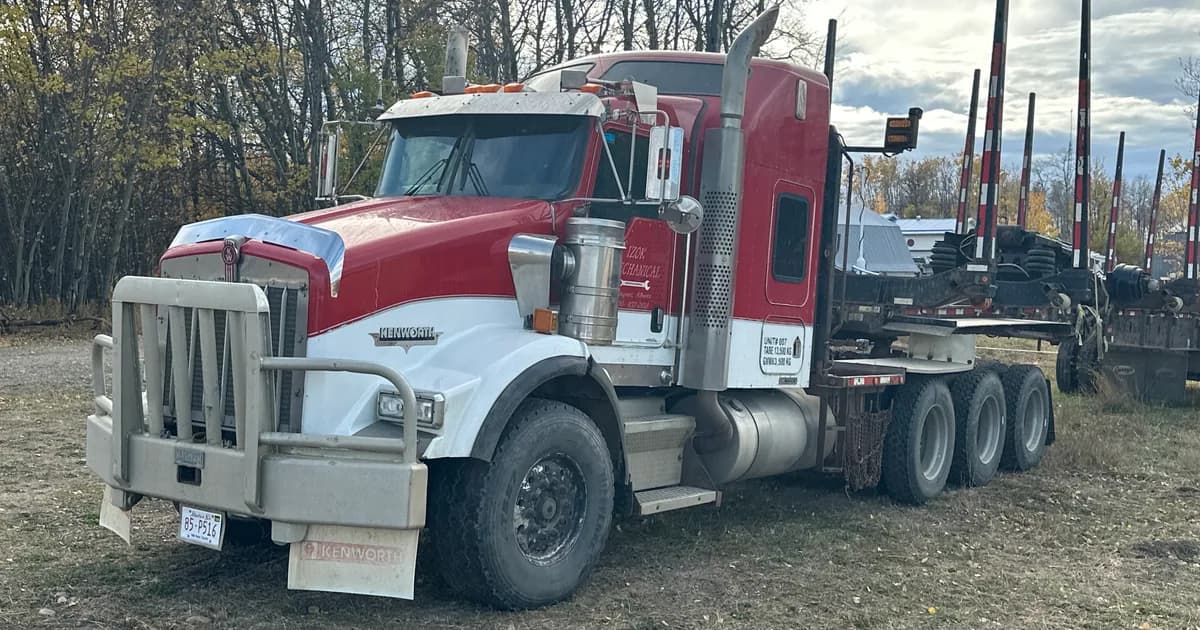
Starting a logging truck business in Canada is one of the more achievable paths into the forestry industry for an operator with driving experience and a reasonable amount of starting capital. A one-truck owner-operator can earn a respectable living hauling logs for a mill or a prime contractor, and over time build up to a small fleet. The barriers are real — the rig is expensive, the regulations are layered, and the work is seasonal — but thousands of contractors in BC, Alberta, Ontario, Quebec, and the Maritimes run profitable one-truck and small-fleet logging operations.
This guide walks through what it actually takes to start a logging truck business in Canada: the licenses you need, the truck and trailer setup, how to find hauling work, what it all costs, and how most new owner-operators fund their first rig.
The Business Setup
Before you buy a truck, you need the underlying business structure in place. Lenders, insurers, and licensees all need a legal business to deal with.
Business registration or incorporation. You can operate as a sole proprietor, but most logging truck businesses incorporate within their first year or two. Incorporation protects personal assets from business liability — meaningful when you are running a multi-hundred-thousand-dollar rig on rough roads. It also makes financing easier once you have two years of corporate financials. If you are starting as a sole proprietor, this companion guide walks through what lenders expect.
GST/HST registration. You generally must register for GST/HST once taxable revenues exceed the CRA's $30,000 small-supplier threshold, which many log-hauling operators reach quickly. Most register from day one so they can claim input tax credits on fuel, maintenance, and the truck itself.
Business bank account. A dedicated business account from day one makes your bookkeeping cleaner and your financing applications much easier. Lenders look for six to twelve months of business bank statements when evaluating a file.
Bookkeeping system. Do not try to run it out of a shoebox. Even a basic cloud bookkeeping subscription (Wave, QuickBooks, FreshBooks) is enough for a one-truck operation, and it pays for itself the first time you need financials for a financing application or a tax filing.
Licensing, Safety, and Regulatory Requirements
Log hauling is one of the more heavily regulated trucking segments in Canada. Here is what you need in place before you can legally haul.
Commercial driver's licence. A loaded log truck-trailer combination — a tractor-trailer with air brakes — requires a Class 1 licence (Class A/AZ in Ontario and the eastern provinces), the highest commercial class, recognized across Canada. A Class 3 (Class D in Ontario) does not permit a tractor-trailer combination; it is limited to straight single-unit trucks. Getting a Class 1 now means mandatory entry-level training: BC's MELT program is 140+ hours of ICBC-approved instruction (and cannot be completed in under 30 days), while Alberta replaced MELT with a Class 1 Learning Pathway whose total cost is regulated to $10,000-$12,000 as of April 1, 2026. Budget roughly $9,000-$15,000 in tuition in most of the country (Ontario tends to run cheaper, around $5,000-$9,000), and confirm the exact class and carrier requirements with your provincial transportation ministry before committing.
National Safety Code (NSC) registration or equivalent. The NSC is a set of 16 national standards (administered through the CCMTA) that every province uses as the backbone of commercial-vehicle regulation. You get your NSC number — also called a Safety Fitness Certificate — from your own province or territory of registration, not from a federal office. The specific thresholds and obligations differ between intra-provincial and extra-provincial carriers, but registration triggers ongoing duties: hours-of-service logs (NSC Standard 13's daily trip inspections), driver medicals, and the periodic vehicle inspections (Standard 11) that provinces implement as the CVIP program below.
Commercial vehicle insurance with logging-specific coverage. This is not the same as a regular commercial trucking policy. Log hauling often carries higher premiums because of off-road operation, load characteristics, and claim history. The BC Forest Safety Council pegs insurance on a log-truck rig at roughly $10,000 a year, but it varies widely — plan on something in the $10,000-$25,000 range depending on province, experience, and claims history, with new operators and higher-risk routes at the top end or beyond.
Workers' compensation registration. This is the line item new operators most often underestimate. Forestry premium rates sit well above the all-industry average — for concrete numbers, WorkSafeBC's 2026 base rate for Log Hauling (classification unit 732044) is $2.36 per $100 of assessable payroll, against a $1.55 all-industry average, and other forestry sub-classes run from about $2.10 up to $3.14. Two caveats: those are BC figures (Alberta's WCB, Ontario's WSIB, Quebec's CNESST, and the others each set their own forestry rates), and BC's 2026 forestry rates actually dropped sharply from 2025 — so confirm the current rate with the board in your province rather than assuming it holds. Either way, register and build it into your per-load math from day one.
Provincial forestry permits and scaling certifications. Forestry hauling permit, scaling, and load-document rules vary by province and by the mills or licensed operators you haul for. BC is the most prescriptive: under the Timber Marking and Transportation Regulation, every load must carry a written transportation document showing the vehicle ID, origin, destination, the applicable timber mark, a unique serial number, and your name and signature — and unscaled timber has to be delivered to a scale site designated by a forest officer before it is scaled. Getting it wrong is an offence that can carry fines up to $50,000. Alberta and Ontario have their own permit structures for hauling off Crown land. Check with the provincial forestry ministry and the mill or licensee you plan to haul for.
Annual vehicle inspections. Commercial log trucks require annual (and in some provinces semi-annual) Commercial Vehicle Inspection Program (CVIP) certifications, plus pre-trip inspection logs every shift.
The Truck and Trailer
Your rig is the single biggest capital decision you will make as a startup logging truck operator. Here is how to think about it.
Truck Brands
The Canadian log hauling industry runs on a small number of brands that have proven they can handle the work:
- Kenworth T800 / T880 — the dominant log truck in most Canadian logging regions. Strong resale, deep parts availability, well-understood by lenders.
- Peterbilt 367 / 567 — close competitor to Kenworth, similar vocational build quality, strong resale.
- Western Star 4900 / 49X — popular in BC and Alberta, built for heavy off-highway work.
- Freightliner Coronado / Cascadia vocational — used in log hauling but less dominant than Kenworth and Peterbilt in forestry-heavy regions.
Lenders strongly prefer Kenworth, Peterbilt, and Western Star for log hauling because the resale market is established and the trucks are known to hold up under forestry conditions. For a deeper look at how brand, age, and configuration affect the financing picture, see the log truck financing guide.
New vs. Used
Most new owner-operators start with a used rig. A well-maintained 4-8 year old Kenworth T800 with 400,000-700,000 kilometres rigged for logging commonly lands in the $130,000-$220,000 range. A new T880 rigged fully for log hauling pushes past $350,000.
Used makes sense for your first rig because the depreciation hit has already happened, the rates and down payment requirements are manageable, and you can prove the business out before committing to new-truck payments. Once you have two or three years of clean hauling under your belt, moving up to a newer rig becomes easier to finance and easier to justify.
Trailer, Bunks, and Scales
The truck is one component. A fully rigged log hauling unit also needs:
- Log trailer — pole trailer, jeep-and-pup, or B-train configuration depending on the length of logs you are hauling and the region. Used trailers run $25,000-$80,000, new $60,000-$150,000.
- Bunks — the steel supports that hold the logs on the truck and trailer. Often already installed on a rigged used truck, otherwise a significant add-on.
- Onboard scales — increasingly required by mills to confirm legal axle weights. Budget $4,000-$8,000 for a proper system.
- Load wrapper / cinching system — required for secure log loads.
- Communication gear — mill radios, sat phones or similar for remote operations.
Expect total rig cost (truck + trailer + bunks + scales + wrapper) of $150,000-$300,000 on the used end, $280,000-$450,000+ on the new end.
Finding Work: Mill Contracts and Prime Contractors
A truck with no hauling agreement is an expensive problem. Here is how most new owner-operators find their first work.
Direct mill contracts. The strongest position is a direct contract with a mill — Canfor, West Fraser, Interfor, Tolko, Mercer, Resolute, and similar in their operating regions. These contracts usually require proof of capacity (a truck, insurance, NSC number), references, and sometimes a minimum number of loads per week. They are harder to land as a brand-new operator but not impossible, especially in regions with driver shortages.
Subcontracting under a prime contractor. Many new operators start by hauling under an established logging contractor who holds the mill contract. The prime takes a cut, but you get predictable work, payment reliability, and exposure to the mill without needing to negotiate your own contract. This is the most common startup path — and it reflects how the industry is actually built: the BC Forest Safety Council reports that more than 85% of BC forestry firms are owner-operators or have five or fewer employees, subcontracting to the major licensees rather than the majors running their own trucks. You would be joining the norm, not the exception.
Brokerage and spot hauling. Some operators run through trucking brokerages that handle log loads as part of a broader freight book. Pay is usually lower and the work is less predictable, but it can fill gaps between contract work.
What mills and prime contractors look for. Reliability, capacity, safety record, clean equipment, and ability to run through the cutting season. A new operator who shows up on time, loads correctly, respects scale weights, and communicates well during breakdowns builds a reputation fast in a regional logging market. Reputation is one of the main currencies in this industry.
Realistic Startup Costs
Below is a representative startup budget for a one-truck owner-operator logging business in Canada using a used rig. These are planning ranges based on used-rig startup scenarios and will vary by province, truck condition, insurance profile, and contract structure — not fixed costs.
| Line Item | Range |
|---|---|
| Used rigged log truck (4-8 years old) | $130,000 - $220,000 |
| Used log trailer | $25,000 - $60,000 |
| Onboard scales and accessories | $5,000 - $12,000 |
| Insurance (first-year premium, often paid in instalments) | $10,000 - $25,000 |
| WCB registration and first-quarter premiums | $2,000 - $6,000 |
| Business registration, GST, bookkeeping setup | $1,000 - $3,000 |
| Licensing, medicals, NSC registration | $1,500 - $4,000 |
| Operating cash reserve (3 months of fuel, maintenance, payments) | $25,000 - $50,000 |
| Contingency (10-15% of the above) | $20,000 - $50,000 |
| Total realistic startup cost | $220,000 - $430,000 |
Operators who buy new or go heavier on reserve can push that total past $500,000. Operators buying older rigs (10+ years) on tight budgets sometimes start closer to $150,000, though the reliability risk and the tighter financing options make that a harder path.
Key takeaway: The truck is not the whole startup cost. Insurance, WCB, reserve capital, and contingency often add 30-40% on top of the rig price. Budget the full picture before committing — the operators who fail in year one are usually the ones who ran out of reserves before contracts ramped up.
How Most Owner-Operators Fund the First Rig
Financing is what gets most new operators on the road, because the rig cost is almost always larger than the cash available. Here is what the path commonly looks like for a first-time owner-operator.
Down payment. Most lenders working with first-time owner-operators on a used log truck look for 15-25% down. Stronger credit or a signed hauling contract can push the requirement toward the lower end. Weaker credit or speculative buying (no contract) pushes it higher.
Term. Used log trucks commonly finance on 48-72 month terms, depending on the age of the rig. The general principle is that the truck should not be older than 10-12 years at the end of the term.
Rate. First-time owner-operators with clean personal credit commonly see rates in the 8-12% range on a used log truck. Challenged credit pushes higher. Full rate, term, and lender-type detail lives in the log truck financing guide.
The cash gap after delivery is a separate problem. Financing the rig does nothing about the wait between hauling a load and the mill paying for it, which commonly runs 30-60 days while fuel, insurance, and the truck payment come due far sooner. That is working capital and invoice financing rather than equipment financing — Crewline Financing covers that side for Canadian haulers.
What lenders look for on a startup file:
- Two or more years of commercial driving experience, preferably in logging
- A signed or strongly indicated hauling agreement with a mill or prime contractor
- Clean personal credit (business credit history usually does not exist yet)
- Proof of the down payment, seasoned in your account
- A realistic business plan showing the rig can generate enough revenue to service the debt
If personal credit is challenged. Specialized private lenders and forestry-aware brokers regularly approve owner-operator log truck deals for borrowers with challenged credit, though terms tighten. If your score is below 620, start with bad credit logging equipment financing, then cross-reference the broader bad credit financing playbook for the strategies that apply across equipment types.
If you are newer than two years in business. Many new owner-operators have the driving experience but do not yet have the corporate history lenders want. The newer-business financing guide lays out what specifically helps on those files.
Why First-Year Logging Truck Businesses Fail
Most new logging truck businesses that fail do not fail because the operator could not drive or because the work was not there. They fail for a small number of predictable financial reasons — and every one of them is avoidable if you know to look for it.
Underestimating reserve capital. The most common failure mode. Operators who budget the rig, the trailer, and the insurance but skip the 3-6 month operating reserve get caught by breakup, a fire season shutdown, or a late-paying prime. The truck payment does not wait. A missed payment in month four can end the business and the credit profile at the same time.
Buying the rig before securing a contract. A sitting truck loses money every day. Operators who buy speculatively and then start looking for work often burn through their reserves before the first hauling agreement lands. The rig payments and insurance run whether or not the wheels are turning.
Overpaying for the rig. In a tight used log truck market it is easy to pay $20,000-$40,000 over fair value just to get a rig on the road. That overpayment compounds — higher payments, more interest, weaker equity if you need to sell. A cool-headed pre-purchase inspection and a realistic comparable search usually prevent this.
Weak maintenance planning. A log truck in forestry service needs aggressive preventive maintenance — tires, drivetrain, brakes, undercarriage, engine oil analysis. The BC Forest Safety Council estimates annual maintenance and service on a working rig at roughly $30,000-$40,000 (less on a newer truck), so this is a real monthly line, not a rounding error. Operators who run reactive ("fix it when it breaks") instead of preventive end up with cascading failures that cost multiples of what scheduled maintenance would have cost, and lose loads during peak cutting season.
Insurance and WCB sticker shock mid-year. Operators who did not fully budget forestry insurance premiums and workers' compensation obligations sometimes get hit with renewal notices, audits, or premium adjustments that blow out the cash plan. Confirm these numbers precisely in your province before you commit to the rig.
Running on gross revenue instead of net. A busy log truck can gross a healthy monthly number, but after fuel, maintenance, insurance, WCB, the truck payment, licensing, and taxes, the net is often a fraction of that. Be skeptical of any tidy "owner-operators net $X per year" figure you see online — reliable Canadian net-income data for one-truck log-haul operations is genuinely scarce, and the widely-circulated numbers do not hold up to scrutiny. Operators who mentally budget off gross instead of net run out of cash fast. Build the plan off conservative net-per-load numbers specific to your own region and route profile, not a national average.
Key takeaway: First-year failures are almost always financial, not operational. The operators who make it past year one are the ones who budgeted a real reserve, locked in a contract before the rig, and planned off realistic net revenue — not gross.
Tips for Year One Survival
Tip 1: Lock in a hauling agreement before you buy. The single biggest predictor of first-year success is having paid work lined up before the rig is on the road. A signed hauling agreement with a mill or prime contractor does two things at once — it improves your financing terms and it gives you immediate revenue. Speculative buying is possible, but it is a much harder path.
Tip 2: Budget for breakup and fire season. Most Canadian logging regions lose 4-10 weeks per year to spring breakup, and fire season can halt operations unpredictably. Build three months of fixed costs into your startup cash reserve so a shutdown does not put you behind on truck payments or insurance.
Tip 3: Run lean on year-one overhead. Do not rent a yard, do not hire a bookkeeper, do not buy a new work truck for yourself. Keep overhead close to zero until you have 12 months of consistent revenue history. Reinvest in maintenance, fuel efficiency, and reserves.
Tip 4: Pick a region where hauling capacity is tight. The log-hauling driver shortage is real and well-documented — the Forest Products Association of Canada has tied hauling-capacity gaps to hundreds of millions in lost business, the broader Canadian trucking sector is short tens of thousands of drivers with a large share near retirement, and major licensees are motivated enough that West Fraser began piloting autonomous log-haul trucks (with Kodiak AI) in 2026 specifically to address it. For a new owner-operator, that shortage is leverage: regions with active licensees and reported capacity gaps are far easier places to land a first contract than regions with long-established hauler rosters and no open seats.
Tip 5: Maintain a clean maintenance record. From day one, keep every receipt, every inspection, every service record organized. A well-documented maintenance history raises the resale value of the rig when you trade up and makes future financing easier. It also protects you if there is ever a question about a crash or a load claim.
Tip 6: Build a relationship with the mill scale house. The scale operators at the mill see every truck, every load, every day. Operators who respect load limits, communicate clearly, and run clean equipment build a reputation fast — and that reputation is the reason you get more loads offered and contract renewals when others get dropped.
Common Mistakes in the First Year
Underestimating total startup capital. The rig is the visible cost. Insurance, WCB, operating reserve, and contingency are not. Operators who focus only on the truck price often run out of cash two or three months in, miss a payment, and damage their credit right when they are building a payment history. Pad your startup budget — then pad it again.
Buying a rig without a contract in hand. A sitting truck is losing money every day. If the rig is on a loan, the payments do not wait for you to find work. Line up the hauling agreement first, the rig second.
Cheaping out on insurance. A single logging-related loss with inadequate coverage can end the business. Get proper logging-specific commercial insurance from a broker who understands the industry, not the cheapest generic commercial policy you can find.
Skipping the pre-purchase inspection. A used log truck has lived a hard life. A $500-$1,000 mechanical inspection before you commit can catch frame issues, engine wear, or transmission problems that would otherwise be a six-figure surprise. Always inspect.
Treating WCB as optional. Forestry workers' compensation rates are heavy, but the alternative — working without coverage in a high-injury industry — is catastrophic. Register, pay, and factor it into your rates from day one. More on what happens when payments start slipping in what happens on an equipment financing default.
Sources: WorkSafeBC — 2026 Premium Rates (Log Hauling CU 732044), CCMTA — National Safety Code, Alberta — Class 1 Learning Pathway, BC Forest Safety Council, BC Laws — Timber Marking and Transportation Regulation, BDC — Starting a Business, Government of Canada — Business Registration, Farm Credit Canada. Rates and rules current as of June 2026; WorkSafeBC figures are BC-specific and reset annually.
Next Steps
If you are a commercial driver thinking about going owner-operator in log hauling, the financing conversation is where the business plan gets real. Start with our log truck financing guide for rates, terms, and lender expectations, our financeability checker for a quick read on your position, or submit your information to IronFinance and we will tell you what is realistic on a first-rig deal given your credit, your experience, and the region you plan to operate in. We work with lenders who specialize in forestry and owner-operator deals, and we will give you a straight answer on what is possible and what would need to change to get there.
Already own equipment, or eyeing a different machine?
Frequently Asked Questions
How much does it cost to start a logging truck business in Canada?
Startup costs for a one-truck logging operation in Canada commonly land between $200,000 and $450,000 when you include the rig, trailer and bunks, insurance, permits, WCB registration, fuel float, and a few months of operating reserve. The truck itself is the biggest line — a used Kenworth or Peterbilt rigged for logging often runs $150,000 to $300,000 depending on age and configuration. New rigs push total startup past $500,000.
Do I need a logging contract before I buy a truck?
You do not strictly need one, but it significantly improves your financing odds and your first-year income stability. Lenders evaluating an owner-operator for a log truck loan look much more favourably on a file with a signed hauling agreement with a mill or a licensed logging operator. Buying a rig on spec and then looking for work is a much higher-risk path for both the lender and the operator.
What licenses and permits do I need to run a logging truck in Canada?
You need a commercial driver's licence (Class 1 or 3 depending on configuration), an NSC (National Safety Code) number, commercial vehicle insurance with logging-specific coverage, WCB or WorkSafe registration in your province, a business registration or incorporation, GST/HST registration if you cross the $30,000 revenue threshold, and any provincial forestry or hauling permits required in your operating area. Some provinces also require scale tickets and specific log-hauling certifications.
Can I finance my first logging truck as a new operator?
Yes, though the deal usually looks tighter than for an established fleet. Most lenders working with first-time owner-operators want at least 2-3 years of industry driving experience, a 15-25% down payment, a signed or strongly indicated hauling contract, and clean personal credit. Specialized private lenders and brokers with forestry relationships are often the best path for a first-rig purchase.