
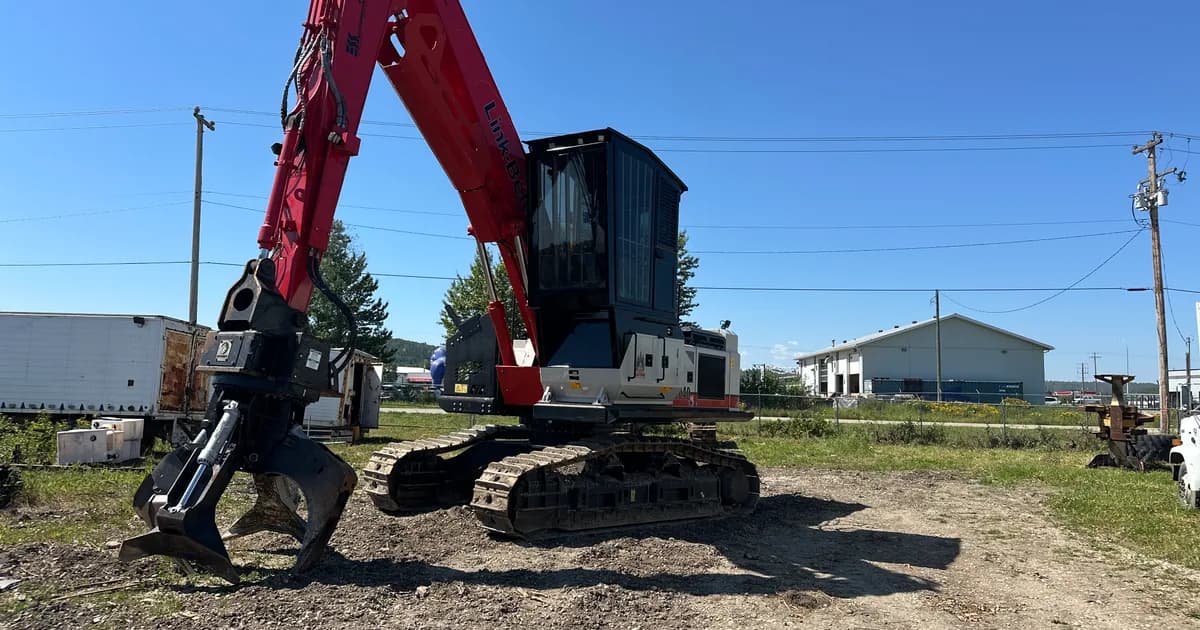
Logging is hard on credit. Spring breakup shuts you down for weeks. A mill curtailment cancels your cut. A prime contractor pays 90 days late and you fall behind on a truck payment. Fire season closes the block. Most loggers who have been in the woods more than a few years have at least one rough stretch on their credit file — and when it comes time to finance the next skidder, buncher, or log truck, that history follows them into the lender's office.
The good news is that bad credit does not shut the door on a logging deal. Specialized lenders in Canada approve forestry files for contractors with challenged credit every month. This page is the national starting point: it covers what is true everywhere in Canada, then points you to the province guide that covers what is true where you actually cut.
The Rules Are National — the Revenue Context Isn't
Here is the mental model that makes everything else fit. The financing mechanics are broadly national. A 590 credit score, a used feller buncher, and a signed contract get underwritten roughly the same way in Prince George as in Thunder Bay: the same credit tiers, similar rate ranges, similar down-payment expectations. Those are covered further down this page and apply wherever you operate.
What is not national is the revenue context — the part of your file a forestry-aware lender actually cares about most. Who you deliver to, what tenure your work runs under, what second income you can layer in, and what structural pressures your region is under all change from province to province. Canada's forest sector is big — over $30 billion in GDP, roughly 200,000 direct jobs (about 375,000 including indirect), and $36.2 billion in exports in 2023 — but it is really a dozen regional industries wearing one name. A lender reads your file through the one you work in.
So use this hub in two steps: read the national financing sections below, and open your province for the part that is specific to you.
Find Your Province
British Columbia
Two industries in one — steep-slope coastal yarders and mechanized Interior logging — under an Interior fibre cliff and coastal old-growth deferrals.
Alberta
Forestry sits on the oil-and-gas landbase — many contractors run both bush work and oilfield clearing, so cash flow tracks two cycles.
Saskatchewan
Harvesting runs through three Forest Management Agreements and an unusually Indigenous-owned mill base.
Manitoba
A concentrated mill side — a few doors — with Manitoba Hydro line-clearing as a real second paycheque.
Ontario
Coming soonThe Northern Ontario boreal, the Great Lakes mills, and Crown forest licences.
Quebec
Coming soonCanada's largest forestry workforce and a distinct provincial tenure system.
New Brunswick
Coming soonThe Maritimes' mill-dense, freehold-heavy forestry economy.
How Forestry Actually Differs by Province
The province pages exist because a lender's read of the same 620-score file changes completely depending on where the revenue comes from. In short:
- British Columbia is really two industries — steep-slope coastal cable and grapple-yarder work, and mechanized ground-based Interior logging — and both are under structural pressure (the Interior fibre cliff and permanent mill closures, coastal old-growth deferrals). Coastal yarder iron also carries a narrow resale pool that lenders price carefully.
- Alberta's forest sits on the busiest energy landbase in the country. A large share of bush contractors run their iron on both logging and oilfield right-of-way clearing, so their cash flow tracks the oil-and-gas cycle as much as the wood cycle — diversification a generalist bank misreads.
- Saskatchewan runs almost entirely through three Forest Management Agreements and the most Indigenous-owned mill base in Canada. Where you sit in that tenure structure matters to a forestry lender more than the score itself.
- Manitoba is defined by concentration — a handful of mill outlets, not a dozen — with Manitoba Hydro line-clearing across ~90,000 km of rights-of-way serving as a genuine second paycheque that diversifies a contractor's cash flow.
Same national financing rules; four very different files. Open your province for the detail, then come back here for the mechanics.
What Counts as Bad Credit in a Logging Deal
Equipment lenders read a credit file differently than a credit card company. They care about how you have handled secured debt — equipment loans, truck payments, mortgages — far more than an old Visa balance. In practical terms, most Canadian equipment lenders bucket credit roughly like this:
- 680+: Good to strong. Logging-comfortable banks and captive finance programs are realistic options.
- 620-679: Fair. Most private equipment lenders, and some banks, will still work with you.
- 550-619: Challenged. Private equipment lenders and forestry-aware specialty lenders are your main path.
- Below 550: Difficult but not closed. Structure, down payment, and the equipment itself carry the file.
Where logging gets treated more cautiously than general construction is the combination of factors. A contractor with a 600 score financing a Cat 320 excavator has a machine with buyers everywhere. The same 600 score financing a Tigercat 870C feller buncher has collateral that only other loggers want, often in a region where the market moves together. Lenders price that collateral risk on top of the credit risk.
Key takeaway: With challenged credit in forestry, lenders are weighing two risks at once — your payment history and the resale market for a specialized machine in a seasonal, regional industry. You can offset both with the right structure.
What Lenders Look At on a Bad-Credit Logging File
Your score is a starting point, not the verdict. These are the factors that most often move a challenged-credit logging deal from decline to approval.
Secured debt history. A clean track record on previous equipment loans and truck payments carries significant weight, even if your overall score is low because of unsecured debt. Lenders want to see that when cash is tight, the equipment payments get made.
Cutting contracts or timber allocations. A signed contract with an established licensed operator or major forestry company is one of the strongest credentials you can put in the file. Even a one-year allocation shows the lender where the revenue is coming from. Contractors without contracts in hand are generally a harder approval regardless of credit.
Revenue documentation. Six to twelve months of business bank statements showing consistent deposits can matter more than the score itself. Lenders who understand forestry expect seasonality — they are not alarmed by lower summer numbers if the winter cutting season shows strong activity and you manage reserves through breakup.
Existing equipment ownership. A logger who already owns a skidder and is adding a processor reads very differently than a first-time buyer. Paid-off iron also gives the lender a potential secondary collateral option on some deals.
Operator experience. Forestry is skilled, dangerous work, and lenders who know the industry want to see real time in the woods — years logging, machine types run, regions worked. On private-lender files reviewed by a human, that summary helps.
Your Realistic Options
Here is what is actually available for a Canadian logger with challenged credit.
Private equipment lenders are the main path for challenged credit in forestry. They evaluate the whole picture — the machine, your revenue, your down payment, your experience, and the credit file — often deciding in one to three business days. Rates commonly land in the mid-teens and can push higher; down payments of 20-30% and terms of 36 to 60 months are typical. See our broader bad credit equipment financing guide for the mechanics and the logging financing pillar for how lenders think about forestry.
Dealer and captive programs (Cat Financial, John Deere Financial, Tigercat dealer programs) sometimes have credit-rebuilding or first-time-buyer tiers. They exist to move machines, so they carry more motivation than an outside lender to find a way — ask the dealer directly before assuming no.
Lease-to-own structures let the finance company hold title during the term while you exercise a buyout at the end. The lessor's lower risk can make approval easier on a borderline file; the total cost is higher. More common on smaller iron than on a half-million-dollar buncher.
A co-signer or guarantor with strong credit changes the picture — lower rate, smaller down, longer term — but they take on real risk, so the conversation has to be honest.
Broker shopping submits your deal to the lenders most likely to approve it on a single application and credit pull, protecting your score from multiple hard inquiries. Applying cold at four lenders yourself tends to cost 15-30 score points and funnels the file to places that were never going to approve logging collateral. At IronFinance, we work with lenders across the credit spectrum, including challenged-credit forestry specialists.
Why Banks Say No When Private Lenders Still Say Yes
One of the most common experiences for a logging contractor with challenged credit is getting declined at a bank and then approved by a private lender — same machine, same dollar amount, same file. That is not a trick; it is a difference in how each lender prices risk.
Banks dislike stacked risk. The combination of specialized collateral, challenged credit, and seasonal cash flow tips a bank's model over the line even when any one factor alone would be acceptable. Forestry equipment checks all three at once.
Private equipment lenders price risk instead of rejecting it. Rather than hit-the-boxes-or-decline, they adjust the rate, term, and down payment to match the risk and still fund the deal. The cost is higher, but the deal happens.
Forestry-aware lenders discount what generalists overweight. They know seasonal revenue is not unstable revenue, that a machine 200 km from pavement is recoverable, and that a specialized buncher has a real if narrower resale market. Knowing which door to knock on is most of the value a broker provides.
What It Actually Costs
There is no point pretending the numbers match a prime borrower. The table shows general market ranges across borrower profiles — directional, not commitments — as of the June 2026 rate environment (the Bank of Canada held its policy rate at 2.25% on June 10, 2026; prime 4.45%). Equipment loans price at prime plus a spread that widens as credit and machine age weaken.
| Borrower Profile | Expected Rate | Typical Down | Typical Term |
|---|---|---|---|
| Strong: 700+, 5+ yrs logging, major contractor relationship | 7-10% | 10-15% | 5-7 yrs |
| Solid: 650-699, 2-5 yrs, stable contracts | 9-13% | 15-20% | 4-6 yrs |
| Challenged: 550-619, some experience, partial docs | 13-18% | 20-30% | 3-5 yrs |
| Severely challenged: below 550, thin history, no contracts | 17-22%+ | 25-35% | 3-4 yrs |
Specialized machines (feller bunchers, forwarders, processors) sit at the higher end of their tier; skidders and log trucks sit lower because resale is broader. European-brand forwarders and harvesters (Ponsse, Rottne) can price tougher than North American equivalents where parts and resale logistics are less certain.
A real deal. A used Tigercat 635E grapple skidder at $180,000, a 625 score, two years in business, and a signed one-year cutting contract:
- Down payment at 25%: $45,000 · Amount financed: $135,000
- Rate 14% · Term 48 months · Payment ~$3,688/month · Total interest ~$42,000
If that skidder runs under a contract producing $40,000-$60,000 a month gross, the math works even at 14%. The cost of not having the machine — lost revenue, lost contract credibility — is almost always larger than the interest premium. Model your own numbers with our payment calculator.
Key takeaway: Challenged-credit logging financing costs more, but the revenue a working machine generates under contract usually outpaces the rate premium. Run the math on your actual numbers, not on a prime rate you cannot access today.
Strategies to Get Approved
- Lead with a signed contract. A cutting contract or timber allocation is the single most powerful credential on a bad-credit logging file. If you do not have one yet, it is often worth waiting until you do.
- Put down more than the minimum. Going from 20% to 30% down can drop the rate by several points and widen the lender pool.
- Target broader-resale machines first. A skidder or log truck is easier to finance than a pure-play buncher. Land the easier deal, build 12-18 months of clean history, then finance the specialized iron.
- Bring clean revenue documentation. Six to twelve months of statements, deposits highlighted, numbers known cold.
- Write a one-page credit explanation. If a prime paid late, a divorce hit, or a fire season killed your volumes, say so factually — underwriters with exception authority respond to context. Small collections cleared before applying can move you a tier; see our credit score guide.
- Use a forestry-aware broker. One submission, one pull, to the desks that actually underwrite logging collateral at your tier.
Common Mistakes to Avoid
- Shotgunning applications. Multiple hard pulls in a short window can cost meaningful points and flag your file as over-shopped. Go through one channel.
- Over-extending on specialized iron before the contracts support it. Match the equipment to the work you have actually signed, not the work you hope to sign.
- Ignoring the true cost of running the machine. Bars, chains, saw teeth, cutting-head maintenance, fuel, forestry-rate insurance, and move costs add up fast — budget the full picture, not just the payment.
- Going silent on a late payment. Call before the due date; lenders who know forestry will often arrange a deferral. Silence followed by a miss triggers collections — see equipment financing default.
- Hiding past credit events instead of explaining them. Proactively addressing a bankruptcy, consumer proposal, or collections period reads better than making the underwriter guess.
Sources: Natural Resources Canada — How the forest sector contributes to Canada's economy (GDP, jobs, exports); BDC — Equipment Loans; Government of Canada — Canada Small Business Financing Program; Bank of Canada — policy rate. Rate, down-payment, and term ranges are directional market conditions as of June/July 2026 that float with prime, not quotes. Information current as of July 2026.
Next Steps
If you are a Canadian logger with challenged credit and a machine you need to finance, the fastest way to know where you stand is to get the file in front of lenders who handle forestry at your credit tier. Start with our financeability checker for a quick read, or submit your information to IronFinance and we will match you to the right lender. If a bank has already declined your forestry deal, our bank-decline guide covers what changes when you switch to specialized equipment lenders.
Then open your province above — Alberta, BC, Saskatchewan, or Manitoba — for the part specific to where you cut. Financing a log truck? See our log truck financing guide and how to start a logging truck business guide. Newer business on top of the credit challenges? Our guide for newer businesses lays out the strategies, and the down payment guide covers how much cash you actually need.
Already own equipment, or eyeing a different machine?
Frequently Asked Questions
Can I finance logging equipment in Canada with bad credit?
Yes. Specialized private lenders and equipment finance companies regularly approve logging contractors with challenged credit, and some will work with scores well below the typical bank threshold when the deal structure supports it. Expect higher down payments, higher rates, and shorter terms than a strong-credit borrower would see. The machine, your revenue, and your cutting contracts often matter as much as the score itself.
Does bad-credit logging financing work differently by province?
The financing mechanics are broadly national — the credit tiers, rate ranges, and down-payment expectations are similar coast to coast. What changes by province is the revenue context a lender reads: the mills you deliver to, the tenure system, the second-income options, and the seasonal and structural pressures. Alberta's oil-and-gas overlap, BC's coastal-versus-interior split, Saskatchewan's Forest Management Agreements, and Manitoba's mill concentration all change how a file is underwritten. That is why we keep a guide for each province — find yours below.
What down payment should I expect on a logging machine with challenged credit?
Lenders working with challenged credit on forestry equipment commonly look for meaningfully more down than they would on a strong-credit file, often in the range of a quarter to a third of the purchase price. Specialized machines like feller bunchers, forwarders, and processors tend to sit at the higher end. Skidders and log trucks tend to sit at the lower end because they have broader resale demand.
Will a cutting contract help me get approved with bad credit?
It helps significantly. A signed cutting contract or timber allocation with an established licensed operator or major forestry company gives the lender visibility into your revenue and offsets some of the credit concern. Even a one-year agreement improves the file. If you have multi-year work committed, lenders who would otherwise decline may approve the deal.