
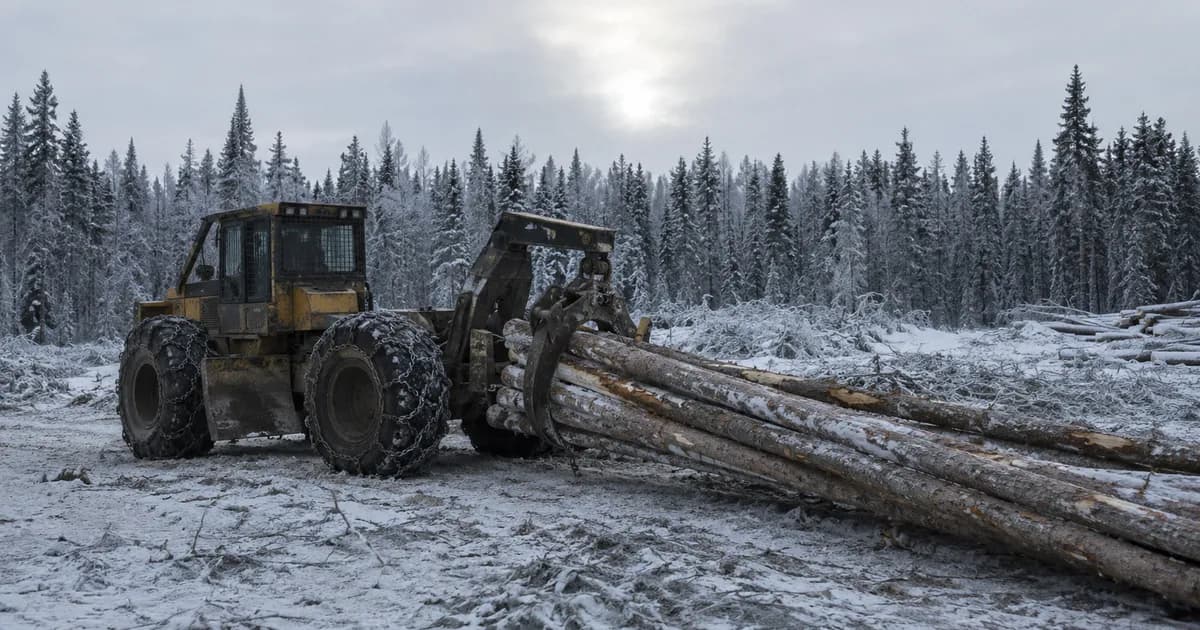
There is a version of the Saskatchewan logging story that a Regina bank never sees. A contractor running a forwarder out of the Prince Albert Timber Supply Area under a Sakâw Askiy shareholder, hauling to a mill that did not exist five years ago, coming off a 2025 fire season that shut down cutblocks for weeks and bruised a credit file that was already thin from the seasonal swings. To a generalist underwriter that file is a 600-something score, a specialized machine, and a revenue chart full of holes. To a lender who actually knows Saskatchewan forestry, it is a working operator embedded in a growing industry, going through exactly the kind of year the province throws at everyone who runs iron in the boreal.
Bad credit does not shut the door on a Saskatchewan logging deal. But Saskatchewan is not Alberta or BC, and the things that get a challenged-credit file approved here are specific to how this province's forest industry is actually built — three Forest Management Agreements, a mill base that is more Indigenous-owned than anywhere else in Canada, a government that is openly trying to double the sector by 2030, and a fire-and-freeze operating rhythm that breaks the math a bank's model expects. This guide walks through all of it: who the players are, where the work is going, what the numbers look like, and how to position a bad-credit file so it lands on a desk that can say yes.
How Saskatchewan's Forest Industry Is Actually Built
Saskatchewan's commercial forest is a relatively narrow band, not a province-wide resource. The commercial forest zone sits largely south of the Churchill River and covers about 14.4 million hectares, with roughly 5 million hectares of that productive forest available for harvest. Inside that band, six large mills and more than 140 smaller producers turn out lumber, oriented strand board (OSB), and pulp, supported by 18 active small-business term supply licences as of 2025. Forestry is the second-largest industry in the north after mining, supporting close to 8,000 direct and indirect jobs, and provincial forest-product sales reached about $1.2 billion in 2023.
Two features make this province read differently to a lender than any other in Canada.
The industry runs through three Forest Management Agreements. Almost all commercial harvesting in Saskatchewan happens inside one of three FMAs, each anchored by its own mills and prime contractors. Where you sit in that structure is the single most important thing a forestry-aware lender wants to understand about your operation — more than the credit score itself. A generalist bank does not know these names; a forestry lender places your file the moment they hear them.
The mill base is unusually Indigenous-owned. About 32 per cent of the province's timber supply is allocated to Indigenous companies, and roughly 27 to 29 per cent of the forestry workforce is Indigenous — both by a wide margin the highest in Canada. NorSask Forest Products in Meadow Lake is the largest First Nations-owned sawmill in the country. This is not a side note; it is the spine of the provincial industry, and it changes which contracts count as bankable revenue.
Key takeaway: In Saskatchewan, a challenged-credit logging file lives or dies less on the score than on whether the lender can place you inside a recognized FMA and an established mill relationship. The province's tenure map is the context that turns a risky-looking file into a fundable one.
The Three FMAs — and Knowing Which One You Work In
Saskatchewan harvesting is organized around three Forest Management Agreement areas plus a handful of term supply licences. A lender who funds forestry iron reads your file by which one feeds your revenue. Here is the map.
Mistik Management FMA — Northwest / Meadow Lake (1.9 million hectares)
The northwest corner of the commercial forest is managed by Mistik Management Ltd., a woodlands company owned 50/50 by NorSask Forest Products LP (itself owned by the Meadow Lake Tribal Council) and Meadow Lake Mechanical Pulp Inc. (Paper Excellence). The Mistik FMA feeds a tight cluster of Meadow Lake mills: the NorSask sawmill (140-million-plus board feet a year, the largest 100% First Nations-owned sawmill in Canada, with profits supporting nine MLTC First Nations), Tolko Industries' Meadow Lake OSB plant, and the Meadow Lake Mechanical Pulp mill. A contractor subcontracting under any of these is working inside one of the most stable mill clusters in the province.
Prince Albert Timber Supply Area — Central (3.3 million hectares)
The central corridor is managed by Sakâw Askiy Management Inc., which holds the Prince Albert FMA on behalf of eight shareholders, several of them First Nations- or Indigenous-owned: Big River First Nation Forestry Products LP, Carrier Forest Products, Edgewood Forest Products, Mistasini Timbers LP, Mitosak Askiy Holdings, Montreal Lake Business Ventures, NorSask Forest Products, and Tolko Industries. Of the area's 3.3 million hectares — about 2.7 million of them forested — roughly 1.7 million are considered harvestable. Sakâw itself owns no mills; each shareholder harvests in its own operating zone and runs its own planning, cutting, hauling, and renewal. If you contract in the PA TSA, the relevant question for a lender is which shareholder's zone you work in — that is the entity whose contract documents your revenue.
Pasquia-Porcupine FMA — Northeast / Hudson Bay (2.02 million hectares)
The northeastern forest around Hudson Bay and Carrot River is managed under the Pasquia-Porcupine Timber Supply Area jointly by Weyerhaeuser and Edgewood Forest Products (owned by Dunkley Lumber since 2019), who are developing the 2025–2045 forest management plan for the area. The region is anchored by Weyerhaeuser's Hudson Bay OSB mill — which opened in 2001, idled during the 2008–2010 downturn, and has since restarted — and Edgewood's Carrot River sawmill, an SPF stud and board mill rated near 140 million board feet a year. This is the eastern operating world, and it bleeds across the Manitoba line toward Swan River, which matters if you run on both sides of the border.
The Term Supply Licences and Small Operators
Outside the three FMAs, Carrier Forest Products holds the Northwest Term Supply Licence — about 790,000 hectares of boreal in the Beauval area — and the province issues smaller volume-based term supply licences and forest product permits to the 18-plus small operators running circular and band sawmills, scragg mills, post and firewood operations, and similar. A contractor feeding one of these smaller licensees has a real, documentable revenue source too; it just sits in a different part of the lender conversation than an FMA prime.
Why the Indigenous-Owned Structure Matters to a Lender
This is the Saskatchewan-distinctive credential, and it is worth understanding why it carries the weight it does on a challenged-credit file.
A subcontract with an Indigenous-owned operator is bankable revenue. A signed cutting, hauling, or subcontracting agreement with NorSask, with one of the four First Nations shareholders in the Sakâw structure, or with the Tribal Council ventures reads on a forestry-aware lender's desk exactly the way a Weyerhaeuser or Tolko contract does — as documented, recurring revenue tied to a real mill. Because so much of the provincial cut flows through these operators, this is not a niche path in Saskatchewan; for a large share of contractors it is the main one.
The structure is stable and government-backed. The province has openly tied its forestry growth strategy to increasing Indigenous participation, and the largest new project in the sector — the One Sky mill, covered below — is itself majority-Indigenous. A lender who follows the industry knows these operators are not fly-by-night; they are the institutional core of where Saskatchewan forestry is headed. That institutional weight transfers, a little, onto the file of a contractor working under them.
A generalist underwriter sees the unfamiliar names as risk. The flip side: an underwriter in a Regina or Saskatoon bank branch who has never seen "Sakâw Askiy" or "NorSask" or "Mistik" on a file sometimes hesitates simply because the names are unfamiliar. That hesitation is not a judgment on the deal — it is a gap in the underwriter's exposure. Routing the file to a lender who already funds Saskatchewan forestry closes that gap.
What Counts as Bad Credit on a Saskatchewan Logging File
Equipment lenders bucket credit into rough tiers, and where you land sets the starting point — not the verdict.
- 680+: Good to strong. Saskatchewan-savvy banks and captive programs are realistic.
- 620–679: Fair. Most private equipment lenders will work with you; some banks still will.
- 550–619: Challenged. Private equipment lenders and forestry-aware specialty lenders are your primary path.
- Below 550: Difficult but not closed. Down payment, deal structure, and the machine itself carry the file.
What makes a Saskatchewan logging deal harder than general construction is the stack: specialized collateral, winter-concentrated revenue, remote northern operating areas, and — increasingly — fire-year disruption, all on top of the credit score. A bank underwriter sees four risk factors at once and declines. A forestry lender sees the same four and prices them.
What Saskatchewan Lenders Actually Weigh on a Bad-Credit File
On a Saskatchewan forestry file, the read is shaped less by the score than by where you sit in the industry and how the operation is documented. These factors carry more weight than a generalist underwriter would expect.
A documented relationship inside an FMA or with an Indigenous-owned operator. This is the credential that sets Saskatchewan apart. A signed agreement with a Mistik, Sakâw, or Pasquia-Porcupine shareholder, or with NorSask or another Indigenous-owned operator, reads as strong revenue documentation — equivalent to a major-licensee contract anywhere else. Even a one-season agreement moves the needle.
Saskatchewan industry experience. Five-plus years running iron on northern cutblocks reads very differently than a first-time forestry operator at the same score. Time in the bush translates into a real risk discount.
Secured-debt history specific to equipment. Clean payment history on prior equipment or log-truck loans carries weight even when the overall score is dragged down by unsecured debt. Saskatchewan-aware lenders read that nuance well.
Revenue documentation through a full winter cycle. Six to twelve months of business bank statements spanning a winter cutting season tell a far stronger story than a three-month snapshot. Strong December-through-March activity with a reserve-drawdown summer is a healthy Saskatchewan forestry cash-flow pattern, not instability.
Existing equipment ownership. A logger who already owns a skidder and is adding a forwarder reads much better than a first-time buyer at the same score.
Where the Work Is Going: The 2030 Plan and the New Prince Albert Mill
This is the part no bank underwriter will factor in, and it is genuinely specific to Saskatchewan right now. The province has put forestry expansion at the centre of its economic strategy, and the direction of travel matters to anyone financing iron they intend to run for the next five to seven years.
The province is openly trying to double the sector by 2030. Saskatchewan's Growth Plan sets a target of roughly doubling the forestry sector by 2030 — toward about $2.2 billion in annual sales and on the order of 12,000 jobs — while increasing Indigenous participation, and the government uses timber allocation as the lever to get there. For a contractor, "more allocation" eventually means more cutblocks and more hauling, which is the forward story a forestry lender actually responds to.
There is real room to grow into. Saskatchewan harvests well under what its forests allow. In 2021–22 the province cut about 3.97 million cubic metres against an annual allowable cut near 8.95 million — roughly 44 per cent. That unused headroom is exactly why the province can hand new fibre allocations to mills like One Sky without overcutting, and it is the structural reason the doubling target is plausible rather than just hopeful. For a contractor weighing a five-to-seven-year loan, an industry with room to expand is a more comfortable backdrop than one already cutting at its ceiling.
A major new mill is coming to Prince Albert. In 2024 the province issued a 1.2-million-cubic-metre timber allocation to One Sky Forest Products for a roughly $400-million OSB mill in Prince Albert, with construction slated to begin in 2025 and an opening targeted around 2027, and an estimated 800 direct and indirect jobs. One Sky is majority-Indigenous — formed by Montreal Lake Business Ventures, the Meadow Lake Tribal Council, Big River First Nation, and Tatanka Oyate Holdings, with Peak Renewables as an industry partner. New OSB capacity in the PA corridor means new harvesting and hauling demand, which strengthens the forward case for a contractor positioning to work that area.
But read the OSB market honestly. Both Tolko's Meadow Lake plant and Weyerhaeuser's Hudson Bay plant produce OSB, and OSB demand softened heading into 2026 — West Fraser announced an indefinite curtailment of its High Level, Alberta OSB mill for spring 2026. A lender funding a buncher or forwarder tied to OSB volumes will weigh that cycle. It is not a reason to avoid the work; it is a reason to keep the down payment healthy and the term realistic so a soft quarter does not break the payment.
And one correction worth knowing. Paper Excellence confirmed in September 2024 that it will not restart the idled Prince Albert pulp mill and is exploring divesting the site — so pulp is not the PA growth story. The growth story is One Sky's OSB project. If you are weighing where future contract work is most likely to appear, that distinction matters.
Your Realistic Financing Options in Saskatchewan
Here is what is actually available for a Saskatchewan logger with challenged credit.
Private Equipment Lenders With Forestry Experience
The main path for challenged credit in Saskatchewan forestry. Private equipment finance companies evaluate the whole picture — the machine, your revenue, your down payment, your Saskatchewan operating history, and the credit file. Approval is often one to three business days depending on how complete your file is. Rates on challenged-credit forestry deals commonly land in the mid-teens and push higher on tougher files, with down payments in the 20–30 per cent range. Our broader bad credit equipment financing guide covers the mechanics, and our national bad credit logging guide covers forestry-specific considerations that apply across provinces.
Captive Finance Programs
Cat Financial through Finning, John Deere Financial through Brandt, and Tigercat through its prairie dealer network (Redhead Equipment serves much of the Saskatchewan forestry market) sometimes have credit-rebuilding or first-time-buyer tiers on forestry iron. The rate will not be pretty on a challenged-credit file, but the conversation tends to be more practical than at a generalist bank because the dealer wants the machine moved.
Lease-to-Own Structures
The finance company retains title during the term and you exercise a buyout at the end. Structurally lower risk for the lessor, which can make approval easier on a challenged-credit file. More common on smaller iron — used skidders, log trucks — than on high-dollar bunchers or forwarders, but worth asking about.
Co-Signer or Guarantor
A partner, spouse, or family member with strong Saskatchewan credit who will co-sign can change the picture — lower rate, smaller down payment, longer term. The co-signer is taking real risk, so the conversation has to be honest.
Broker Shopping
A broker with Saskatchewan forestry-aware lender relationships submits your file to the lenders most likely to approve it on a single application and credit pull — protecting your score from multiple hard inquiries and routing the file to underwriters who already know Mistik, Sakâw, and Pasquia-Porcupine names. Applying cold at three or four Regina or Saskatoon banks usually costs you score points and funnels the file to places that were never going to approve forestry collateral. At IronFinance, we work with lenders across the credit spectrum, including specialists in Saskatchewan forestry files.
What It Actually Costs in Saskatchewan
The ranges below are directional — based on lender type, machine type, documentation strength, and borrower profile — not lender commitments. Every file is individual.
| Borrower Profile | Expected Rate Range | Typical Down Payment | Typical Term |
|---|---|---|---|
| Strong: 700+ credit, 5+ years SK logging, FMA-shareholder contract | 7–10% | 10–15% | 5–7 years |
| Solid: 650–699, 2–5 years in SK forestry, stable contracts | 9–13% | 15–20% | 4–6 years |
| Challenged: 550–619, some SK industry experience, partial docs | 13–18% | 20–30% | 3–5 years |
| Severely challenged: Below 550, limited history, no contracts in hand | 17–22%+ | 25–35% | 3–4 years |
Specialized machines (feller bunchers, forwarders, processors) sit at the higher end of their tier; skidders and log trucks sit at the lower end because resale is broader. Older European-brand forwarders and harvesters can price tougher on challenged-credit files because parts and resale logistics in northern Saskatchewan are thinner than for North American brands.
A Realistic Saskatchewan Deal
Picture a used John Deere 1210G forwarder at $220,000, a 610 credit score, three winters running cut-to-length in the Prince Albert Timber Supply Area under a Sakâw Askiy shareholder, and a signed agreement for the coming season — but a credit file knocked down by the 2025 fire shutdown that cost six weeks of production.
- Down payment at 30%: $66,000
- Amount financed: $154,000
- Rate: 15%
- Term: 48 months
- Approximate monthly payment: $4,290
- Total interest over the term: approximately $52,000
- Total cost including down payment: approximately $272,000
If that forwarder runs a full winter under contract producing $45,000–$65,000 a month in gross revenue, the math works even at 15 per cent. The cost of not having the machine — lost season, lost zone position with the shareholder, lost credibility for next year's allocation — is almost always larger than the interest premium on challenged-credit terms. Our payment calculator lets you model your actual numbers.
Key takeaway: Challenged-credit Saskatchewan logging financing costs more, but the revenue a working machine generates under an FMA-shareholder contract usually outpaces the rate premium by a wide margin. Run the math on the deal you can actually access today, not on a prime-credit rate you cannot.
Why a Regina or Saskatoon Bank Says No When a Forestry Lender Says Yes
A common Saskatchewan experience: an operator out of Meadow Lake, Prince Albert, or Hudson Bay walks a clean deal — solid machine, signed shareholder agreement, real revenue — into a city bank, waits two or three weeks, and gets declined. The same file, sent to a forestry-aware private lender, sometimes funds in a day or two. The mechanics are predictable.
Banks dislike stacked risk, and Saskatchewan forestry stacks it high. Specialized collateral, winter-concentrated revenue, remote northern operating areas, and fire-year volatility are factors a generalist model handles in isolation but that tip a file over the line when they stack — which in Saskatchewan forestry they do by default. The unfamiliar Indigenous-owned operator names add a variable the underwriter has never priced.
Forestry-aware lenders price those factors instead of rejecting them. A lender who funds Saskatchewan logging iron knows winter-concentrated revenue is normal; that a forwarder 200 kilometres north of Prince Albert is recoverable; that a Sakâw or NorSask subcontract is as bankable as a Weyerhaeuser one; that a 2025 fire-season gap in the statements is an industry-wide event, not a sign the operator failed. They adjust rate, term, and down payment to match the risk and still fund the deal.
The lender pool, not the deal, changes the answer. A $220,000 used forwarder, a 610-score operator, a one-season PA TSA agreement — that exact file can run through three desks in one week and come back declined at a bank, priced punitively at a generalist finance company, and approved at workable challenged-credit terms by a forestry-aware specialty lender. The deal does not change. The desk does. Knowing which desk to send it to is most of what a broker provides.
Strategies That Work on Saskatchewan Files
Tip 1: Lead with your FMA-shareholder or Indigenous-operator contract. A signed agreement inside the Mistik, Prince Albert, or Pasquia-Porcupine structure — or with NorSask or another Indigenous-owned operator — is the single most powerful credential on a challenged-credit file. Name the entity and the operating zone in your application. If you do not have a contract signed yet, it is often worth waiting until you do.
Tip 2: Put down more than the minimum. Moving from 20 to 30 per cent down can drop the rate by several points and widen the lender pool. If the machine will generate strong winter revenue, borrowing less and putting more down is almost always the right trade.
Tip 3: Target skidders and log trucks first. Rebuilding credit and need to get into a machine? Start with a skidder or log truck — broader resale, easier financing. Land the easier deal, build 12–18 months of clean payment history, then finance the specialized iron at better terms.
Tip 4: Document the full Saskatchewan cycle — including the fire year. Pull 12 months of business bank statements that include a winter cutting season, highlight the deposits, and show that the seasonal low is expected and reserves carry the operation through breakup. If a fire season cut into a stretch of statements, say so in writing — 2025 hit nearly the whole northern industry and lenders who know the province understand it.
Tip 5: Write a credit-explanation letter specific to your situation. If your credit dropped because a prime paid late, because the 2025 fire season killed weeks of volume, because a mill curtailment pulled work, or because a divorce split your finances — put it in writing. A short, factual note on what happened and what has changed since is surprisingly effective with underwriters who have authority to make exceptions.
Tip 6: Use a forestry-aware broker. The wrong lender is not just a no — it is a wasted hard pull and sometimes an over-shopped flag on your file. A broker who already knows which lenders approve Saskatchewan forestry collateral at your tier submits the file once, to the right place, on a single pull.
Common Mistakes on Saskatchewan Bad-Credit Logging Files
Applying at three or four banks before trying anything else. Multiple hard pulls in a short window can cost meaningful score points — often the difference between approval and decline on a challenged-credit file. Go through one channel, or be very deliberate about which one or two lenders you approach directly.
Buying specialized iron before the contracts support it. Financing a full harvesting spread on the assumption that an FMA allocation or a One Sky-driven contract will materialize is the fastest way to trouble. Match the equipment to the work you have actually signed, not the work you are hoping to sign.
Ignoring the true cost of running northern Saskatchewan iron. Fuel, bars, chains, saw teeth, cutting-head maintenance, winter-grade lubricants, and moving equipment between remote cutblocks add up fast. Budget the full picture, not just the monthly payment — a mid-winter cash-flow breakdown is what destroys payment history.
Silence when a payment is going to be late. Breakup, a fire-season shutdown, a mill curtailment, a late-paying shareholder — these happen in Saskatchewan forestry. Lenders who know the province will often arrange a temporary deferral if you call before the payment is due. Silence followed by a missed payment is what triggers collections. Our guide on equipment financing default covers the mechanics.
Hiding past credit events instead of explaining them. Underwriters will see the file. What they will not see unless you provide it is the Saskatchewan-specific context. Proactively addressing a bankruptcy, consumer proposal, or collections period with a short written explanation almost always reads better than letting the underwriter guess.
Sources: Saskatchewan Trade and Invest — Forestry, Government of Saskatchewan — 30 Goals for 2030, Government of Saskatchewan — State of the Environment: Annual Timber Harvest, Sakâw Askiy Management — Shareholders, Mistik Management (MLTC Industrial Investments), NorSask Forest Products, Weyerhaeuser — Pasquia-Porcupine 2025–2045 Forest Management Plan, Government of Saskatchewan — One Sky Timber Allocation, BDC — Equipment Loans. Information current as of June 2026.
Sources: Saskatchewan Trade and Invest — Forestry — Government of Saskatchewan; Government of Saskatchewan; Government of Saskatchewan; Sakâw Askiy Management; MLTC Industrial Investments; NorSask Forest Products; Weyerhaeuser; Government of Saskatchewan; BDC. Rate, term, down-payment and approval-timing figures are directional practitioner conventions current as of August 2026 — they move with the prime rate, vary by lender and by machine, and are not quotes or approvals. Equipment prices are asking prices rather than transaction prices. Tax treatment depends on your own contract and circumstances; confirm with your accountant.
Next Steps
If you are a Saskatchewan logger with challenged credit and a machine you need to finance — a used Tigercat skidder, a John Deere 1210G forwarder, a Cat 563 buncher, a Kenworth log truck — the fastest way to know where you actually stand is to get the file in front of lenders who handle Saskatchewan forestry deals at your credit tier. The deal will look different than a prime-credit file, but it gets done. Start with our financeability checker for a quick read, or submit your information to IronFinance and we will match you to the right lender. We work with forestry-aware lenders who understand the Mistik, Prince Albert, and Pasquia-Porcupine tenure structures, the Indigenous-owned mill base, the winter-dominant operating model, and the realities of running iron in the northern boreal from Meadow Lake to Prince Albert to Hudson Bay. If a city bank has already declined the deal, our bank-decline guide for equipment financing walks through what changes when you move the file to specialized lenders.
For the broader national picture, see our national bad-credit logging guide. If you operate across provincial lines — common around the Saskatchewan/Manitoba boundary near Hudson Bay and Swan River — see our Alberta, BC, and Manitoba versions. If you are financing a log truck specifically, our log truck financing guide and how to start a logging truck business guide cover the truck-specific considerations. For the mechanics of down payment on a challenged-credit file, the down payment guide is the most practical starting point.
Already own equipment, or eyeing a different machine?
Frequently Asked Questions
Can I finance logging equipment in Saskatchewan with bad credit?
Yes. Specialized private lenders and forestry-aware brokers regularly approve Saskatchewan logging contractors with challenged credit, particularly when the file is tied to one of the province’s three Forest Management Agreements — a Mistik Management subcontract out of Meadow Lake, a Sakâw Askiy shareholder in the Prince Albert Timber Supply Area, or a Pasquia-Porcupine prime around Hudson Bay — or to an Indigenous-owned operator such as NorSask Forest Products. The deal is tighter than a strong-credit file (larger down payment, higher rate, shorter term), but the door is not closed.
Which Saskatchewan forestry companies and FMAs do lenders recognize on a cutting contract?
Saskatchewan harvesting runs through three Forest Management Agreement areas, and a forestry-aware lender reads your file by which one you work in. The Mistik Management FMA (1.9 million hectares, northwest) feeds NorSask Forest Products, Tolko’s Meadow Lake OSB plant, and Meadow Lake Mechanical Pulp. The Prince Albert Timber Supply Area (3.3 million hectares) is managed by Sakâw Askiy Management for eight shareholders — including Carrier Forest Products, Edgewood Forest Products, Tolko, and NorSask, several of them First Nations- or Indigenous-owned. The Pasquia-Porcupine Timber Supply Area (2.02 million hectares, northeast near Hudson Bay) is managed by Weyerhaeuser and Edgewood (owned by Dunkley Lumber), anchored by Weyerhaeuser’s Hudson Bay OSB mill and Edgewood’s Carrot River sawmill. A signed agreement anywhere in that chain strengthens a challenged-credit file.
How do Saskatchewan's winter season and wildfire years affect financing?
Most commercial harvesting in Saskatchewan happens in winter, when frozen muskeg and bog open access to the northern boreal, so a typical operator’s revenue is concentrated from December through March. Forestry-aware lenders expect that and may structure seasonal payments. The bigger recent wildcard is fire: 2025 was a near-record season with more than 26,000 people evacuated and large stretches of the commercial north under fire or smoke disruption, which directly hit cutblock access, hauling, and contractor cash flow. Lenders who know the province price that risk; generalist Regina or Saskatoon banks often misread the seasonal or fire-year dip as instability.
What down payment should I expect in Saskatchewan with challenged credit?
Saskatchewan logging contractors with challenged credit commonly see down payment requirements of roughly a quarter to a third of the purchase price on specialized forestry iron — feller bunchers, forwarders, processors. Skidders and log trucks often sit at the lower end of that range because the resale market is broader. A signed cutting contract with an FMA shareholder or Indigenous-owned operator, strong revenue documentation through a winter cycle, or a larger down payment can all reduce the requirement.
Is the new Prince Albert OSB mill creating financing opportunities for contractors?
It should, over time. One Sky Forest Products — a majority-Indigenous venture backed by Montreal Lake Business Ventures, the Meadow Lake Tribal Council, Big River First Nation, and Tatanka Oyate Holdings — received a 1.2-million-cubic-metre timber allocation in 2024 for a roughly $400-million OSB mill in Prince Albert, with construction slated to begin in 2025 and an opening targeted around 2027. New allocation means new harvesting and hauling demand around the Prince Albert corridor, which gives contractors there a stronger forward story to bring to a lender. As always, lenders fund signed work, not announced work — but the trajectory helps.