
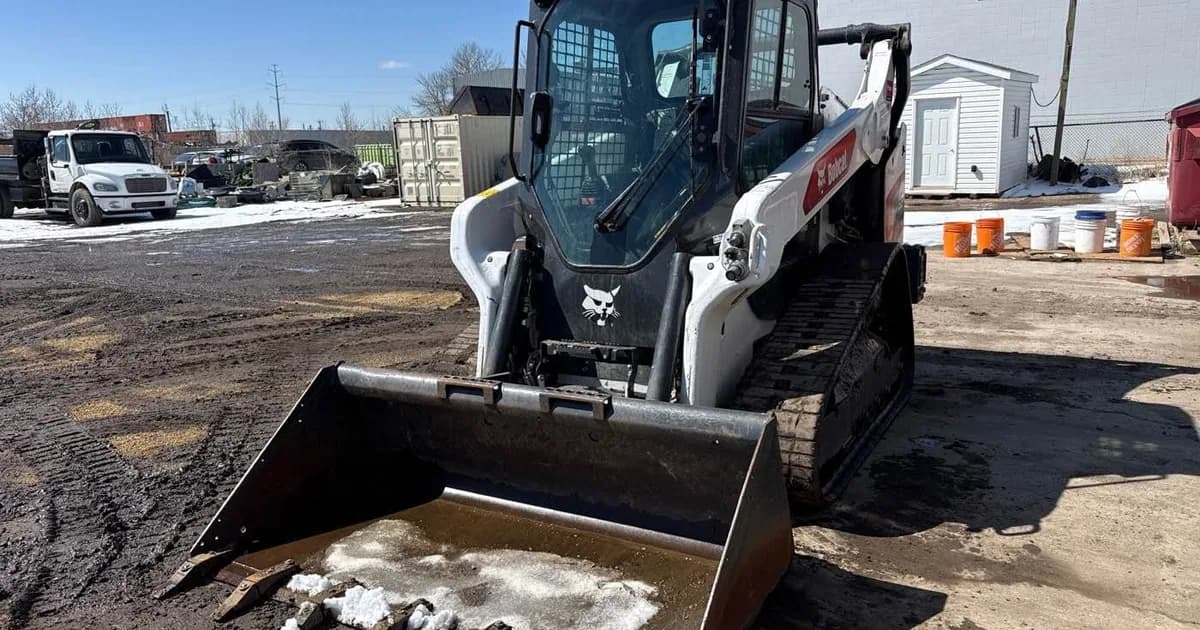
A skid steer is one of the most versatile machines on any job site. With the right attachments, it grades, digs, lifts, sweeps, breaks concrete, and clears brush. It is the Swiss Army knife of heavy equipment, and that versatility is exactly why so many contractors in Canada need one — and why financing one is usually a straightforward process.
Whether you are looking at a brand new Bobcat S750, a used Cat 262 with 3,000 hours, or a John Deere 333G compact track loader, this guide covers everything you need to know about financing a skid steer in Canada. We will walk through common models and prices, what lenders look for, typical rates and terms, the lease vs buy decision, and how to bundle attachments into your deal.
Common Skid Steer Models and What They Cost
Before we talk about financing, let us talk about what you are financing. Skid steer prices in Canada range from about $18,000 for an older used machine to $115,000 or more for a brand new compact track loader. Here is a snapshot of popular models and typical price ranges.
| Model | Type | New Price Range (CAD) | Used Price Range (CAD) | Notes |
|---|---|---|---|---|
| Bobcat S450 | Small Frame | $42,000 - $50,000 | $18,000 - $32,000 | Great for tight spaces, landscaping |
| Bobcat S650 | Medium Frame | $55,000 - $75,000 | $25,000 - $50,000 | Most popular size, very versatile |
| Bobcat S750 | Large Frame | $65,000 - $80,000 | $35,000 - $55,000 | More lift capacity, bigger jobs |
| Cat 242D3 | Small Frame | $45,000 - $55,000 | $22,000 - $38,000 | Smooth controls, good visibility |
| Cat 262D3 | Medium Frame | $55,000 - $75,000 | $28,000 - $50,000 | Strong performer, dealer support |
| John Deere 320G | Medium Frame | $52,000 - $65,000 | $25,000 - $42,000 | Reliable, good resale |
| John Deere 333G | CTL | $70,000 - $90,000 | $40,000 - $65,000 | Track version, soft ground king |
| Kubota SVL75-3 | CTL | $90,000 - $115,000 | $35,000 - $60,000 | Popular compact track loader |
| Case SV340B | Large Frame | $75,000 - $95,000 | $40,000 - $60,000 | Strong hydraulics, good for attachments |
Treat these as indicative ranges, not a price sheet — actual prices move with year, hours, condition, region, and the exchange rate, so verify current listings before you budget. The sweet spot for most contractors is a medium-frame skid steer in the $35,000 to $65,000 range. That is big enough to handle real work but not so expensive that the financing becomes a burden. Compact track loaders (CTLs) like the John Deere 333G or Kubota SVL75-3 cost more — generally 15–30% more than a comparable wheeled skid steer — but work on soft ground where wheeled machines struggle, and they hold that premium on resale.
New vs Used: What Makes Sense Financially
This is one of the first decisions you need to make, and it affects your financing more than you might think.
New skid steers come with a factory warranty (typically 2 to 3 years), the latest emissions technology, better fuel efficiency, and smoother controls. Financing is straightforward — lenders love new equipment because the value is clear and the risk of breakdown is low. You can get longer terms (up to 7 years) and lower rates. The downside is the price and the depreciation. A new skid steer loses 15-25% of its value in the first two years.
Used skid steers cost 30-50% less than new, and the heavy depreciation has already happened. A 3-year-old Bobcat S650 with 2,500 hours can do the same work as a new one for $30,000 to $40,000 less. These machines hold value unusually well — a well-maintained skid steer or CTL commonly resells for roughly 40–60% of its original cost years down the road, which is exactly why lenders treat them as easy collateral. Financing terms are a bit shorter (3 to 5 years typically) and rates may be slightly higher, but your total cost of ownership is often lower. The risk is that you are buying someone else's problems if you do not inspect the machine carefully.
✓Key takeaway: For most contractors, a used skid steer in the 2-5 year old range with under 3,000 hours offers the best balance of price, financing terms, and remaining useful life. You skip the worst depreciation and still get a machine with plenty of years left.
If you are considering a used machine, our guide on used skid steer prices in Canada breaks down what you should expect to pay by model, year, and hours.
What Lenders Look for on a Skid Steer Deal
Skid steers are among the easiest pieces of equipment to finance in Canada. The dollar amounts are lower than excavators or dozers, the resale market is strong, and demand is consistent. But lenders still evaluate the deal based on several factors.
Your credit profile. Your credit score is the starting point, but lenders also look at your full credit history — payment patterns, existing debt, collections, and bankruptcies. For skid steer financing, here is a general breakdown:
| Credit Score Range | What to Expect |
|---|---|
| 750+ | Best rates (7-9%), lowest down payment, longest terms |
| 680-749 | Competitive rates (8.5-11%), standard terms |
| 620-679 | Moderate rates (11-14%), may need 15%+ down |
| 550-619 | Higher rates (14-18%), 15-20% down typical |
| Below 550 | Private lender territory, 18%+, 20-25% down |
These ranges are for equipment under about seven years old and reflect the June 2026 rate environment (prime 4.45%); equipment loans are typically quoted as prime plus a spread that widens as credit and machine age weaken, so any future Bank of Canada move shifts the whole table.
For more detail on how credit scores affect your equipment financing, check out our credit score guide.
Time in business. Lenders want to see that you have been operating for at least a year, and ideally two or more. Startups can still get financed, but expect higher rates and larger down payment requirements. If you have been in business for 5+ years with a clean track record, you are in a strong position.
Revenue and cash flow. The lender wants to know you can afford the payment. They will look at your bank statements (usually 3 to 6 months), your tax returns, or your financial statements. The payment should not eat up more than a reasonable portion of your monthly revenue.
The machine itself. For used skid steers, lenders look at the brand, model, age, hours, and condition. Bobcat, Cat, John Deere, and Kubota are easy because the resale market is well-established. A 2020 Bobcat S650 with 2,000 hours is an easy approval. A 2012 no-name loader with 7,000 hours and no maintenance records is a tougher sell.
There is no hard hours or age cutoff in Canada. What lenders actually cap is the machine's age at the end of the term, not its age today — typically around 10–12 years at payoff for banks and credit unions, about 15 for equipment finance companies, and sometimes to 20 for private lenders. That means a 15-year collateral cap plus a five-year term puts the oldest financeable machine at about 10 years old now. Hours work the same way: they feed the appraised value and remaining-life estimate that set your term and down payment, rather than triggering a flat decline.
Typical Rates and Terms for Skid Steer Financing
Here is what you should expect when shopping for skid steer financing in Canada. These are realistic ranges based on what we see in the market, anchored to the June 2026 rate environment.
Interest rates: roughly 7% to 18%, depending on your credit profile, the machine, and the lender. Since the Bank of Canada held its overnight rate at 2.25% and bank prime sits at 4.45%, equipment loans are quoted as prime plus a spread — the average contractor with decent credit financing a well-maintained skid steer lands somewhere in the 9-11% range.
Term length: 3 to 7 years (lenders quote 12 to 84 months). New skid steers can go up to 7 years. Used machines are typically 3 to 5 years, depending on age and hours. The lender wants the loan paid off while the machine still has meaningful value.
Down payment: typically 10% to 20%. Top-tier credit on a new machine may qualify for zero down; challenged credit means 15-25%. A federal option worth knowing: BDC's equipment loan can finance up to 125% of the purchase price — covering related costs like transport, installation, and attachments — with amortization up to 12 years.
Here is what monthly payments look like on a $50,000 skid steer at different scenarios:
| Scenario | Down Payment | Rate | Term | Monthly Payment | Total Interest |
|---|---|---|---|---|---|
| New, strong credit | $5,000 (10%) | 8% | 6 years | $789 | $11,810 |
| New, average credit | $7,500 (15%) | 11% | 5 years | $924 | $12,940 |
| Used, strong credit | $5,000 (10%) | 10% | 5 years | $956 | $12,360 |
| Used, average credit | $7,500 (15%) | 13% | 4 years | $1,140 | $12,220 |
| Used, fair credit | $10,000 (20%) | 16% | 4 years | $1,186 | $16,930 |
These numbers show why a skid steer is one of the most accessible machines to finance. Even at higher rates, the monthly payments are manageable for most operations because the total dollar amount is relatively low compared to excavators or dozers.
Lease vs Buy: Which Makes Sense for Your Skid Steer?
This is one of the most common questions we hear, and there is no universal right answer. It depends on how you use the machine.
Buying (loan financing) makes sense when:
- You plan to keep the skid steer for its full useful life (8+ years)
- The machine will run almost every day
- You want to own it free and clear after the loan is paid
- You want to build equity that you can use as a trade-in later
- You want maximum flexibility — no restrictions on hours or modifications
Leasing makes sense when:
- You want to upgrade to a newer machine every 3 to 5 years
- You want lower upfront cash and a lower monthly payment (an FMV lease finances only the depreciation, so payments run below a comparable loan)
- You prefer to keep the machine off your balance sheet (operating lease)
- The skid steer is for specific projects and you may not need it long-term
- You value predictable costs — lease payments are fixed, and warranty often covers the lease period
Common lease structures for skid steers:
| Lease Type | How It Works | Best For |
|---|---|---|
| $1 Buyout | You own it at the end for $1. Essentially a loan structured as a lease. | Contractors who want to own but prefer lease tax treatment |
| 10% Buyout | You can buy the machine at end of term for 10% of original value. | Contractors who probably want to keep it but want flexibility |
| FMV (Fair Market Value) | Buyout at end of term is whatever the machine is worth. | Contractors who plan to upgrade regularly |
| Operating Lease | Off balance sheet, return at end. | Businesses that want the machine for a specific period |
A lower lease payment does not make leasing categorically cheaper. Because skid steers depreciate slowly and hold strong resale, a loan usually minimizes your long-run cost if you keep the machine past payoff — you end up owning an asset that is still worth real money. Leasing wins on upfront cash, monthly payment, and flexibility to upgrade, not on total cost of ownership for a machine you intend to keep. The tax treatment differs too: in Canada, operating-lease payments are generally fully deductible as a current expense each year, while a purchased machine is written down over time through capital cost allowance (CCA) on a declining-balance basis, with the financing interest separately deductible (the principal is not). Run both past your accountant before deciding.
Key takeaway: If you are a contractor who runs a skid steer hard every day and plans to keep it for years, buy it — the strong resale means a loan usually costs less over the full life. If you like having the newest machine and your accountant likes keeping equipment off the balance sheet, lease it. There is no wrong answer — just pick what fits your situation.
Financing Skid Steer Attachments
One of the best things about a skid steer is the attachment ecosystem. A single machine with the right attachments can replace three or four pieces of equipment. But those attachments cost money, and you need a plan for financing them.
Common attachments and prices:
| Attachment | Price Range (CAD) | Common Use |
|---|---|---|
| General Purpose Bucket | $1,500 - $3,500 | Grading, loading, backfilling |
| Pallet Forks | $1,200 - $2,500 | Material handling |
| Auger | $2,200 - $7,000 | Post holes, footings |
| Hydraulic Breaker | $5,000 - $12,000 | Concrete demolition |
| Brushcutter | $4,000 - $10,000 | Land clearing |
| Trencher | $4,000 - $9,000 | Utility trenches |
| Grapple Bucket | $3,000 - $6,000 | Debris, logs, demolition |
| Snow Pusher | $2,500 - $5,000 | Winter revenue |
| Sweeper | $3,000 - $7,000 | Parking lots, cleanup |
How to finance attachments:
The best approach is to bundle attachments into your skid steer financing. If you are buying a $50,000 skid steer and need $15,000 in attachments, finance the full $65,000 as a single deal. This is easier than trying to finance attachments separately, and the rate is usually better because the total package has stronger collateral value.
Most lenders will happily include attachments in the equipment loan. Some programs are built for exactly this — BDC's equipment loan, for instance, finances up to 125% of the purchase price specifically to cover related costs like transport, installation, and attachments. Just make sure the attachments are listed on the loan agreement so there is no confusion about what is covered.
If you already own a skid steer and need to finance attachments separately, it gets trickier. Attachment-only financing under $10,000 is hard to find from traditional equipment lenders. Your best options are a business line of credit, a credit card with a promotional rate, or a general-purpose small business loan.
The Application Process
Getting financed for a skid steer in Canada is not complicated, but knowing what to expect saves time.
What you will need:
- Business registration or incorporation documents
- 3 to 6 months of business bank statements
- A quote or listing for the machine you want to buy
- Your driver's licence (for identity verification)
- Details on any existing equipment loans or leases
How long it takes: Most equipment lenders can give you a preliminary answer within 24 to 48 hours. Some, including IronFinance, can give you a same-day answer on straightforward deals. Full approval and funding typically takes 3 to 7 business days once all documents are submitted.
Private sale vs dealer purchase: You can finance a skid steer from either a dealer or a private seller. Dealer purchases are simpler because the dealer handles the paperwork and the lender has an established relationship. Private sales work too, but the lender will want a third-party appraisal and a lien search on the machine. If you are buying privately, our private-sale equipment financing guide walks through the lien search, the appraisal and the bill of sale.
Tips for Getting the Best Skid Steer Deal
After seeing hundreds of skid steer deals, here is what separates contractors who get good financing from those who overpay.
Know the market value. Before you apply, research what the machine you want is actually worth. Check dealer listings, auction results, and online marketplaces. If you are overpaying for the machine, the lender may not finance the full amount, and you are starting with negative equity.
Get pre-approved before you shop. Having a financing approval in hand when you negotiate with a dealer or private seller gives you leverage. The seller knows you are a serious buyer who can close quickly.
Compare at least three lenders. Banks, credit unions, captive finance companies (Bobcat Financial, Cat Financial), and independent equipment lenders all have different rates and terms. A 1% rate difference on a $50,000 loan over 5 years saves you about $1,500 in total interest.
Time your purchase. Dealers are most motivated to deal at the end of a quarter (March, June, September, December) when they are trying to hit sales targets. Used equipment prices also tend to dip in late fall and winter when demand slows.
Inspect used machines thoroughly. Pay for a mechanic to inspect any used skid steer before you commit. Check for frame cracks, loader arm play, hydraulic leaks, tire or track condition, and test all functions. A $500 inspection can save you $10,000 in surprises. Our guide on skid steer hours explains what to look for at different hour thresholds.
💡Key takeaway: Skid steers are one of the most financeable pieces of equipment in Canada because of their versatility, strong resale values, and manageable price points. Whether you have strong credit or challenged credit, there is usually a path to get one financed.
Sources: Bank of Canada rate decision and WOWA prime rate for the June 2026 rate context; BDC equipment loan for financing terms; Mehmi Group and Equipment Finance Canada for Canadian lender practice, terms, and lease structures; CRA guidance on leasing costs and capital cost allowance for tax treatment. Model price ranges are indicative snapshots that vary by year, hours, condition, and region; where model-level resale data is US-denominated it should be converted and checked against Canadian listings. Rate figures are current as of June 2026 and change at each Bank of Canada decision.
Ready to Get Started?
If you have a skid steer picked out — or you are still shopping and want to know what you qualify for — you can apply with IronFinance to get a real answer on your rate, term, and payment. We work with contractors across Canada at every credit level, and we will match you with the lender that fits your situation best. No obligation, no pressure, and checking your options does not affect your credit score.
Already own equipment, or eyeing a different machine?
Frequently Asked Questions
What credit score do I need to finance a skid steer in Canada?
A score around 680 or higher gets you the best rates on skid steer financing, with the very lowest pricing reserved for 750+. Equipment-focused lenders still work with scores as low as 550 — and private lenders below that — though you will pay higher rates and need a larger down payment. Skid steers are among the easier machines to finance at any credit level because of their strong resale value.
Can I finance skid steer attachments along with the machine?
Yes, most lenders will roll attachment costs into your skid steer financing. Buckets, forks, augers, brushcutters, and other attachments can be bundled into a single loan as long as the total amount fits within the lender's guidelines. This is usually the smartest move because attachment-only financing is harder to find and more expensive.
Is it better to lease or buy a skid steer?
It depends on how you use it. If the skid steer runs every day and you plan to keep it for years, buying makes more sense because you build equity and own the machine outright. If you need it for specific projects or want to upgrade every few years, leasing keeps your payments lower and gives you flexibility to swap machines.
Are compact track loaders financed on the same terms as wheeled skid steers?
Broadly yes, with one difference that shows up in the numbers: tracks are a large wear item and their remaining life affects both value and near-term cost. A track machine with worn undercarriage carries a repair bill an appraiser will discount for, in a way that tyres on a wheeled unit generally do not. Expect the condition of the tracks to be looked at closely on a used compact track loader, and get a measurement rather than an opinion.
Can I finance a skid steer bought from a private seller?
Yes, though it is underwritten as a different transaction than a dealer purchase rather than a cheaper version of one. The lender advances against appraised value, wants a registry search against both the serial number and the seller's legal name, and needs a bill of sale carrying that serial number. Any existing security interest must be paid out directly and discharged at closing. It is routine work, but it adds days — gather the seller documentation before applying, not after.