
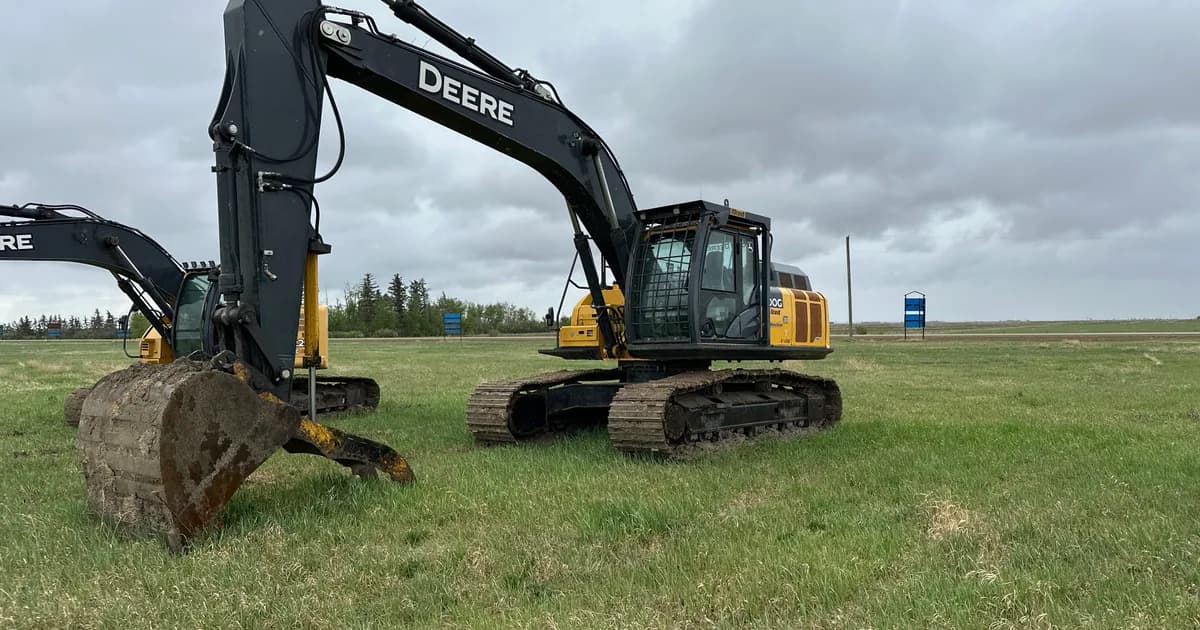
Here is the thing most contractors do not realize when they apply: the lender is not financing your excavator. They are financing the collateral. Your credit, your revenue, your time in business — all of it matters, but it sits on top of one question the underwriter asks first. If this deal goes sideways and we have to take the machine back, how fast can we sell it and for how much?
That single question is why excavators are the easiest piece of heavy iron in Canada to finance. A Cat 320, a Komatsu PC210, a Deere 210G — these are liquid assets. There is a deep used market, predictable depreciation, and a buyer in every province. The lender can model the downside, so they get comfortable on the upside. Once you understand that you are really selling the lender on the machine, the whole process makes more sense.
This guide walks through how excavator financing actually works in Canada in 2026 — what the lender scores, what the machines really cost (using live Canadian dealer-inventory pricing, not list-price guesses), your financing options, and how to get approved without wasting weeks.
Why Excavators Finance So Easily
Lenders sort heavy equipment into buckets by how confidently they can resell it. Excavators sit at the top. Three things put them there.
The resale market is deep and national. Ritchie Bros, MachineryTrader, MarketBook, dealer lots — there is a constant, liquid market for used excavators across Canada. A lender repossessing a Cat 336 is not stuck with an oddball asset; they have a dozen channels to move it. That liquidity is the whole game.
Depreciation is predictable, not brutal. Excavators typically lose around 20-25% in the first year, then settle into a slower 5-12% per year, holding roughly 40-70% of their value over a normal ownership cycle depending on hours and condition. Premium brands — Cat, Komatsu, Deere, Volvo, Hitachi — hold the high end of that range. Predictable depreciation means the lender can draw a straight line from today's value to the machine's value at any point in your term and know they are covered.
The 2026 market is soft, not scary. The used-equipment market has been normalizing off its 2021-2023 pandemic peak. Ritchie Bros reported year-over-year price declines on excavators and wheel loaders through 2025, and RB Global's construction and transportation auction volume eased about 2% on the year before strengthening 9% in the fourth quarter. The takeaway for you: prices have come down from the highs, which is good for buyers — and because the decline has been orderly rather than a collapse, it does not rattle underwriters. Stable, slightly-softening collateral is exactly what a lender likes to lend against.
The flip side is just as important. The machine works for you when it is a recognized brand with documented hours, and against you when it is an off-brand import with no Canadian dealer network. Same contractor, same credit — one deal funds in three days and the other gets declined, purely on collateral liquidity.
What Excavators Actually Cost in Canada
Before financing, you need a real read on price. The numbers below come from live Canadian dealer inventory pulled in June 2026 — actual asking prices on active listings, not MSRP estimates. New-machine list prices are not publicly published and swing widely with configuration, attachments, and dealer, so the most honest signal for "near-new" is the top of each used range, where you will see recent low-hour units.
Mini Excavators (Under 10 Tons)
The workhorses of residential, landscaping, utility, and tight-space work: Cat 303–308, Kubota KX-series, Bobcat E35–E85, John Deere 35G–60G, Takeuchi TB-series.
| Model Family | Used Asking Range | Typical (median) | Notes |
|---|---|---|---|
| Cat 305/308 | $23,500–$183,300 | ~$81,000 | High end = new/near-new 2024 units |
| Kubota KX (040–080) | $22,500–$177,800 | ~$99,000 | Small-frame to 8-ton |
| Bobcat E-series | $39,000–$124,900 | ~$70,000 | E35 to E85 |
| John Deere 35G–60G | $48,000–$118,900 | ~$84,500 | Deep supply on the Prairies |
| Takeuchi TB | $46,000–$155,000 | ~$85,000 | Reduced-tail-swing models |
Financing note: most used minis land between $55,000 and $100,000. The dollar amounts are low enough that some equipment lenders' minimum-deal thresholds come into play — many set a floor in the low five figures, below which you are looking at a line of credit or a dealer in-house plan instead. Minis from the major brands are still easy to place because they sell fast.
Mid-Size Excavators (10–30 Tons)
The sweet spot for most construction contractors — commercial excavation, road work, site development: Cat 320/325, Komatsu PC210, John Deere 210G, Volvo EC220, Hitachi ZX210.
| Model Family | Used Asking Range | Typical (median) | Notes |
|---|---|---|---|
| Cat 320 | $63,500–$252,500 | ~$144,900 | The Honda Civic of excavators |
| Komatsu PC210 | $69,000–$275,000 | ~$187,500 | Strong Western Canada supply |
| John Deere 210G | $70,000–$280,000 | ~$177,800 | Prairie-heavy inventory |
| Volvo EC-series | $60,000–$625,000 | ~$175,000 | Spans mid to full size |
| Hitachi ZX | $49,000–$635,000 | ~$148,000 | ZX210 up through ZX670 |
Financing note: these are the most-financed excavators in the country. Lenders have years of resale data on a Cat 320 or PC210, they know the market cold, and they are comfortable. This is where the best rates and longest terms live.
Full-Size Excavators (30+ Tons)
Large commercial, demolition, quarry, and major earthmoving: Cat 330/336/349/390, Komatsu PC360/490, John Deere 350G, Hitachi ZX350+.
| Model Family | Used Asking Range | Typical (median) | Notes |
|---|---|---|---|
| Cat 330 | $57,500–$399,000 | ~$127,000 | 2023 330 GC near the top |
| Cat 336 | $74,000–$399,500 | ~$170,400 | Volume model in the class |
| Komatsu PC360/390 | $60,000–$329,500 | ~$108,700 | Thinner supply, more spread |
Financing note: bigger numbers mean deeper underwriting — expect the lender to want detailed financials and to confirm the revenue supports the payment. But these machines are excellent collateral and hold value well, so a contractor who can show the work can absolutely finance a $400,000 Cat 336.
For a deeper dive on used pricing, see our average used excavator price guide.
What the Lender Scores on Your Excavator
Every machine gets underwritten differently. Here is what moves the needle specifically on excavators.
Brand and model liquidity. Cat, Komatsu, Deere, Volvo, Hitachi, Kobelco — known quantities with national dealer networks, parts availability, and active resale. An off-brand or grey-market import with no Canadian dealer support is much harder to finance, because the lender cannot price the downside. This is the single biggest collateral factor.
Hours. This is the mileage equivalent and it drives financeability hard. Industry and dealer data put a hydraulic excavator's useful life around 10,000 hours, with well-maintained machines running 10,000-20,000; contractors typically retire one from primary production at about six years or roughly 9,800 hours. Mini excavators usually deliver 8,000-12,000 productive hours. Lenders read hours against those benchmarks:
| Hours Range | Financing Difficulty | Typical Lender Response |
|---|---|---|
| Under 3,000 | Easy | Best rates and terms |
| 3,000–6,000 | Easy to moderate | Standard terms |
| 6,000–10,000 | Moderate | May want more down |
| 10,000–15,000 | Harder | Higher rate, shorter term |
| Over 15,000 | Difficult | Private lenders, high down |
Our excavator hours guide goes deep on where the real thresholds sit.
Age at end of term. Most lenders want the machine under 12-15 years old when your final payment lands. A 5-year loan on a 2021 machine is fine; the same term on a 2013 machine puts it at 18 years old at maturity, which most banks will not touch. Some private lenders flex on age for well-kept major-brand iron — we cover that in the equipment age guide.
Condition and documentation. Dealer service records, oil-sample history, and a recent inspection make the same machine worth more to a lender than an identical unit with no paper. If you are buying used, get the records — for major brands the dealer can often pull service history by serial number.
Application. A demolition machine takes more abuse than one doing general excavation or grading. Lenders may ask what the unit will do and lean toward lower hours or a shorter term on hard-use applications. It does not kill the deal; it shapes the terms.
Your Four Financing Lanes
There are four ways to fund an excavator in Canada, and the right one depends on the machine, your credit, and how fast you need to move.
1. Your bank. Best rates if you have strong credit, two-plus years in business, and clean financials — and you are buying a clean, late-model machine. The trade-off is speed and flexibility: banks want the full document package and take one to several weeks, and they are conservative on age, hours, and private-party sales.
2. Captive (manufacturer) finance. The brands run their own lenders, and this is where the sharpest new-machine promos live:
- Komatsu Financial operates a Canadian entity with purchase and lease terms from 12 to 60 months and rotating 0%-financing-for-up-to-48-months promotions on compact excavators (models like the PC30–PC55MR). Authorized Canadian distributors such as SMS Equipment run these offers across the West.
- Volvo Financial Services has offered rates as low as 0% for up to 48 months for qualified buyers on model-year-2025-and-newer crawler and wheeled excavators (one such program ran in Canada through June 30, 2026).
- Cat Financial and John Deere Financial also finance in Canada through their dealer networks.
Captive promos are model-specific, credit-qualified, and time-limited — a 0% headline almost always applies to select new models for a limited window, with standard rates on everything else. Always confirm the current offer with the dealer before you build your numbers around it.
3. Private equipment lenders. Faster and far more flexible on credit, age, hours, and private sales — often funding in days. You pay for it in rate (commonly 12-20% on challenged files). For used machines, bad credit, or private-party deals that a bank will not touch, this is usually the lane.
4. A broker. A broker like IronFinance submits your one application to multiple lenders — bank, captive, and private — and brings back the live options. It saves you the legwork and usually surfaces a better fit than going door to door. Our rate comparison guide explains how to weigh the offers.
Rates and Terms in 2026
Rates float off the prime rate, which sits at 4.45% in June 2026 (the Bank of Canada held its policy rate at 2.25% on June 10). These are directional ranges based on current market conditions, not quotes — your actual rate depends on the full picture of your credit, the machine, and the lender.
| Credit Profile | New / Clean Late-Model | Used (5–10 yr, higher hours) | Term | Down |
|---|---|---|---|---|
| Excellent (720+) | 6.5–9% | 8–11% | 5–7 yr | 0–15% |
| Good (680–719) | 8–11% | 9.5–13% | 4–6 yr | 10–20% |
| Fair (620–679) | 11–15% | 12–16% | 3–5 yr | 15–25% |
| Challenged (<620) | 14–20% | 15–22% | 3–4 yr | 20–25%+ |
The honest version: strong credit on a tired machine does not get a strong-credit rate, and a clean new machine does not rescue a rough credit file. Your terms come from both sides of the deal at once. The best pricing happens when your credit and the collateral are both solid.
One number that quietly improves the math: the tax treatment. Heavy mobile equipment falls in CCA Class 38 (30%), and for 2026 the Reaccelerated Investment Incentive lets you write off roughly three times the normal first-year depreciation. That accelerated deduction can meaningfully offset your financing cost in year one — worth a conversation with your accountant before year-end. Our lease vs. finance guide digs into the tax side.
The Process, Start to Finish
1. Nail down the machine. Dealer purchase: get a written quote. Private sale: get the serial number, year, make, model, hours, and asking price. Lenders underwrite specifics, not "a 320-ish excavator."
2. Gather your documents. Typically two years of financials or tax returns (T2 for corporations, T1 with business schedule for sole proprietors), three to six months of business bank statements, photo ID, the equipment details, and proof of your down payment. Banks want the full set; private lenders often work off bank statements plus the equipment. Having it ready speeds everything up.
3. Apply — directly to a lender, or through a broker who submits to several at once.
4. Underwriting. The lender pulls credit, evaluates the deal, and may ask for a contract showing upcoming revenue, an explanation of a credit blemish, or an inspection. Clean files move in 24 hours to a couple of days with a private lender, one to two weeks with a bank.
5. Documentation. Read the agreement before signing — rate, payment, term, fees, prepayment terms, and insurance requirements. Confirm the numbers match what you discussed.
6. Funding. Dealer deals: the lender pays the dealer directly. Private sales: funds typically flow through a lawyer or to the seller with a lien registered on the machine. Then it is yours to put to work.
| Lender Type | Typical Timeline |
|---|---|
| Private lender (dealer purchase) | 3–5 business days |
| Private lender (private sale) | 5–10 business days |
| Bank (dealer purchase) | 2–5 weeks |
| Bank (private sale) | 3–6 weeks |
| Captive (Komatsu, Volvo, etc.) | 1–2 weeks |
Field-Tested Tips
The serial number is the whole verification. A legitimate seller hands it over without hesitation. It lets the lender check liens, confirm specs, and — for some brands — pull service history and hours. Reluctance to share it is a red flag; walk away.
Run the lien search yourself. Before you get deep into a private deal, do a PPSA (Personal Property Security Act) search on the serial number to confirm nobody else has a claim on the machine. It is genuinely cheap through the provincial registries — a self-serve online search runs about $7-$10 in BC and $8 in Ontario, well under $20. If the seller still owes money on the unit, that lien has to clear before your lender will fund. Your broker or lender does this too, but checking yourself early saves wasted effort.
An inspection pays for itself. A few hundred dollars on a pre-purchase inspection either strengthens your application (clean report) or saves you from a bad machine before you have sunk time into paperwork. Either outcome is a win.
Buy in the off-season. The Canadian equipment market is seasonal — demand and prices soften in late fall and winter. Buying in November or December often means a lower purchase price (so you finance less), and lenders chasing year-end targets can be more aggressive on rate.
Bundle multiple machines. Buying two or three units at once? Many lenders will package them into one deal, which simplifies the paperwork and can earn a better rate on the larger total.
Match the machine to the work. A Cat 336 is a lot of machine. If 80% of your work runs on a 320, you are paying for capacity you rarely use. Finance the machine that fits your typical workload — and remember the payment is not the only cost. Fuel, maintenance, insurance, and repairs add up; a good rule of thumb is that the machine should generate three to four times its monthly payment in revenue.
Common Mistakes to Avoid
- Financing more machine than the work supports. Capacity you do not use is just a bigger payment.
- Shopping rate instead of total cost. An 8% rate with $2,500 in fees can beat a 7% rate with none, or lose to it — compare the all-in cost.
- Waiting until you have found the machine to start financing. Get pre-approved so you can move when the right unit shows up; approval takes time and good deals do not wait.
- Not reading the agreement. Prepayment penalties, insurance requirements, and fees live in the fine print. Read it.
- Putting too little down when you can afford more. A larger down payment lowers the payment, cuts total interest, and can improve your rate — just keep enough working capital to operate.
Sources: live IronFinance Canadian dealer inventory (used prices, June 2026); Komatsu Financial; Volvo CE Canada current offers; Ritchie Bros / RB Global market trends; Construction Equipment magazine (equipment economic life); BC Personal Property Registry fees; Ontario lien search (Access Now); Bank of Canada policy rate. Prices and rates verified June 2026.
Getting Started
Financing an excavator in Canada is a well-worn path — thousands of contractors do it every year, and it is straightforward when you go in prepared. Know your credit, have your documents ready, and understand both the machine and the market you are buying into.
If you want help finding the right lender for your specific situation, get in touch with IronFinance. We work with contractors across the country and match each deal to the right lender — a bank for a prime deal on a new Cat, a captive program for a 0% new-machine promo, or a private lender for a used Komatsu when you need speed and flexibility.
For more, explore our related guides on used excavator financing, what excavator hours mean for financing, average used excavator prices, and the monthly payment on a $150K excavator.
Already own equipment, or eyeing a different machine?
Frequently Asked Questions
How much do you need to put down to finance an excavator in Canada?
Strong credit on a new or late-model machine can mean zero to 10% down. The typical range is 10-20%. Older units, high-hour machines, or weaker credit usually need 15-25%, and private-seller deals almost always want at least 10% regardless of credit. Our down payment guide breaks it down by scenario.
Can you finance an excavator with bad credit in Canada?
Yes. Below roughly 650 you are mostly working with private lenders, not banks. Expect rates in the 12-20% range, 15-25% down, and a shorter term. The machine carries the deal: a Cat, Komatsu, Deere, Volvo or Hitachi with reasonable hours is far easier to place than an off-brand import, because the lender knows it can resell the collateral.
What is the maximum term for excavator financing in Canada?
New excavators typically finance over 5-7 years. Clean used units with reasonable hours get 4-6 years. Older or high-hour machines are usually capped at 3-4 years. The governing rule is the machine's age at the end of the term — most lenders want it under 12-15 years old when the last payment lands, because that protects their collateral value.
Do excavator manufacturers offer their own financing in Canada?
Yes. Komatsu Financial runs a Canadian entity with 12-60 month terms and rotating 0%-up-to-48-month promos on compact excavators, and Volvo Financial Services has offered 0% for up to 48 months on model-year-2025-and-newer excavators in Canada. Cat Financial and John Deere Financial also operate here. Captive promos are model-specific and time-limited, so always confirm the current offer before you count on it.
Is 2026 a good time to buy a used excavator in Canada?
Prices have eased. Ritchie Bros reported year-over-year price declines on excavators through 2025, and the used market has been normalizing off its 2021-2023 peak rather than crashing. That is good for buyers and it does not spook lenders, because the declines have been orderly and excavators still hold 40-70% of their value over a typical ownership cycle.