
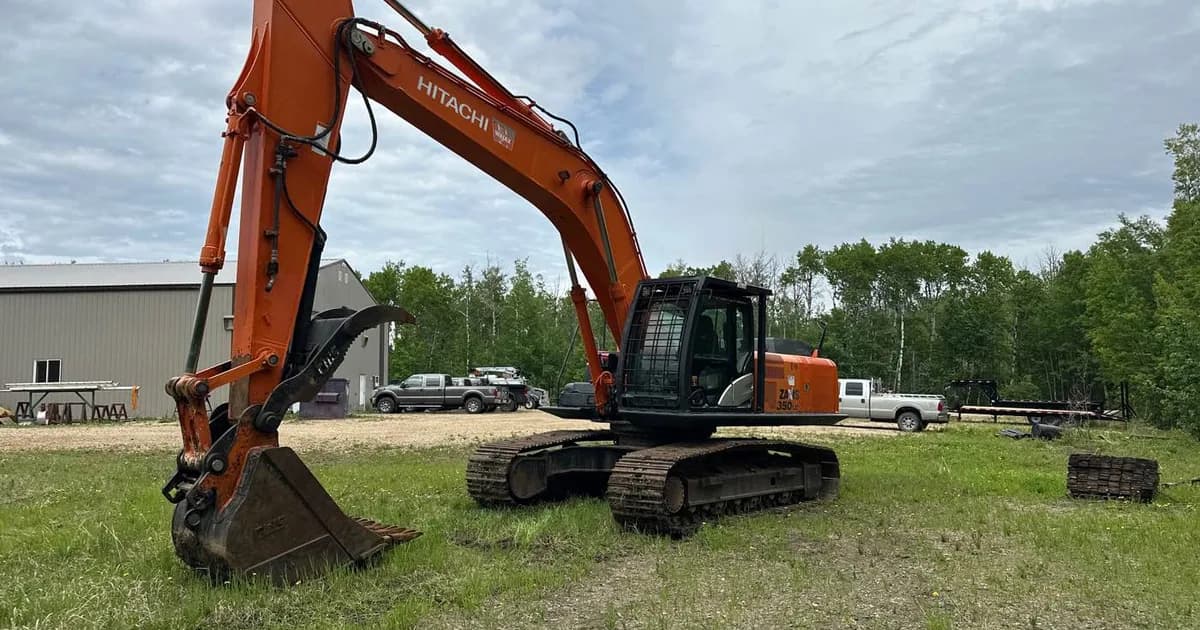
You have two listings open on your phone. A 2013 Hitachi ZX210 at $49,000 with 13,400 hours, and a 2013 Hitachi ZX250 at $175,000 with 5,675 hours. Same brand, same year, both sitting on real lots in Alberta right now. One costs three and a half times the other. If you cannot explain why, you are not ready to buy — because the seller across the table can, and that gap is exactly where you either get a deal or get taken.
Pricing a used excavator is not guesswork. It is a small number of factors — hours, condition, brand, year, emissions tier, and where you buy — applied in a predictable way. This guide gives you the real numbers from live Canadian dealer inventory, breaks down what moves them, and shows how the price you pay shapes the financing you can get. Read a price like an appraiser does, and no listing can surprise you.
What a Used Excavator Actually Costs Right Now
Used excavators sort into three size classes, and the price gap between them is enormous. Here is the live picture across Canada in mid-2026. Prices have come well off the 2022-2023 peak — Ritchie Bros./RB Global's quarterly Market Trends reports show Canadian earthmoving values still drifting down through 2025 — so today's buyer has leverage that did not exist two years ago.
Mini Excavators (Under 10 Tonnes): $20,000 - $120,000
Minis are the entry point — residential builds, landscaping, utility and trenching work, anything in tight spaces. The range is wide because the class spans a 1.5-tonne micro to a 9-tonne machine that does real production work. An old, high-hour micro like a 2016 John Deere 26G lists around $20,000. A near-new Kubota KX080 or Cat 308 pushes past $120,000.
Most working contractors land in the middle. Across live dealer inventory, the median asking price for popular compacts — the Cat 305/308, Kubota KX, Bobcat E-series, John Deere G-series — sits around $70,000 to $95,000. That gets you a 3-to-7-year-old machine from a name brand with a few thousand hours on it.
Mid-Size Excavators (10 - 30 Tonnes): $70,000 - $280,000
This is the contractor's bread-and-butter class — the Cat 320, Komatsu PC210, John Deere 210G, Volvo EC220, and Hitachi ZX210. These machines hold their value better than almost anything else on a jobsite, which is why a clean late-model unit still commands six figures years after it left the dealer.
A 2012-2013 example with high hours can be had in the $70,000 range. A 2018 John Deere 210G with mid hours sits around $219,000 on a Saskatchewan lot today, and a 2023 210GLC with 1,662 hours is listed at $280,000. The jump from "older working machine" to "late-model low-hour" roughly doubles the price.
Full-Size Excavators (30 Tonnes and Up): $75,000 - $400,000+
The heavy iron for major earthmoving, demolition, aggregate, and site prep — Cat 330 and 336, Komatsu PC360 and PC390, John Deere 350G, Hitachi ZX350. The spread here is brutal because hours and age compound on machines that cost this much new.
A 2017 Cat 336EL with nearly 11,000 hours lists at $74,000 in Ontario. A 2019 Cat 336GC with 9,293 hours runs $138,000. A 2015 336F with 7,000 hours sits at $220,000, and a 2021 336 with 4,100 hours commands $315,000. The very largest production machines — a Hitachi ZX670 class unit — climb past $600,000 even used.
Key takeaway: Within a single size class, hours and condition can swing the price by a factor of three or more. The size class sets the ballpark; everything after that is about the individual machine. Never anchor on "what a Cat 336 costs" — anchor on what this Cat 336 costs given its hours, year, and shape.
Real Prices by Model
These ranges come from active dealer and auction listings across Canada as of June 2026. Asking prices run a little above final transaction prices — expect to negotiate 5-10% off a private or dealer ask, less at a busy auction.
Mini Excavator Pricing
| Model | Typical Year | Typical Hours | Used Price (CAD) |
|---|---|---|---|
| Cat 305 / 305.5 | 2018-2022 | 1,500-4,000 | $52,000-$96,000 |
| Cat 308 | 2019-2024 | 800-3,000 | $60,000-$120,000 |
| Kubota KX040 | 2018-2024 | 1,000-3,500 | $45,000-$75,000 |
| Kubota KX080 | 2019-2023 | 1,000-3,000 | $75,000-$130,000 |
| Bobcat E35 / E45 | 2017-2022 | 1,000-3,500 | $45,000-$75,000 |
| Bobcat E60 / E85 | 2018-2022 | 1,200-3,500 | $60,000-$125,000 |
| John Deere 35G | 2018-2023 | 800-3,000 | $50,000-$80,000 |
| John Deere 60G | 2019-2023 | 600-3,000 | $75,000-$119,000 |
| Takeuchi TB260 / TB290 | 2019-2023 | 700-2,500 | $65,000-$120,000 |
Mid-Size Excavator Pricing
| Model | Typical Year | Typical Hours | Used Price (CAD) |
|---|---|---|---|
| Cat 320 (all variants) | 2012-2016 | 5,000-10,000 | $70,000-$130,000 |
| Cat 320 (all variants) | 2017-2020 | 3,000-7,000 | $130,000-$200,000 |
| Cat 320 (all variants) | 2021-2023 | 1,500-4,000 | $200,000-$270,000 |
| John Deere 210G | 2012-2016 | 5,000-10,000 | $70,000-$130,000 |
| John Deere 210G | 2018-2023 | 1,500-5,000 | $180,000-$280,000 |
| Komatsu PC210 | 2014-2020 | 3,000-8,000 | $80,000-$190,000 |
| Volvo EC220 | 2017-2021 | 3,000-7,000 | $110,000-$190,000 |
| Hitachi ZX210 | 2013-2020 | 3,000-13,000 | $49,000-$160,000 |
| Hitachi ZX250 | 2013-2020 | 4,000-9,000 | $120,000-$190,000 |
Full-Size Excavator Pricing
| Model | Typical Year | Typical Hours | Used Price (CAD) |
|---|---|---|---|
| Cat 330 | 2014-2019 | 5,000-10,000 | $130,000-$260,000 |
| Cat 336 | 2015-2019 | 7,000-11,000 | $74,000-$220,000 |
| Cat 336 | 2020-2023 | 2,500-6,000 | $260,000-$400,000 |
| Komatsu PC360 / PC390 | 2014-2020 | 5,000-10,000 | $78,000-$200,000 |
| John Deere 350G | 2017-2021 | 4,000-8,000 | $180,000-$310,000 |
| Hitachi ZX350 | 2016-2020 | 4,000-9,000 | $150,000-$280,000 |
Key takeaway: Brand matters in price. A Cat consistently commands a 10-20% premium over a comparable Komatsu, Deere, or Hitachi of the same year and hours. You pay it on the way in — but Cat's deeper resale market and dealer network means you get a chunk of it back on the way out. Across the majors, a well-kept, high-demand machine holds roughly 45-70% of its purchase price after five years (Heavy Equipment Appraisal). Premium brands cost more and hold more.
What Drives the Price
Two machines with the same badge and year can be priced $50,000 apart. Here is what explains the gap.
Hours on the clock. This is the single biggest price driver, full stop. Go back to those two 2013 Hitachis — the 13,400-hour ZX210 at $49,000 and the 5,675-hour ZX250 at $175,000. A bigger machine, yes, but the hour spread is doing most of the work. Value falls fastest early: a clean machine at 6,000-8,000 hours typically sells 20-40% below a comparable unit under 2,000 hours (Heavy Equipment Appraisal). An excavator's economical service life runs roughly 10,000 to 15,000 hours, and past about 10,000 hours it should be priced as a machine that will need regular repairs — the hour meter alone stops signalling value cleanly (SupplyPost, 2026). Our guide on excavator hours covers the thresholds in detail.
Condition and maintenance records. Same year, same model, same hours, and the price can still split $30,000-$50,000 on condition alone. Full service records, tight pins and bushings, healthy undercarriage, no cylinder leaks, and clean paint earn a premium. No records, worn tracks, and a cracked cab sell at a discount because the buyer is pricing in the repairs they can see and fearing the ones they cannot.
Attachments and configuration. A machine with a quick coupler, a hydraulic thumb, and two or three buckets is worth more than a bare unit with one bucket. A hydraulic quick coupler runs roughly $4,000-$12,000 as an option and auxiliary hydraulics another $3,000-$7,000 (SupplyPost, 2026); a GPS grade-control system adds more again. How much of that you recover at resale is hard to pin down — but a better-equipped machine is easier to sell, so compare like-equipped units, not a loaded machine against a bare one.
Emissions tier. Tier 4 Final standards took full effect on excavator-size engines (roughly 56-560 kW) around model-year 2014, so a 2015-and-newer machine meets current North American emissions rules without workarounds. Some municipal and government contracts require Tier 4 Final iron, which thins the buyer pool for older Tier 3 machines and softens their resale price.
Where in Canada it sits. Construction-heavy markets — the GTA, Calgary, the Lower Mainland — price higher on demand. Quieter regions price lower. Moving a machine between provinces can add $2,000-$8,000 in transport, so a "cheaper" out-of-province unit is not always cheaper once it is on your yard.
Season and new-machine supply. Prices firm up in spring (March-May) as the build season starts and soften in late fall and winter. And when new excavators are backordered — as they were in 2021-2023 — used prices spike because buyers who cannot wait turn to the secondary market. With new supply normalized in 2026, that pressure is off.
Dealer, Private, or Auction — and What Each Really Costs
Where you buy changes both the price and the risk you carry home. The three channels are not interchangeable.
Equipment Dealers
A dealer prices at or near full market value and has the least room to move, because the lot, the staff, and the warranty reserve all have to be covered. What you buy with that premium is certainty: the machine is usually inspected and serviced, often carries a 30-90 day or powertrain guarantee, comes with clean title and lien work done, and can be test-run before you commit. Dealers also make financing easy — lenders prefer dealer paper. The markup over what the dealer paid typically runs 15-25%. For a contractor who is financing and wants a known quantity, that premium is the price of sleeping at night.
Private Sellers
A private seller usually prices 5-15% below a comparable dealer ask, because there is no overhead to cover and a motivated seller — someone retiring or downsizing — may want it gone. You get a lower price, more negotiating room, and the chance to see the machine in its working environment and talk to the operator. The trade-off is real: no warranty, as-is, more risk of undisclosed problems, and a financing process that requires you to do the verification a dealer would otherwise handle — PPSA lien searches, an appraisal, an inspection. A self-serve PPSA lien search runs about $7-$10 in BC and $8 in Ontario, and skipping it is how buyers inherit someone else's loan. Our used excavator financing guide walks through financing a private-party deal.
Auctions (Ritchie Bros., IronPlanet)
Here is where most buyers misjudge the math. An auction hammer price often lands 10-20% under a dealer ask, and the fee on a heavy machine is smaller than the lore suggests. Ritchie Bros.' Canadian buyer transaction fee is tiered: 10% on lots selling for $12,000 or less, 4.85% on lots from $12,000 to $75,000, and a flat CAD $3,638 on anything selling over $75,000. On a $250,000 excavator, that $3,638 is about 1.5% — not the "10-15% buyer's premium" people repeat from the small-lot world.
So the real cost of buying at auction is not the fee. It is everything else: the machine sells as-is, where-is, with no warranty; you get limited time to inspect and usually cannot operate it; transport is on you; and the auction floor is engineered to make you bid past your number. Ritchie Bros. does publish inspection reports on most machines, which helps. But you need financing arranged before you raise your hand, because you are committed the moment the hammer drops.
Key takeaway: Dealers sell you safety at a premium. Private sellers sell you savings in exchange for doing your own due diligence. Auctions can be the cheapest path on a big machine — the flat fee barely moves the needle — but they hand you the most risk and the strongest temptation to overpay. Match the channel to how well you can read a machine yourself.
How the Price Shapes Your Financing
The number on the listing does more than empty your bank account. It sets the terms of your loan.
Loan-to-value is the lender's first question. Lenders lend against what the machine is actually worth, not what you agreed to pay. Buy at or below market and your LTV is clean and the file moves. Overpay — finance a $130,000 machine that appraises at $100,000 — and the lender funds the $100,000 and leaves the $30,000 gap for you to cover in cash. Knowing real market value protects you here.
Down payment scales with price. Down payment is a percentage of the purchase price, so a cheaper machine ties up less cash. A $200,000 excavator at 15% down needs $30,000; a $120,000 machine at the same 15% needs $18,000. That $12,000 difference is working capital you keep.
A lower price does not always mean a lower payment. Cheaper machines are usually older and higher-hour, which means a higher rate and a shorter term. Here is what that looks like with real machines on the market today:
| Machine | Price | Structure | Est. Monthly Payment |
|---|---|---|---|
| 2020 Kubota KX080 mini | $98,900 | 10% down, 9% APR, 60 mo | ~$1,850 |
| 2018 Cat 320 mid-size | $175,000 | 10% down, 9% APR, 72 mo | ~$2,840 |
| 2013 Hitachi ZX210 (13,400 hr) | $85,000 | 15% down, 13% APR, 36 mo | ~$2,435 |
| 2021 Cat 336 full-size | $315,000 | 15% down, 8.5% APR, 72 mo | ~$4,760 |
Look at the Cat 320 against the high-hour ZX210. The ZX210 costs less than half as much, but the shorter term and higher rate put its monthly payment within $400 of the far newer, far better machine. Half the price is not half the payment. Our rate guide breaks down where those rates come from. (Payments are estimates for illustration; your actual terms depend on credit, lender, and the machine.)
Mind the minimum. Most equipment lenders have a floor of $15,000-$25,000 on the amount financed. Buy a $20,000 mini with 20% down and you are financing $16,000 — right at or below some lenders' minimums. Know the floor before you shop the bottom of the market.
Red Flags in a Used Excavator Price
The price itself is often the first clue that something is off. Watch for these.
A price far below market. A 2020 Cat 320 with 3,000 hours listed at $110,000 when comparable machines are $180,000-plus is not a deal — it is a warning. Undisclosed damage, an outstanding lien, a salvage history, or an outright scam all show up first as a price that is too good. Verify the serial number and run a lien search before you get excited.
A price far above market, framed as firm. Some sellers anchor high expecting a negotiation. A machine priced 15-20% over market is a starting point; one priced 30%-plus over is either an unrealistic seller or one who is not actually motivated to sell. Use the tables above to anchor your offer to reality, not to their ask.
The "auction premium" myth working against you. Sellers and brokers sometimes justify a high fixed price by claiming you would "lose 10-15% to buyer's premiums at auction anyway." On a machine over $75,000, that is simply false — the Ritchie Bros. fee caps at a flat $3,638. Do not let a bad number talk you into overpaying retail.
Bundled attachments inflating the sticker. A $140,000 machine with a thumb, a coupler, and three buckets is a different deal than a $140,000 machine with a single bucket. Get an itemized list of what is included before you compare it to anything.
US-import currency games. Some machines listed in Canada were imported from the States. The price should already reflect Canadian dollars including duties, taxes, and import fees. Make sure you are comparing CAD to CAD, not a converted US sticker that hides the landed cost.
Sources: live Canadian dealer inventory (June 2026); Ritchie Bros / RB Global Market Trends (Q3 2025) and Canadian buyer transaction fee schedule; Heavy Equipment Appraisal value-retention data; SupplyPost 2026 used-excavator guides; MachineryTrader; US EPA Tier 4 nonroad diesel standards via DieselNet.
Next Steps
Knowing what a machine is really worth is what lets you walk into any deal — dealer lot, private yard, or auction floor — and know within minutes whether the price in front of you is fair. The next step is making sure you can finance it on terms that fit your business rather than just the seller's timeline.
At IronFinance, we help contractors across Canada finance used excavators of every brand, age, and hour range — from a $35,000 mini to a $350,000 full-size machine. We match your deal to the right lender and help you see the total cost, not just the sticker.
For more, read our complete guide to financing an excavator, our breakdown of how excavator hours affect value and financing, or our guide on financing older equipment if the machine you are eyeing is 10-plus years old.
Already own equipment, or eyeing a different machine?
Frequently Asked Questions
How much does a used mini excavator cost in Canada?
In June 2026, used mini excavators (under 10 tonnes) in Canada run from about $20,000 for an old, high-hour micro like a 2016 John Deere 26G up to $120,000 for a near-new 8-tonne machine like a Kubota KX080 or Cat 308. Most contractors land between $50,000 and $95,000, which buys a 3-to-7-year-old machine from a major brand with moderate hours. Live dealer inventory shows the median asking price for compacts like the Cat 305/308 and Deere G-series sitting around $80,000.
Are used excavator prices going up or down in Canada?
Softening. After spiking in 2022-2023 when supply-chain delays made new machines hard to get, used excavator prices settled roughly 10-20% below that peak — and Ritchie Bros./RB Global's quarterly Market Trends reports show Canadian earthmoving prices still drifting down through 2025. In Q3 2025, every earthmoving group except wheel loaders and skid steers fell year-over-year, and Canadian construction prices dropped 5 percentage points from the prior quarter. The path is choppy quarter to quarter, and crawler excavators have held up better than most categories on tight supply, but the direction off the peak is down, not up. Prices still sit above pre-2020 levels, and buyers have their negotiating power back.
Is it cheaper to buy a used excavator at auction or from a dealer?
An auction hammer price is often 10-20% below a comparable dealer's asking price, and on a heavy machine the auction fee is smaller than most people assume — Ritchie Bros. caps its Canadian buyer transaction fee at a flat CAD $3,638 on any lot selling over $75,000, not a 10-15% premium. The real cost of buying at auction is not the fee. It is that the machine sells as-is with no warranty, you get limited time to inspect it, and it is easy to get caught up in bidding and overpay. Dealers cost more but carry that risk for you.
Does a lower purchase price always mean a smaller loan?
No — and this catches people on private deals. Lenders advance a percentage of appraised or assessed market value rather than a percentage of what you agreed to pay. If you negotiate well and the machine appraises above the price, the same advance rate can mean less cash at closing. If you overpay and it appraises under, the gap comes out of your pocket on top of the down payment you already budgeted. Ask the lender early whether their advance rate applies to price or to appraised value, because on a used machine those two numbers can sit a long way apart.
Why do two identical used excavators list at very different prices?
Because a model is not a price, it is a distribution. Hours, undercarriage life, attachments, service history, province and how badly a dealer wants the floor space all sit inside the spread. Our own Canadian dealer inventory data shows excavator listings running a median around $126,000 with a quartile range of roughly $74,900 to $220,000, and same-model same-year machines routinely asked tens of thousands apart. Treat any single quoted average as the middle of a wide band, not as the number your machine is worth.