
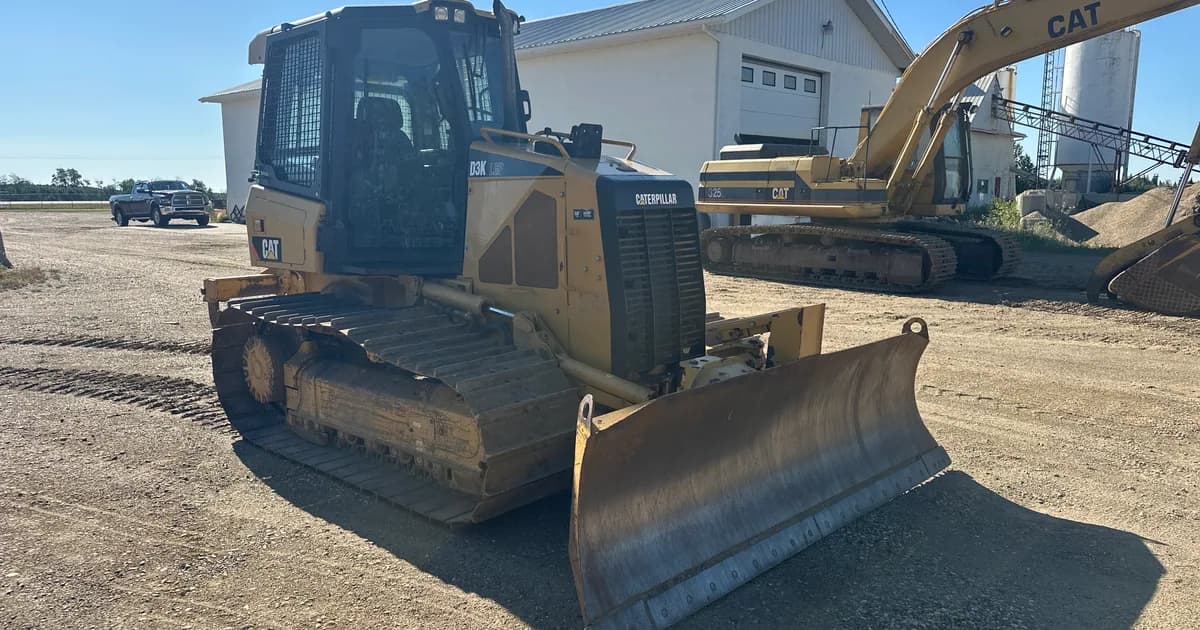
You found a Cat D6T with 11,200 hours listed for $130,000. Or maybe it is a Komatsu PC210 excavator with 10,500 hours that a retiring contractor wants to sell for $78,000. The price is right. The machine has been maintained. You know it still has years of productive life left. But when you call your bank, they tell you they cannot finance it.
This is one of the most common frustrations in heavy equipment buying. The machine works fine. The deal makes financial sense. But the bank says no because of a number on the hour meter.
Here is the real answer on bank financing for 10,000-hour equipment, why they draw the line where they do, and what your actual options are.
Why Banks Say No to High-Hour Equipment
Banks are not in the equipment business. They are in the risk management business. When they finance a piece of heavy equipment, they are betting that if you stop paying, they can repossess the machine and sell it for enough to cover the remaining loan balance. That is the entire calculation.
A machine with 10,000 or more hours presents a problem in that equation. The bank's underwriting model says that machine is closer to the end of its useful economic life. Even if the machine runs perfectly today, the bank worries about what it will be worth in three to five years when it has 14,000 or 16,000 hours on it. Their resale data tells them the value drops sharply at those levels, and they do not want to be holding a loan on a machine that is worth less than what is owed.
Key takeaway: Banks do not reject high-hour equipment because the machine is bad. They reject it because their internal risk models do not account for well-maintained machines that outperform averages. It is a system limitation, not a judgment on the iron.
There are a few specific reasons banks draw hard lines on hours:
Automated underwriting. Most bank equipment financing goes through a system that checks boxes. Age of machine, hours, brand, loan amount. If the hours exceed a threshold — usually 6,000 to 8,000 for most banks — the system flags it or rejects it outright. There is no human reviewing the actual condition of the machine.
Depreciation schedules. Banks use standardized depreciation tables that assume a machine loses value at a predictable rate per hour. A 10,000-hour machine on those tables is deeply depreciated regardless of its actual mechanical condition.
Resale market uncertainty. Banks want liquid collateral. A low-hour Cat 320 can be sold at auction in a week. A 12,000-hour Cat 320 might sit for months. Banks do not like holding equipment they cannot move quickly.
Regulatory pressure. Banks face regulatory requirements around loan quality and collateral values. High-hour equipment financing creates scrutiny they would rather avoid.
What 10,000 Hours Actually Means on Different Machines
Here is the thing most bankers do not understand but most operators know instinctively: 10,000 hours means very different things on different machines. The figures below are rough industry rules of thumb — surveyed medians (e.g. Construction Equipment's component-life data) often land lower, around 10,000-12,500 hours for dozers and excavators — but service life depends far more on maintenance, work type, and rebuilds than on any single number, and a well-kept or rebuilt machine runs well beyond the averages.
| Machine Type | Expected Service Life | 10,000 Hours Means |
|---|---|---|
| Mini excavator (Cat 308, Kubota KX080) | 8,000-12,000 hours | Near end of economic life |
| Mid-size excavator (Cat 320, Komatsu PC200) | 12,000-18,000 hours | Middle of life, plenty left |
| Large excavator (Cat 349, Hitachi ZX490) | 15,000-25,000 hours | Barely broken in |
| Dozer (Cat D6, Komatsu D65) | 15,000-22,000 hours | Mid-life, strong resale |
| Wheel loader (Cat 950, Volvo L120) | 12,000-18,000 hours | Solid working machine |
| Articulated truck (Cat 730, Volvo A30) | 15,000-20,000 hours | Still has good years |
| Motor grader (Cat 140, John Deere 772) | 12,000-18,000 hours | Mid-career |
A Cat D8T dozer with 10,000 hours is roughly at the halfway point of its expected service life. That machine, properly maintained, will push dirt for another 10,000 hours or more. But the bank's system sees "10,000 hours" and treats it the same as a mini excavator with 10,000 hours, which genuinely is near the end of its useful life. Our excavator hours guide breaks down exactly where those thresholds fall for different machine sizes.
This one-size-fits-all approach is why so many good deals get killed at the bank level. The equipment matters. A 10,000-hour Komatsu PC490 large excavator that has been doing production work in a quarry with full dealer maintenance records is a completely different proposition than a 10,000-hour no-name skid steer that has been bouncing around rental yards.
Key takeaway: The type of machine matters enormously when evaluating hours. A large dozer or excavator at 10,000 hours is often in the prime of its working life, while a compact machine at the same hours may genuinely be nearing the end.
What Banks Will Typically Finance
To understand the gap, here is what most Canadian banks are comfortable with on equipment financing:
| Factor | Bank Comfort Zone | Gets Difficult | Usually Declined |
|---|---|---|---|
| Hours | Under 5,000 | 5,000-8,000 | Over 8,000 |
| Age | Under 7 years | 7-10 years | Over 10 years |
| Age at end of term | Under 10 years | 10-12 years | Over 12 years |
| Down payment required | 10% | 15-20% | N/A (declined) |
| Brands | Cat, Komatsu, Deere, Volvo | Hitachi, Kobelco, Case | Lesser-known imports |
If your deal falls outside the bank comfort zone on even one of these factors, you are likely looking at a decline or conditions you cannot meet. If it falls outside on two or more factors — say, a 10,000-hour machine that is also 12 years old — the bank is almost certainly going to pass.
Alternative Lenders for High-Hour Equipment
This is where the real options are. While banks have rigid systems, alternative lenders and private finance companies take a different approach.
Equipment-specific lenders. These are finance companies that specialize in heavy equipment. They understand that a 10,000-hour dozer is not the same as a 10,000-hour compact track loader. They evaluate deals on a case-by-case basis, looking at the specific machine, its brand, its maintenance history, and the operator's ability to make payments. Alternative lenders such as Accord Financial operate in this space, as do the equipment-finance arms now consolidated into the major banks (CWB Maxium Financial, for example, was absorbed into National Bank in 2026). A broker keeps track of which lenders are actively funding high-hour iron at any given time.
Private lenders. These are typically smaller finance companies or private capital groups that lend against equipment. They charge higher rates — often 12-18%, sometimes higher (equipment rates float off the prime rate, which is 4.45% as of June 2026) — but they are willing to look at deals that banks will not touch. For a contractor who knows a high-hour machine is a money-maker, the higher rate is worth it because the machine generates revenue from day one.
Broker-arranged financing. Working with a financing broker like IronFinance is often the fastest path for a high-hour deal. A broker has relationships with multiple lenders and knows which ones are currently funding high-hour machines. Instead of you calling five lenders and getting rejected by four, the broker places the deal where it fits.
Dealer financing. Some equipment dealers have captive finance arms or relationships with lenders who specifically fund their inventory. A dealer selling a 10,000-hour Cat D6 may have a finance partner that will fund the deal because the dealer stands behind the machine and the lender trusts that dealer's reconditioning program.
How to Make a High-Hour Deal Work
If you have found a high-hour machine that makes sense for your operation, here is how to give your financing application the best chance.
Get a mechanical inspection. This is the single most impactful thing you can do. A $300-500 inspection from an independent mechanic or dealer service department that shows the machine is in good mechanical condition gives the lender confidence that their collateral is solid. Oil samples, compression tests, hydraulic pressure checks, and undercarriage measurements (for dozers and excavators) all help.
Gather maintenance records. If the seller has records showing regular service — oil changes, filter replacements, undercarriage work, major component rebuilds — get copies of everything. A machine with documented maintenance history is worth more and easier to finance than an identical machine with no records.
Put more money down. For high-hour equipment, plan on 20-35% down instead of the 10-15% you might put down on a newer machine. This reduces the lender's risk exposure and makes the numbers work even at higher rates. If you are financing a $130,000 dozer, putting $35,000-$45,000 down brings the financed amount to a level where the lender feels protected.
Accept a shorter term. Banks might offer 5-7 years on a low-hour machine. For a high-hour machine through an alternative lender, expect 3-4 years. The shorter term means higher monthly payments, but you build equity faster and the lender is comfortable because the loan is paid off while the machine still has significant value.
Show the revenue. Lenders want to know the machine is going to earn enough to cover the payments. If you have contracts lined up, jobs booked, or can show what similar machines earn in your operation, include that in your application. A dozer with 10,000 hours that is going to work a subdivision grading job worth $200,000 is a much easier sell than a machine sitting in your yard waiting for the phone to ring.
Here is what a realistic high-hour financing scenario looks like:
| Scenario | Low-Hour D6 | High-Hour D6 |
|---|---|---|
| Machine | 2022 Cat D6T, 3,200 hrs | 2018 Cat D6T, 10,800 hrs |
| Purchase price | $320,000 | $145,000 |
| Down payment | $32,000 (10%) | $43,500 (30%) |
| Financed amount | $288,000 | $101,500 |
| Rate | 8.5% | 13% |
| Term | 60 months | 42 months |
| Monthly payment | ~$5,900 | ~$3,020 |
| Total interest | ~$66,000 | ~$25,400 |
The high-hour machine has a higher rate, but the total cost of ownership is significantly lower. You pay less per month, less total interest, and you are into the machine for much less overall. If you know the machine is solid and it can earn, the high-hour deal can actually be the smarter financial move.
For more on how down payments affect your financing, read our guide to equipment financing down payments. And if credit is a factor in your situation, our bad credit equipment financing guide covers strategies that apply to high-hour deals too.
When to Walk Away from a High-Hour Deal
Not every high-hour machine is worth financing. Here are the warning signs.
No maintenance records and the seller cannot explain the machine's history. If a 10,000-hour dozer has no records and the seller bought it at auction and never ran it, you are flying blind. The inspection might look fine today, but you have no idea what is coming.
The price is not actually that good. Sometimes sellers of high-hour equipment price it as if it were a low-hour machine. If the discount over a comparable low-hour machine is not at least 40-50%, the financing math might not work in your favor once you factor in higher rates and shorter terms.
The machine needs major components. A 10,000-hour dozer that needs a new undercarriage, a transmission rebuild, or an engine overhaul — each of which can run into the tens of thousands — is not a deal at the wrong price. Get a real quote on the work, add it to the purchase price, and recalculate. Often you are better off buying a lower-hour machine at a higher price.
You cannot put enough down. If the lender wants 30% down and you can only do 10%, forcing the deal is not smart. You will end up with unfavorable terms that put you underwater. Save up or look at a different machine in a lower price range.
Your operation cannot absorb a shorter term. If 3-year financing on the high-hour machine creates a monthly payment your cash flow cannot support, the deal does not work regardless of how good the machine is. Run the real numbers, not the hopeful ones.
Key takeaway: A high-hour deal makes sense when the machine is well-maintained, the price reflects the hours, you can put adequate money down, and the revenue from the machine comfortably covers the payments. If any of those pieces are missing, keep looking.
Sources: Construction Equipment; Accord Financial; Bank of Canada. Rate, term, down-payment and approval-timing figures are directional practitioner conventions current as of August 2026 — they move with the prime rate, vary by lender and by machine, and are not quotes or approvals. Equipment prices are asking prices rather than transaction prices. Tax treatment depends on your own contract and circumstances; confirm with your accountant.
The Bottom Line on High-Hour Equipment Financing
Banks are not going to finance your 10,000-hour machine. That is the reality, and no amount of explaining to your banker that the dozer "still runs like new" is going to change their underwriting system. But that does not mean the deal is dead.
Alternative lenders, private finance companies, and equipment-specific lenders fund high-hour deals regularly. The terms are different — higher rates, more money down, shorter terms — but for the right machine at the right price, the math works.
The key is knowing what you are getting into before you commit. Get the inspection. Run the real numbers. Make sure the machine can earn its keep even with the higher financing costs. If it all checks out, the high-hour deal can be one of the best moves you make. For a broader overview of how the process works, see our complete guide to financing heavy equipment in Canada. You can also use our financeability checker to get a quick read on whether the equipment age and hours are in a range lenders will work with.
Rate references reflect the prime rate of 4.45% as of June 2026 (Bank of Canada policy rate held at 2.25%). Service-life-by-class figures are rough industry rules of thumb (see Construction Equipment component-life data); repair costs, alternative-lender rates, down payments, and terms are practitioner estimates, not quotes — confirm for your specific machine and deal.
If you have a high-hour machine you want to finance, reach out to IronFinance. We work with lenders who evaluate these deals individually, not through automated systems that reject anything over an arbitrary hour threshold. Tell us about the machine and your situation, and we will tell you what is realistic.
Already own equipment, or eyeing a different machine?
Frequently Asked Questions
Will any bank finance equipment with over 10,000 hours?
Traditional banks almost never finance equipment over 10,000 hours because their underwriting models flag the machine as too close to end of useful life. Alternative lenders and private finance companies are more flexible and evaluate the deal based on the specific machine, its condition, and the borrower's overall profile.
What is considered high-hour equipment in Canada?
In the financing world, anything over 8,000 hours is considered high-hour for most heavy equipment. Lenders start getting cautious around 6,000-8,000 hours for excavators and wheel loaders, while dozers and larger machines may get slightly more leeway because their expected service life is longer.
Can I finance a high-hour machine if I put more money down?
Yes, a larger down payment is one of the most effective ways to get a high-hour deal funded. Putting 25-35% down reduces the lender's exposure and makes the loan-to-value ratio more comfortable. Combined with strong credit and proof of income, this approach opens doors with alternative lenders that banks keep shut.
Does a 10,000-hour machine cost more to finance, or just get declined more often?
Both, and in a predictable order. First the machine has to clear whatever age and hours cap the lender applies, which is where banks most often say no outright. Once you are with a lender that will look at it, high hours shorten the term and increase the down payment before they raise the rate — because the lender is managing how fast the collateral falls below the balance owing, not just pricing risk. Expect a shorter amortisation and more money down rather than simply a higher percentage.
Is a high-hour machine from a major brand easier to finance than a low-hour orphan?
Usually yes, and this surprises people. A lender's downside is a machine it has to sell, so what matters is the depth of the resale market: parts availability, dealer support, and a real auction record. A well-known machine with high hours has a liquid market and a defensible value; a lightly-used machine from a brand with thin Canadian support does not. Brand and resale depth frequently outrank the hour meter in the decision.