
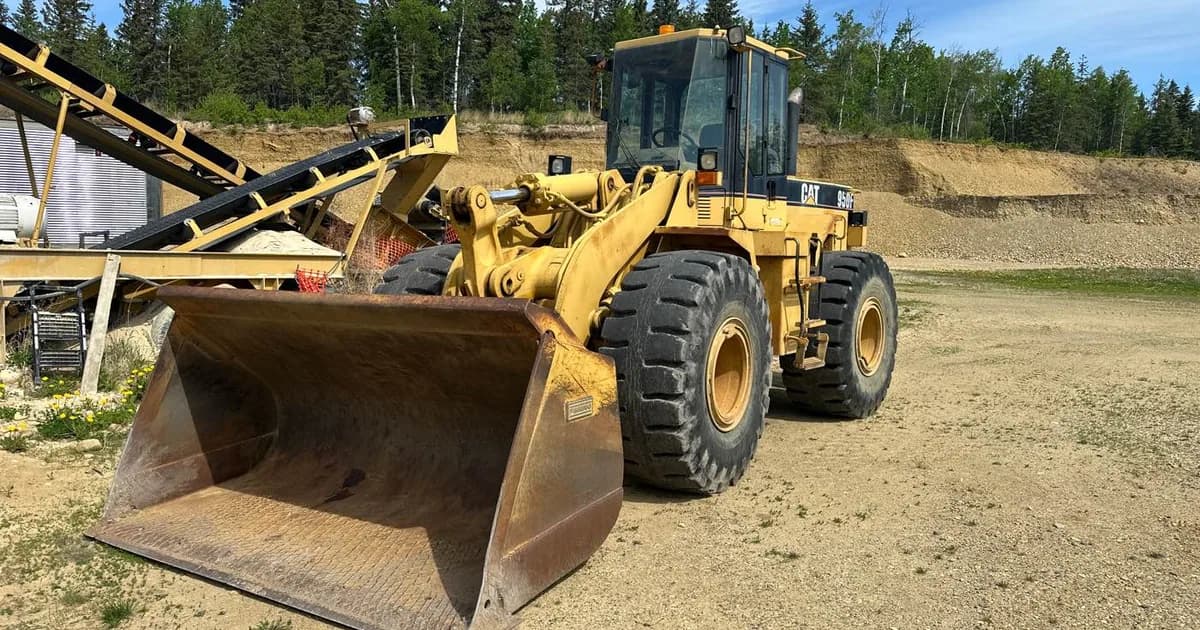
A wheel loader gets sold twice. Once as a machine — the iron you can walk around, kick the tires on, and run through its cycles in the yard. And once as a paper trail — the binder of oil sample reports, dealer work orders, and service records that tells you what the iron has actually been through. On most used equipment the iron is what you are buying. On a wheel loader, the paper trail is the asset, and the hour meter is almost a distraction.
That sounds backwards until you have watched two identical machines sell for double the price difference their hours would suggest. A 12,000-hour Cat 966 with a folder full of oil analyses, a documented transmission rebuild at 9,500 hours, and dated service intervals going back to new will out-sell — and out-finance — a 9,000-hour machine of the same age and model with nothing but a verbal "she's been good to us." The meter says the second machine is the better buy. The records say the first one is.
This guide is about how to read a used wheel loader honestly — from the seat, from the lender's desk, and from the resale market — and why the question is never really "how many hours is too many."
Fast answer. On a mid-size wheel loader, 10,000–12,000 hours is where most buyers and lenders start calling it high-hour, and roughly where major components hit their first rebuild window. But documented maintenance — oil analysis, service history, and component-replacement records — matters more than the meter. A high-hour loader with strong records can be a better buy than a low-hour machine with none.
The Honest Hour Benchmarks
You asked the question, so here are the real numbers — with the honest caveat that every one of them is a range, not a rule.
Industry data puts a wheel loader's average economic life at roughly 10 years, or 7,000–12,000 hours — the range where the major components reach their first rebuild window. Read that as an average, not a wall: a well-kept major-brand machine with components rebuilt along the way works past it, while a hard-used machine in abrasive work can be tired well short of it. (For scale, the trade-survey "average" loader — a 3.25-cubic-yard, 170-hp power-shift unit — reaches about 10,100 hours by year 7, with engine, transmission, and axles averaging 10,000–11,000 hours before rebuild.) Underneath that, the individual components wear on their own schedules:
| Component | Typical first-rebuild window | Notes |
|---|---|---|
| Engine | 8,000–15,000 hrs | Wide range; application and maintenance drive it more than age |
| Transmission & axles | ~10,000–11,000 hrs | The heart of wheel-loader wear — not the engine |
| Tires | 4,000–10,000 hrs | A major recurring cost, and they age out even at low hours |
| Brakes | 5,000–15,000 hrs | Usually oil-cooled wet discs; long-lived but expensive |
| Bucket / cutting edge | 7,000–10,000 hrs | Operator technique and material drive wear |
The number worth remembering is the one most "10,000 hours is too many" articles leave out: a machine's biggest known costs are the major-component rebuilds, and a loader that has already had its engine, transmission, and axles addressed has paid down that known wear. A documented rebuild resets the clock on the most expensive parts of the machine. The unit that worries an experienced buyer is not the rebuilt 14,000-hour loader with the invoices to prove it. It is the 9,000-hour machine sitting on every one of those bills at once, with no records to say which, if any, have been done.
Key takeaway: Hours tell you which rebuild windows a machine is approaching. The records tell you which ones it has already passed through. The second piece of information is worth far more than the first.
A Wheel Loader Is Sold Twice — and the Records Are the Second Sale
This is the part of the evaluation that most buyers underweight and every experienced seller understands. On a wheel loader, the maintenance record is not paperwork that supports the value. It is the value.
Here is what that means in practice, backed by how the used market actually prices these machines:
- Documented machines hold their value; undocumented ones get priced for the worst case. Operating hours are the headline number a buyer reacts to, but hours only estimate wear — two loaders showing the same meter can be very different machines. The records are what prove which is which, so a documented machine sells and finances on its real condition while an undocumented one gets discounted as if every major component is due. That gap is not the iron. The iron is identical. The gap is the binder.
- Oil analysis is the strongest single signal. A history of oil sample reports tells a buyer and a lender that the machine was monitored — that metal in the oil, fuel dilution, coolant intrusion, and contamination were being watched and caught early, as planned repairs instead of roadside failures. A machine with oil analysis history was managed. A machine without it was just used.
- Component-replacement work orders convert "high hours" into "known condition." A dated, itemized invoice for a transmission rebuild at 9,500 hours does two things: it resets the clock on that component, and it proves the owner spent real money keeping the machine right. Both raise value and both widen the financing pool.
- No work orders plus high hours equals buy-at-your-own-risk. This is the rule to carry into every deal. A high-hour wheel loader with no service records is not a bargain that happens to lack paperwork. The missing paperwork is the risk, and it should be priced as if every major component is due — because you have no evidence that any of them have been done.
When a seller can hand you a maintenance binder, you are buying a known machine. When a seller says the records were lost, you are buying a lottery ticket, and you should pay lottery-ticket prices.
Key takeaway: Ask for the records before you ask about the hours. The records will tell you whether the hours even matter.
Reading the Same Machine Three Ways
The reason hours are so easy to over-weight is that buyers look at a loader through only one lens at a time. The machine that is "too many hours" operationally might be perfectly financeable, and the machine that finances easily might be a poor resale bet. Here is the same used wheel loader read through all three.
Operationally: it is a driveline, not an engine
A wheel loader does the same punishing thing over and over — load the bucket, carry it, dump it, reverse, repeat. That repetitive high-load cycle puts the wear where most buyers do not look: the torque converter, transmission, drive axles, final drives, and differentials. The engine is rarely what ends a loader's life. The driveline is.
That changes what "too many hours" means depending on what the machine did:
- Aggregate, quarry, recycling, and slag work is the hardest life a loader lives — abrasive material, full buckets every cycle, long shifts. A loader at 8,000 abrasive hours can be more worn than one at 14,000 hours of lighter work.
- Snow, yard, and stockpile handling is far gentler — lighter loads, shorter cycles, less shock. These hours are easy hours.
- Forestry and mill-yard work sits in between, with its own corrosion and debris concerns.
Two loaders showing the same 11,000 hours can be completely different machines depending on which of these lives they lived. The meter does not know the difference. The records — and the wear on the driveline and tires — do.
Financially: records widen the lender pool
Lenders read a wheel loader the way they read any asset-backed file: how predictable is the collateral, and how predictable is the borrower's ability to pay. Hours feed the first question, but documented condition feeds it harder. A high-hour machine with oil analysis and a recorded powertrain rebuild is more predictable collateral than a mid-hour machine with no history — and predictability is what moves a file from "decline" to "approve with conditions."
First, the part that trips up most buyers: there is no hard hours number that makes a loader unfinanceable in Canada. Lenders do not publish an hours cap the way they cap age. What they actually do is appraise the machine and cap its age at the end of your term — commonly a 10-to-15-year window depending on the lender and the asset. Hours matter because they drive that appraised value and the machine's remaining life, which then shape your rate, term, and down payment rather than producing a flat "no." That structure also sits on top of today's cost of money: as of June 2026 the Bank of Canada's overnight rate is 2.25% and prime is 4.45%, and equipment loans are typically priced as prime plus a spread for the asset and the borrower. Programs like BDC's equipment loan can finance new or used machines up to 125% of the purchase price, covering extras such as freight and installation.
The broad pattern of how lenders tend to size up a used wheel loader by hours — read as how the structure tightens, not whether you get a yes:
| Hour Range | How the Deal Structures | Typical Terms |
|---|---|---|
| Under 6,000 | Strongest collateral, comfortable across all lender types | Longer terms, lower down payment, best rates |
| 6,000–10,000 | Comfortable on major brands at banks and EFCs | Moderate terms; records start to matter |
| 10,000–15,000 | Banks tighten; equipment finance companies preferred | Shorter terms, larger down payment, brand and records drive it |
| 15,000+ | Appraisal-led; asset-based and specialty private lenders most active | Short terms, high down payment, condition-and-records driven |
What shifts a file up a tier: documented maintenance, a major-brand machine with strong dealer parts support, and a signed contract or steady revenue source. What shifts it down: no records, an off-brand machine with thin parts availability, and abrasive-application wear the price does not reflect. If the bank has already said no on hours alone, our used heavy equipment financing guide and bad-credit equipment financing guide cover what changes when you move to lenders who underwrite the whole picture — and our guide to whether banks will finance 10,000-hour equipment gets specific on that exact threshold.
For resale: you are buying your own exit
The smartest used-loader buyers think about the day they sell before the day they buy. Because the resale market rewards documented machines and discounts undocumented ones to the worst case, the records you inherit — and the records you keep — are what decide whether your machine sells on its real condition or sells at salvage logic when it is your turn.
This is why working contractors so often sell a loader right after a major rebuild: the fresh transmission or engine is worth more in the next owner's hands, with the invoice attached, than the few thousand hours of life they would get from keeping it. A high-hour machine with a documented rebuild moves quickly and confidently. A high-hour machine with no story sits, and then sells at salvage logic. Buy the machine whose records you would be proud to show the next buyer, and keep the binder going from the day you take delivery.
Not sure what your current machine is worth before you trade, sell, or borrow against it? Get a fast estimate with our equipment value tool, or contact us to order a formal appraisal on your equipment.
Wheel-Loader-Specific Wear Points That Matter More Than Hours
Regardless of the meter, this is where the money is on a used wheel loader. Walk these before you walk the asking price.
The driveline. Torque converter, transmission, drive axles, final drives, and differentials. Symptoms of trouble: slipping or hesitation under load, harsh or hunting shifts, whining or grinding from the planetaries, and metal fines on a magnetic drain-plug check. A driveline overhaul is the single largest bill on a wheel loader. This is the system the oil analysis history protects.
Tires. Not a maintenance item — a major cost. A full set of large radials on a mid-size loader can run well into five figures, often $15,000–$40,000+ depending on size and brand — treat that as a general North American range rather than a firm Canadian quote, as it moves with the exchange rate, freight, and tire type. They also age out on the sidewall even at low hours. A loader being sold on worn tires at like-new pricing is over-priced by the cost of a tire set. A low-hour machine with old, cracked tires is a real concern, not a bargain.
The articulation hitch and centre pin. Wheel loaders are articulated, and the centre hitch takes load on every turn under a full bucket. Look for play, oil weeping at the pins, and — most telling — evidence of greasing discipline. A dry, worn hitch tells you how the rest of the machine was maintained.
The loader linkage. Z-bar or parallel-lift, the bucket pins, bushings, and tilt linkage develop slop from missed greasing. Watch the bucket for chatter and drift, and check every pin joint for wear. Slop here is cheap to find and expensive to ignore.
The front frame and hitch welds. Frame cracks around the hitch or the loader-tower mounts are abuse and overload signs. Fresh paint over the structural areas almost always covers a structural repair. Inspect every weld in the load path.
Brakes and the cooling system. Most loaders use oil-cooled wet-disc brakes — long-lived but expensive to service, and easy for a seller to ignore. A tired cooling system (plugged coolers, weak fan drive) is what cooks a driveline and an engine over time.
Bucket, cutting edge, and ground-engaging tools. Cheap relative to the driveline, but a worn, badly repaired, or wrong-application bucket tells you how the machine was run and what it was run in.
Brand and Dealer Reality in Canada
Like every piece of heavy iron, wheel loaders are underwritten and resold by specific brand and the dealer support behind them — not as a generic "loader."
Caterpillar (950, 962, 966, 972, 980 and up) — the deepest market in Canada, strongest resale, best parts availability, and the most lender comfort at higher hours. Finning covers Western Canada and Toromont covers Ontario and Quebec. A documented Cat at high hours finances and resells more readily than almost anything else.
John Deere (524, 544, 644, 724, 744, 824, 844) — strong national presence through Brandt and Nortrax, good parts support, and lender treatment close to Cat. A well-kept Deere loader is an easy file.
Komatsu (WA200, WA320, WA380, WA470, WA500 and up) — supported nationally through SMS Equipment, well-built, often strong value on the used market, and comfortably financeable on major models with records.
Volvo (L60 through L250) — known for fuel efficiency and a loyal owner base, supported by Volvo CE and its dealer network. Solid resale on the popular sizes, comfortably financeable.
Case, Kawasaki/KCM, Hitachi (ZW), Hyundai, Develon (Doosan), Liebherr — all capable machines, but resale markets are thinner and lenders are somewhat more conservative on hours than they are with the top brands. Confirm dealer parts support in your specific region before committing, especially on a high-hour unit — a machine you cannot get parts for is a machine you cannot keep working or easily resell.
Key takeaway: On a high-hour loader, brand and dealer parts support do real work in both the financing decision and the resale. A documented Cat, Deere, Komatsu, or Volvo at 13,000 hours is often a stronger file than an off-brand machine at 8,000.
Sources: Equipment World; Construction Equipment; BDC; Ratehub; Bank of Canada; Mehmi Group — used-equipment financing in Alberta — Mehmi Financial Group; Quinn Company. Rate, term, down-payment and approval-timing figures are directional practitioner conventions current as of August 2026 — they move with the prime rate, vary by lender and by machine, and are not quotes or approvals. Equipment prices are asking prices rather than transaction prices. Tax treatment depends on your own contract and circumstances; confirm with your accountant.
How to Actually Decide
Hours are one input. Here is how the decision shapes up on a real used wheel loader.
If this is your primary machine for the next 5+ years, buy the records first and the hours second. A major-brand loader in the moderate-hour range from a one-owner operator with a full maintenance binder is the straightforward path — predictable financing, predictable resale floor, and substantial life ahead.
If you want the most working life per dollar, a documented high-hour machine with a recent powertrain rebuild is frequently the best value on the market. You may pay tighter financing terms, but you are buying paid-down wear at a discount — the most expensive rebuilds are already behind it. Match the working life ahead to your need, and budget the next major service as part of the deal.
If you are buying for a specific contract, a high-hour loader priced correctly — particularly one with documented driveline work — can be the smartest deal on the lot. Match the life ahead to the contract length and price in a major repair as part of the purchase.
If you are rebuilding credit and need a working machine, a documented major-brand loader through an asset-based lender is often the open door, and six months of clean payments on that file improves what you can finance next. Run the numbers first with our financeability checker, and see where rates land across lenders in our Canadian equipment loan rates guide.
In every case, the inspection — ideally with a mechanic who knows loaders — plus the maintenance binder is worth more than the hour-meter reading. On a machine this expensive, buy the records, not the meter.
Thinking about a high-hour wheel loader?
Send us the deal — the make and model, the hours, the asking price, and whatever the seller can show you for oil analysis, service history, and major-component work orders. The first read is a soft-touch review with no credit pull required: we will tell you whether the file still looks financeable, which lender categories are realistic for the brand and hour range, and what the structure — rate, term, down payment — is likely to look like before you commit. We work with lenders who underwrite a used loader on the full picture — brand, condition, application, contract, and records — not just the number on the meter.
Sources: Equipment World — wheel loader equipment lifecycles and Construction Equipment — wheel loader/excavator/dozer economic life for economic-life and component-hour figures; BDC equipment loan for financing terms; Ratehub — Canadian prime rate and the Bank of Canada rate decision for the June 2026 rate context; Mehmi Group — used-equipment financing in Alberta for the age-and-hours underwriting framing; Quinn Company on hours and trade-in value. Manufacturer service guidelines from Caterpillar, John Deere, Komatsu, and Volvo dealer networks. Component-cost and lifespan figures reflect North American field data, not Canadian-specific quotes, and are guidelines rather than current prices. Rate figures are current as of June 2026 and change at each Bank of Canada decision. Information current as of June 2026.
For related reading, see our hours guides for the excavator, dozer, skid steer, skidder, motor grader, backhoe, and telehandler, plus how those numbers translate into current equipment loan rates and our used heavy equipment financing guide.
Already own equipment, or eyeing a different machine?
Frequently Asked Questions
How many hours is a lot for a wheel loader?
Around 10,000–12,000 hours is the point most buyers and lenders treat as high on a mid-size wheel loader, and roughly where major components — engine, transmission, axles — reach their first rebuild window. But hours alone are a weak signal. A 12,000-hour machine with documented oil analysis, scheduled service, and a recorded transmission rebuild is often a better buy than an 8,000-hour machine with no paperwork. What the records show matters more than the number on the meter.
How many hours does a wheel loader last?
Industry data puts a wheel loader's average economic life at roughly 10 years or 7,000–12,000 hours — that is an average, not a hard ceiling, and a well-maintained machine with documented major-component work can run beyond it. Individual component lives vary: engines 8,000–15,000 hours, transmissions and axles around 10,000–11,000 hours, tires 4,000–10,000 hours. Once the first powertrain rebuild is behind a machine, its biggest known wear items have been paid down — which is why a documented, rebuilt high-hour loader is not automatically a money pit.
Do maintenance records really affect a wheel loader's value?
Yes, more than almost any other factor. Operating hours are the headline valuation number, but they only estimate wear — the records prove it, and that is what separates two machines with the same meter reading. As a rough industry rule of thumb against a normal 1,000–1,500 hr/yr pace, a lightly-used machine can command around a 10–15% premium while a hard-used one takes an extra 10–15% off, and documented condition is what tells a buyer and a lender which side of that line a loader sits on. Oil sample analysis, dealer work orders, and dated component-replacement records are what let them see what they are getting. A high-hour loader with no records should be priced and financed as a buy-at-your-own-risk machine.
Will a lender finance a high-hour wheel loader?
Yes. There is no hard hours cutoff in Canada — lenders cap on the machine's age at the end of the term (often a 10-to-15-year window depending on lender and asset) and read hours as a driver of appraised value and remaining life, which shapes your rate, term, and down payment rather than triggering a flat decline. BDC, for example, finances new or used equipment and can lend up to 125% of the purchase price. Banks and captive finance arms are most comfortable on lower-hour, major-brand machines; equipment finance companies and asset-based private lenders go further on hours when oil analysis, service history, and documented major-component work support the file. A signed contract or steady revenue source strengthens any high-hour application.