
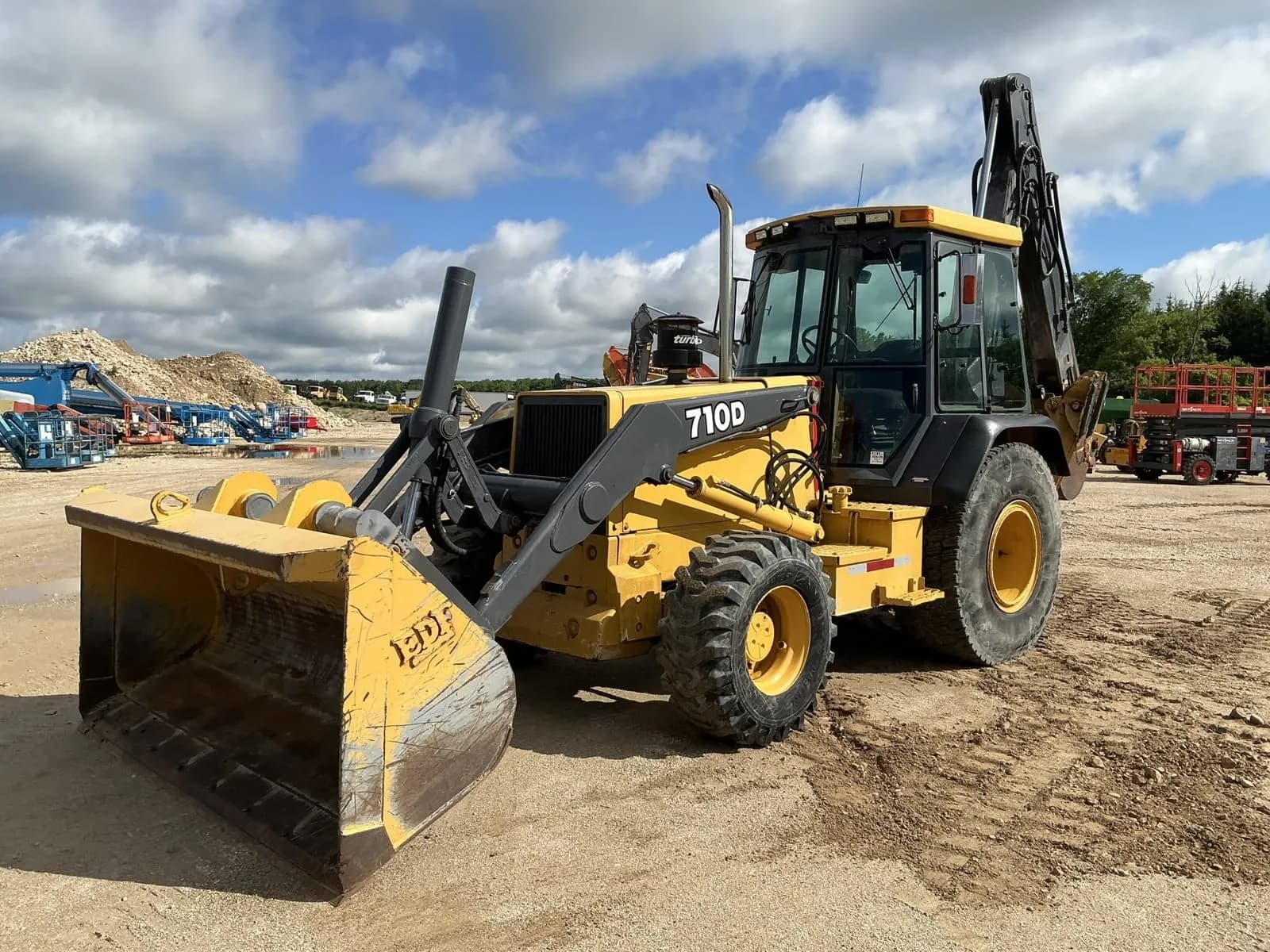
You are looking at a used JCB 3CX, or a Cat 420, or a John Deere 310 with 6,500 hours on the clock, and the price looks right — but that hour number is nagging at you. Is this machine halfway through its life, or near the end? Will a lender even touch it?
Right questions, and for a backhoe the answers work differently than for almost any other machine. A backhoe is not one machine with one job. It is a loader on the front and an excavator on the back, bolted to the same chassis and sharing one engine-hour meter — and those two ends do completely different work and wear at completely different rates. That single number on the dash is an average of two lives, and it cannot tell you which end got hammered. So the meter, on its own, tells you even less on a backhoe than it does on an excavator or a dozer.
One thing to clear up first, because it trips up almost everyone: there is no magic hours number that makes a backhoe "unfinanceable." Canadian lenders do not post an hours cap the way they cap age. What they actually do is appraise the machine and cap its age at the end of your term — often a 10-to-15-year window depending on the lender and the asset. Hours matter because they drive that value and the machine's remaining life, which then shape your rate, term, and down payment. Keep that in mind as we go.
The Backhoe Problem: One Meter, Two Machines
Every other machine in the fleet has a signature wear point you can point to — the undercarriage on a dozer, the circle on a grader. A backhoe has two, at opposite ends, wearing on two different jobs.
The front loader spends its hours pushing, carrying, loading trucks, backfilling, and rolling across the yard. That work loads the loader arms, the torque tube that ties them together, the front axle, and the transmission. The rear hoe spends its hours digging, swinging, and curling — cyclic, high-force work that loads the boom, the dipper, the swing tower, and every pin and bushing in the linkage. A machine that lived on the loader end can have a nearly new hoe. A machine that trenched all day can have a tired hoe bolted to a loader that barely worked.
The engine-hour meter counts all of it as one number. So two backhoes at 6,500 hours can be worlds apart, and the meter will never tell you which is which. That is why, on a backhoe more than on anything else, you stop reading the meter and start reading the machine — both ends of it.
Key takeaway: A backhoe's hour meter is the average of two very different lives. Never buy or price one on the number alone — inspect the loader end and the hoe end separately, because one of them may be far more worn than the other.
How Long a Backhoe Actually Lasts
Here is where the honest answer has to come with a flag on it: the hard numbers on backhoe service life are US and North-American, not Canadian. Canadian-specific service-life and resale data on backhoes barely exists, so the figures below are the best available industry data — useful for direction, not a Canadian appraisal.
The most-cited source is a 2005 contractor survey (Construction Equipment magazine's Lifecycle Study) of 14-to-15-foot backhoe loaders. It found that about 20% of engines needed major repair or replacement before roughly 6,000 hours, about half by around 8,500 hours, and most of the rest by about 12,000 hours. More recent used-market guides put the common band at 5,000 to 8,000 hours, with over 10,000 hours signalling heavy wear — though every one of them adds the same caveat: condition beats hours. Treat these as survey-averaged, roughly two-decade-old US numbers, not precise current-model facts.
The practical read: a realistic first-rebuild window for a backhoe lands somewhere around 6,000 to 8,000 hours, earlier than a long-life machine like a grader and much earlier than a well-kept excavator. That is not a wall — it is the neighbourhood where the first big-ticket repair tends to come due, and a documented rebuild resets the clock. But it does mean a 9,000- or 10,000-hour backhoe is genuinely in the back half of its life, and it should be priced and financed like one.
Key takeaway: Plan around a first-rebuild window of roughly 6,000 to 8,000 hours (US survey data, not Canadian). A backhoe wears through its life faster than a grader or excavator, so high hours arrive sooner — but a clean, documented machine can run well past the averages.
Red Flags: What the Two Ends Are Hiding
Because the loader and the hoe wear separately, you inspect them separately. This is the part that matters more than any number on the meter, and it is where you find the money — or the trap.
The loader torque tube. Up front, the single most important structural part is the torque tube that connects the two loader arms. It takes twisting loads every time the bucket meets uneven resistance, and on a hard-worked machine it can develop stress cracks. Look for cracks near the welds — and, just as telling, look for evidence of a prior repair: a plate welded over the tube is a sign the machine has already cracked there once. That is not automatically a deal-breaker, but you need to know about it and price it in.
The swing tower and the hoe pins. Out back, the hoe's whole job runs through pins and bushings — at the swing tower, the boom, and the dipper. These wear, and when they do, they start to bang audibly as the machine swings and digs. Worn swing-tower pins are a real repair: re-pinning or line-boring the tower runs roughly US$1,500 to $6,000 (a US figure — Canadian shop rates differ). Any visible slack or "slop" at a pivot when the machine moves means the pins and bushings are due. Work every hoe function through its full range and watch the joints.
The rest of the walk-around. Beyond the two signature points, check the transmission (shift through the powershuttle in both directions, listen and feel for slipping), the loader and hoe hydraulics (watch for drift, weeping cylinders, and slow cycle times), the stabilizers (the two rear legs plant and level the machine for digging — the real test is whether the stabilizer cylinders hold it up without settling or creeping back down under load, and whether they are leaking), and — on a four-wheel-drive machine — the front drive axle, which does real work on a 4WD backhoe. None of these has a tidy hours number attached; they are condition items you read with your eyes and ears.
⚠Key takeaway: On a backhoe, the inspection is the appraisal. A cracked or plated torque tube up front, or a banging swing tower and visible pin slop out back, tells you more about what this machine is worth than the meter ever will.
How the Work Changes What the Hours Mean
Not all backhoe hours are equal, and the gap is wide. The same 2005 US survey that gave the life numbers also found that backhoes in moderate applications averaged around 9,180 hours of primary production life versus about 6,800 hours in severe ones — roughly a quarter less (survey-averaged US figures, not a precise Canadian benchmark). Where the machine spent its life changes what a given reading is worth:
- Municipal road and utility work. This is the backhoe's home turf, and often its gentlest life — driving between sites under its own power, loading, backfilling, and digging service trenches at a measured pace. A high-hour municipal or utility machine can be in better shape than a lower-hour one from a harder setting. Backhoes stay the preferred tool here precisely because they self-transport at road speed and reach the lift and trench depth that sewer and utility work demands.
- General contracting and landscaping. Mixed duty, predictable middle-of-the-road wear. Where the site is tight, though, a backhoe often is not even the machine anymore — the work has moved to compact excavators and skid steers (more on that next).
- Rental fleets and hard continuous digging. The hard end. A backhoe that dug in rock and abrasive ground all day, or that passed through a rental fleet with a dozen different operators, puts wear on the hoe, the pins, and the drivetrain well beyond what the meter suggests. Rental provenance is worth asking about directly.
This is why two backhoes with identical hours can be worlds apart. When you read the meter, read the application right next to it — and remember you are really reading two applications, one per end.
The Jobs Backhoes Lost — and Why Resale Is Firming Anyway
There is a bigger story sitting behind a used backhoe, and it cuts against what most people assume. Over the past decade, North American backhoe sales roughly halved — from around 20,000 units a year to somewhere near 9,000 to 10,000 — as compact track loaders and mini excavators took over the tight-site and landscaping work backhoes used to do. Mini-excavator sales alone climbed from roughly 4,000 units a year in the 1990s to around 65,000 a year by 2021-22. For a confined job, a skid steer and a mini are cheaper to buy, easier to trailer, and fit where a backhoe cannot. (These are US and North-American figures.)
You would expect that to crush backhoe resale. It has not. In early 2026, used loader backhoes led every tracked category of used construction equipment for shrinking inventory and firming values — inventory down about 6% month over month and roughly 25% year over year, with auction and asking values ticking up (US data, from Sandhills/MachineryTrader). Fewer new backhoes sold over the years means fewer good used ones now, and the contractors who genuinely need a backhoe's reach and road speed — municipalities, utilities, sewer and water crews — still need it and cannot substitute a skid steer.
Why this matters for you: a machine with a tight, shrinking used supply holds its collateral value, and collateral value is exactly what a lender underwrites. The backhoe's shrinking niche is, counterintuitively, part of what keeps a well-kept one financeable.
Key takeaway: Backhoes lost the tight-site work to skid steers and mini excavators, but the used ones that remain are getting scarcer and holding value — which supports resale and, with it, financeability for the buyer who actually needs one.
How Backhoe Hours Affect Financing
Lenders evaluate backhoe hours through the lens of risk, not as a pass/fail gate. There is no hard hours number that triggers an automatic decline in Canada. As Canadian equipment-finance lenders frame it, hours are the "mileage" on heavy equipment — underwriters use them to estimate remaining life and repair risk, then structure the deal around a few things: hours today, expected annual use, projected hours at the end of the term, and whether any major component is near a rebuild. If the projected end-of-term value still supports the loan, the deal works. If it does not, the lender shortens the term, raises the down payment, or declines — in that order. Hours drive the structure, not a flat cutoff.
What lenders actually cap on is age at the end of the term — often a 10-to-15-year window, measured at loan payoff rather than at purchase. That band is at the generous end; conservative banks target more like 7 to 10 years at maturity, while specialist and private lenders reach further. Because a backhoe's useful life is shorter than a grader's, its remaining-life runway is tighter at a given hour count — which is why documentation and a clean two-end inspection carry so much weight on a higher-hour machine.
The following table reflects common patterns we see when contractors finance backhoes. Every lender underwrites differently based on borrower strength, machine age, dealer support, and intended use — but it gives you a sense of how the structure moves, not whether you get a yes:
| Hours | How the Deal Structures | Typical Terms Available |
|---|---|---|
| Under 3,000 | Strongest collateral | Longest terms, lowest down, best rates |
| 3,000 - 5,000 | Straightforward | Standard terms and down payment |
| 5,000 - 8,000 | Value-driven | Shorter term or more down; a clean inspection of both ends holds the term |
| 8,000 - 12,000 | Tighter structure | More down, shorter term; records and pin/torque-tube condition matter most |
| Over 12,000 | Appraisal-led | Broker or specialized lenders; a documented rebuild can restore financeable life |
As of the June 10, 2026 decision, the Bank of Canada held its overnight rate at 2.25% — the fifth consecutive hold — with the major banks' prime rate at 4.45%. Equipment loan pricing floats above prime with a spread that widens as credit and machine age weaken, so any future Bank of Canada move shifts the whole picture. Used equipment also tends to carry a slightly higher rate or shorter term than new, which is worth building into your numbers.
Where BDC fits. The Business Development Bank of Canada finances new or used equipment up to 125% of the purchase price — enough to roll in delivery, attachments, or training — with amortization up to 12 years and, if you qualify, interest-only payments for up to the first 24 months. BDC confirms the final rate during application review and may require a down payment depending on the structure and risk profile. It is a mainstream-flexible option for a well-kept backhoe; a documented rebuild and clean inspection are what open the longer terms.
So How Many Hours Is Too Many?
There is no single number — but here is a practical framework.
If you are buying a backhoe as a core machine for the next several years, look for something under 5,000 hours from a major brand, and inspect both ends before anything else. You will get straightforward financing and a machine with real resale value and working life left.
A backhoe in the 5,000-to-8,000-hour band is the heart of the used market and can be a smart buy when the torque tube is clean, the swing tower is tight, the records are complete, and the price reflects the hours. Budget for the first major service and expect the financing structure to tighten a little.
Over 10,000 to 12,000 hours you are buying a machine in the back half of its life. That can still make good sense — a documented rebuild resets the clock, and a well-priced high-hour backhoe with tight pins and a sound torque tube can outrun a tired mid-hour one with no history. Go in with a proper inspection of both ends and a maintenance budget.
If you need help financing a used backhoe at any hour range, you can apply with IronFinance and we will match you with a lender who fits your situation. We will give you a straight answer about what is realistic for the machine you are looking at.
Sources: Construction Equipment — Contractors Report Real Backhoe and ADT Life (2005 Lifecycle Study; US, self-reported); Equipment World — how to inspect a used backhoe; Papé Machinery — backhoe pins and bushings; Heavy Equipment Guide (Canada) — backhoe vs excavator and skid steer; MachineryTrader / Sandhills — used loader backhoe market data; Equipment & Contracting — backhoe popularity; BDC — equipment financing; Bank of Canada — June 10, 2026 rate decision; Mehmi Group — used-equipment financing, age and hours. Service-life, wear-cost, sales, and resale figures reflect US or North-American data where Canadian-specific figures are not published; they are industry ranges, not model-level Canadian pricing. Information current as of July 2026.
For related reading, see our hours guides for the excavator, skid steer, dozer, wheel loader, motor grader, skidder, and telehandler, plus our guides on financing high-hour equipment, how to finance heavy equipment in Canada, and current equipment loan and lease rates.
Already own equipment, or eyeing a different machine?
Frequently Asked Questions
How many hours will a backhoe last?
US industry survey data — the main source of hard numbers, and not Canadian-specific — puts a backhoe loader's realistic run at roughly 6,000 to 8,000 engine hours before major component work, with a well-maintained machine going well past that. A widely cited 2005 contractor survey of 14-to-15-foot backhoes found about half of engines needed major repair by around 8,500 hours and most of the rest by about 12,000. But a backhoe is dual-purpose — a front loader plus a rear hoe that wear separately — so condition and the signature wear points tell you far more than the single number on the meter.
Is 5,000 hours a lot on a backhoe?
Not on its own. 5,000 to 8,000 hours is the most common band on the used market, and a well-kept 5,000-hour backhoe from municipal or utility work can easily have most of its life left. What matters more than the number is what the machine was doing and how the two ends look: check the loader torque tube for cracks or weld repairs and the rear swing tower for worn, banging pins. A 5,000-hour machine that dug hard every day can be more worn than an 8,000-hour one that graded driveways and loaded trucks.
What wears out first on a backhoe loader?
The two ends wear differently, so inspect them separately. On the loader end, the torque tube that ties the two loader arms together takes twisting loads and can develop stress cracks — look for cracks or evidence of a weld-and-plate repair. On the hoe end, the swing tower pins and the boom and dipper pins wear and start to bang or show visible slack; re-pinning or line-boring a worn swing tower is a real repair (roughly US$1,500 to $6,000 in US figures). Beyond those, check the transmission, the loader and hoe hydraulics, the stabilizer cylinders (they should hold the machine up without settling under load), and the front axle on four-wheel-drive units.
Do backhoe hours affect financing in Canada?
Yes, but not as a pass/fail gate. Canadian lenders do not publish a hard hours cutoff on a backhoe. They read hours as the 'mileage' that estimates remaining life and repair risk, and they cap on how old the machine will be at the end of your term — commonly a 10-to-15-year window depending on the lender and the asset (BDC, for example, amortizes new or used equipment over up to 12 years). High hours mean less collateral value, so lenders offset with more down or a shorter term rather than a flat decline. Good records and a clean inspection of both ends can keep a high-hour backhoe financeable.