
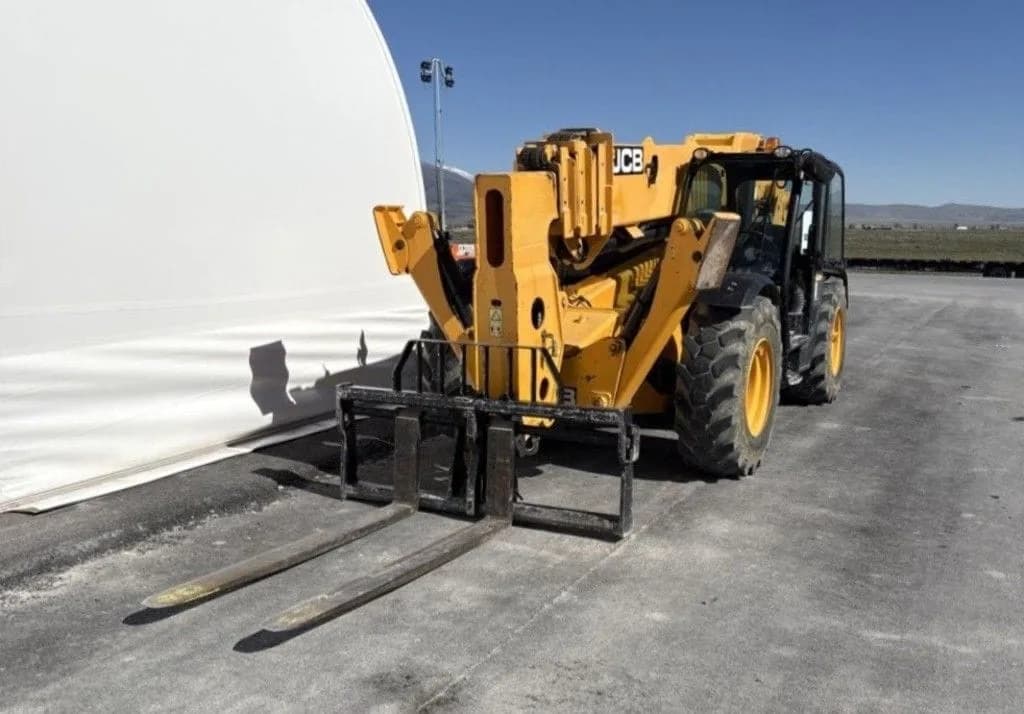
You are looking at a used JCB 536-70 Loadall, or a Cat TL943, or a Genie or Manitou telehandler with 6,000 hours on the clock. The price looks fair, the tires still have tread, and the boom goes up and down. But that hour number is sitting in your head. Is this machine halfway through its life, or worn out? Will a lender even touch it?
Right questions — and for a telehandler the answer leans on the hour meter less than for almost anything else you could buy. A telehandler is not an earthmover. It is a lift machine: it picks, carries, places, and spends a lot of its day idling at low rpm between lifts. Engine hours pile up slowly and unevenly relative to the real work, so the meter undercounts what actually ages the machine — the boom, the driveline, and, more than anything, how hard it was loaded. Two telehandlers at 6,000 hours can be worlds apart, and the clock will never tell you which is which.
One thing to clear up first, because it trips up almost everyone: there is no magic hours number that makes a telehandler "unfinanceable." Canadian lenders do not post an hours cap the way they cap age. What they actually do is appraise the machine and tie your term to its age and expected life at the end of the loan — so high hours mean a shorter term, not an automatic decline. Hours matter because they hint at remaining life. But on a telehandler, they hint at it poorly, and that is the whole story of this page.
The Hour Meter Is the Wrong Gauge
Most machines wear in proportion to their engine hours because the engine is under load whenever it runs. A telehandler breaks that link. It is a materials-handling machine — it lifts a load, tramples across a yard or a field, sets the load down, and idles while the operator lines up the next pick. As one trade publication puts it, machine hours are a weak lifecycle indicator for telehandlers precisely because they idle at low rpm; the parts that decide when a rebuild is due are structural and hydraulic — the boom, the pins, the pumps — not the engine.
So the number that matters is not the one on the dash. It is the answer to a different question: how was this machine loaded, and was it greased? A telehandler that lifted within its chart and got daily lubrication will outlast one with half the hours that was run overloaded out at full reach and never touched with a grease gun. That is not a soft opinion — it is the consensus across every serious inspection guide, and it is why the rest of this page is about wear points and abuse signatures, not thresholds.
Key takeaway: On a telehandler, the hour meter is close to the least useful number on the machine. Read the boom, the driveline, and the signs of overloading — a well-loaded, well-greased high-hour unit beats an abused low-hour one every time.
How Long a Telehandler Actually Lasts
Here is where the honest answer needs a flag on it: the hard numbers on telehandler service life are US and UK dealer figures, not Canadian, and not from the manufacturers. Canadian-specific service-life and resale data on telehandlers barely exists, so treat the following as directional rules of thumb, not a Canadian appraisal.
The commonly cited band is roughly 8,000 to 12,000 engine hours before major component work for a well-maintained machine run within its limits — with premium or larger units reaching 10,000 to 15,000, and abused machines needing rebuilds as early as 5,000 to 7,000. Predictable age-related wear tends to start around 3,000 to 6,000 hours — usually minor at first, like a bit more clearance in the boom pads or a little hose seepage — with bigger bills more likely the higher the hours climb. These figures come from equipment-dealer sources, not OEM engineering data, so anchor on the pattern, not the precise number.
The pattern is the useful part: maintenance discipline outweighs the raw hour reading. Consistent oil changes and clean hydraulic fluid can push a telehandler well past 10,000 hours, and a neglected machine can be finished far earlier "regardless of total hours." A first-rebuild window somewhere around 8,000 to 12,000 hours is a reasonable planning assumption — but the records, not the meter, tell you where in that range a specific machine sits.
Key takeaway: Plan around a rough 8,000-to-12,000-hour first-rebuild window (US/UK rule of thumb, not Canadian), but weight the maintenance records far more heavily than the number. A documented machine can run past it; a neglected one won't reach it.
The Boom Is the Expensive Part
Every machine has a signature high-cost component. On a dozer it is the undercarriage; on a telehandler it is the boom — the most costly single component to replace, and the one whose wear is hardest to see.
Most boom wear is hidden inside the tubes. The chains, sheaves, and hoses that run inside the telescoping sections wear where you can't easily look, so the only real gauge of remaining boom life is a current internal inspection with the boom extended. Bent or cracked boom sections — and the chains, sheaves, and hoses inside the boom — rank among the most expensive telehandler repairs there are.
Wear pads are cheap; pivot pins are not. The boom slides on replaceable wear pads that deteriorate with use — and those are a cheap fix, re-shimmed for very little. The expensive failure is cracking around the main boom pivot pins — relatively uncommon, but when it happens it needs certified lifting-equipment welding and runs into real money (the trade-press figures are UK pounds and JCB-specific, so treat them as illustrative, not Canadian). The tell that connects the two: excess play in the pads is the early warning that a machine is heading toward that costly failure, so slop you can feel today is worth pricing in now.
Grease is the whole game. Boom wear pads need daily cleaning and greasing, with inspection intervals around 250 to 1,000 hours depending on the maker. Neglected lubrication is the single most common cause of telehandler mechanical breakdowns, and the rear axle pivot is one of the most vulnerable points if it is not kept greased. A dry, ungreased machine tells you how it was cared for, whatever the meter says.
Key takeaway: Extend the boom and inspect it. Cheap wear pads are fine; sideways slop in the extended boom is the warning sign — it is what leads to the rare but costly pivot-pin cracking — and a bone-dry grease record predicts trouble.
The Driveline Is the Hidden One
If the boom is the expensive wear point, the driveline is the invisible one. A telehandler spends its life in load-and-carry: picking up a heavy load and driving it across rough, uneven ground. That constant travel under load is hard on axles and transmissions, and broken axles and damaged transmissions are not uncommon on worked machines.
The problem is you often can't see it coming. Internal axle and transmission damage is nearly impossible to detect without a fluid sample or an outright failure — the machine drives fine right up until it doesn't. This is exactly why a used-telehandler inspection should include oil and fluid sampling on the driveline, not just a test drive. A clean bill on the boom means nothing if the transmission is grinding itself apart internally.
Tires are the opposite kind of wear — the biggest and fastest-wearing item on the machine, responsible for a disproportionate share of downtime, but a simple visual check. Budget for tires on any high-hour telehandler; just don't confuse a fresh set for a healthy machine underneath.
Red Flags: The Fingerprints of Abuse
Because hours tell you so little, the most valuable thing you can do on a used telehandler is read it for overloading — the abuse that actually shortens its life and that the meter cannot show. These are the tells inspectors look for:
Sideways play in the extended boom. Rock the boom sections when fully extended and watch for lateral movement. Worn pads and excess play are what eventually lead to the costly pivot-pin cracking — so slop out at reach is both a current problem and a warning about how hard the machine was pushed.
A tampered or damaged load-sensor switch. Telehandlers have a load-sensing system that limits what you can lift out at reach. Signs that it has been tampered with or bypassed are a red flag that the machine may have been deliberately overloaded — one of the clearest "this was abused" signals there is.
Damaged fork tines, tine bars, and carriages. These get bent and worn from misuse, not from normal life — using the boom to push or pull, using the machine as an over-capacity crane, or dropping the tines into the ground to dig. Damage here is evidence the machine was worked outside what it was built to do.
A dry, ungreased machine. As above — neglected lubrication is the top cause of breakdowns. Empty grease points and dry pivots tell you the maintenance story faster than any logbook.
Where It Worked Changes What the Hours Mean
The research on telehandlers is clearer about abuse than about neat per-application multipliers, so read this as informed judgement rather than a hard table — but where a telehandler spent its life shapes what a given hour reading is worth.
- Agricultural and seasonal use. Often a gentler life mechanically — grain, bales, feed, and yard work, frequently within the machine's comfortable range — but concentrated into busy seasons and exposed to mud, dust, and weather. A high-hour farm Loadall that was greased and lifted sensibly can be a genuinely good buy.
- Construction and site work. Heavier, mixed materials, and more time out at reach placing loads on a building — closer to the machine's limits, more of the time. Watch the boom and the load-sensor closely.
- Rental-fleet machines. The hard end. A rental telehandler sees many operators, gets pushed to its limits by people who don't own it, and is the most likely to have been overloaded out at reach. Ask about rental provenance directly, and inspect for the abuse signatures above before you trust the hours.
The through-line is the same one that runs through the whole machine: on a telehandler, how it was worked matters more than how long.
How Telehandler Hours Affect Financing
Lenders evaluate telehandler hours through the lens of risk, not as a pass/fail gate. There is no hard hours number that triggers an automatic decline in Canada. Underwriters read hours as the "mileage" on heavy equipment — a proxy for remaining useful life — and evaluate age, usage, and condition together. Because a loan term is tied to the machine's expected lifespan and its age at the end of the term, higher accumulated hours simply shorten the term the lender will offer, rather than killing the deal. If the projected end-of-term value still supports the loan, it works; if not, the lender shortens the term, raises the down payment, or declines — in that order.
The following table reflects common patterns we see when contractors and farmers finance telehandlers. Every lender underwrites differently based on borrower strength, machine age, dealer support, and intended use — but it gives you a sense of how the structure moves, not whether you get a yes:
| Hours | How the Deal Structures | Typical Terms Available |
|---|---|---|
| Under 3,000 | Strongest collateral | Longest terms, lowest down, best rates |
| 3,000 - 6,000 | Straightforward | Standard terms and down payment |
| 6,000 - 8,000 | Value-driven | Shorter term or more down; a clean boom-and-driveline inspection holds the term |
| 8,000 - 12,000 | Tighter structure | More down, shorter term; records and boom/pivot condition matter most |
| Over 12,000 | Appraisal-led | Broker or specialized lenders; documented service and a sound boom can still finance |
As of the June 10, 2026 decision, the Bank of Canada held its overnight rate at 2.25% — the fifth consecutive hold — with the major banks' prime rate at 4.45%. Equipment loan pricing floats above prime with a spread that widens as credit and machine age weaken, so any future Bank of Canada move shifts the whole picture.
Where BDC fits. The Business Development Bank of Canada finances new or used equipment up to 125% of the purchase price — enough to roll in delivery, attachments, or training — for a Canada-based business with at least 12 months of revenue and a good track record. BDC is explicit that "credit isn't everything," so a solid operating history and a well-kept machine carry real weight. A documented service record and a clean inspection are what open the longer terms on a higher-hour telehandler.
What About Brand and Resale?
There is always a reliable resale market for a good used telehandler that has been well maintained and is within a reasonable age and hour range — and documented service history is the dominant value driver, worth a meaningful premium over a machine with patchy records (that premium figure is US/North-American, not Canadian).
On brand, the one name with solid resale evidence is JCB: well-kept JCB Loadalls are cited as holding their value well relative to competitors, with service history the deciding factor (this is most pronounced in the UK/EU market, so treat it as directional here). Beyond that, be skeptical of brand resale rankings — the strongest such claim in circulation traces to a manufacturer's own marketing and does not survive scrutiny. The honest read: across Cat, Genie, JLG, Manitou, Bobcat, New Holland, and JCB, a documented, well-loaded machine holds value; an abused or undocumented one doesn't — and that matters far more than the badge.
So How Many Hours Is Too Many?
There is no single number — but here is a practical framework.
If you are buying a telehandler as a core machine for the next several years, look for something under 6,000 hours with complete service records, and extend the boom to inspect it before anything else. You will get straightforward financing and a machine with real life and resale value left.
A telehandler in the 6,000-to-12,000-hour band can be an excellent buy — often at a much better price — if the records are complete, the boom shows no sideways slop, the load-sensor is intact, and a driveline fluid sample comes back clean. Budget for tires and expect the financing structure to tighten a little.
Over 12,000 hours you are buying a machine in the back half of its life. That can still make good sense on a documented, well-loaded unit with a sound boom — a telehandler that was never abused ages gracefully — but go in with a proper inspection, fluid samples, and a maintenance budget.
If you need help financing a used telehandler at any hour range, you can apply with IronFinance and we will match you with a lender who fits your situation. We will give you a straight answer about what is realistic for the machine you are looking at.
Sources: Equipment World — telehandlers (hours as a lifecycle indicator); ForConstructionPros — inspect used telehandlers before purchase; ForConstructionPros — know what you're getting in a used telehandler; Farmers Weekly — buying a used JCB telehandler; Compact Equipment — telehandler maintenance; Mevas — telehandler inspection checklist; Commercial Credit Group — equipment loan terms; BDC — equipment financing; Bank of Canada — June 10, 2026 rate decision. Service-life, wear-cost, and resale figures reflect US or UK data where Canadian-specific figures are not published; they are industry rules of thumb, not model-level Canadian pricing. Information current as of July 2026.
For related reading, see our hours guides for the excavator, skid steer, dozer, wheel loader, motor grader, skidder, and backhoe, plus our guides on financing high-hour equipment, how to finance heavy equipment in Canada, and current equipment loan and lease rates.
Already own equipment, or eyeing a different machine?
Frequently Asked Questions
How many hours will a telehandler last?
As a generic industry rule of thumb — from US and UK dealer sources, not Canadian or manufacturer data — a well-maintained telehandler run within its rated limits typically reaches roughly 8,000 to 12,000 engine hours before major component work, with premium or larger units going 10,000 to 15,000 and abused machines needing rebuilds by 5,000 to 7,000. But hours are a weak gauge on a telehandler: it is a lift machine that spends a lot of time idling at low rpm, so the engine meter undercounts what actually wears — the boom, the driveline, and how hard the machine was loaded. Maintenance history tells you far more than the number on the clock.
Is 5,000 hours a lot on a telehandler?
Not on its own. 5,000 hours is mid-life for a well-kept telehandler, and a documented machine at 5,000 hours can easily have most of its life left. What matters more than the number is how it was loaded: rock the extended boom for sideways play, check the load-sensor switch for tampering, and look at the fork tines and carriage for damage. A 5,000-hour machine that was overloaded out at reach every day can be more worn than an 8,000-hour one that lifted within its limits and was greased daily.
What wears out on a telehandler?
The boom is the most expensive component to replace, and its internal wear — the chains, sheaves, hoses, and especially the main pivot pins — is hard to see without an inspection (wear pads are cheap to re-shim; a cracked pivot pin is not). The driveline is the hidden one: axles and transmissions take a beating from constant load-and-carry travel over rough ground, and internal damage often can't be found without a fluid sample. Tires are the biggest and fastest-wearing item but are a simple visual check. Neglected greasing is the most common cause of telehandler breakdowns.
Do telehandler hours affect financing in Canada?
Yes, but not as a hard cutoff. Canadian lenders do not publish an hours limit on a telehandler. They read hours as the 'mileage' that estimates remaining useful life and tie the loan term to the machine's age and expected lifespan at the end of the term, so a higher-hour machine simply earns a shorter term rather than a flat decline. BDC, for example, finances up to 125% of the purchase price of new or used equipment for a Canada-based business with 12+ months of revenue and a good track record. Documented maintenance and a clean boom-and-driveline inspection keep a high-hour telehandler financeable.