
You are looking at a used Cat 140M listed with 11,000 hours, or a John Deere 770G with 14,000, and the price looks fair — but that hour number is sitting in your head. Is this machine halfway through its life or near the end? Will a lender even touch it?
These are the right questions, and for a motor grader the answers are different than for almost any other machine. A grader does not live the punishing life a dozer does. It carries light structural loads, spends much of its time finishing rather than moving bulk, and as a result it is one of the longest-lived machines in the fleet. The hour meter, on its own, tells you remarkably little. What tells the story is the circle, the blade, the articulation joint — and what the machine was actually doing all those hours.
One thing to clear up first, because it trips up almost everyone: there is no magic hours number that makes a grader "unfinanceable." Canadian lenders do not post an hours cap the way they cap age. What they actually do is appraise the machine's value and cap its age at the end of your term — often a 10-to-15-year window depending on the lender and the asset. Hours matter because they drive that value and the machine's remaining useful life, which then shape your rate, term, and down payment. Keep that in mind as we go.
How Long a Motor Grader Actually Lasts
Graders are built to run a long time. A well-maintained machine will typically deliver 8,000 to 12,000 hours before a major component needs rebuilding or replacing, and machines with total service lives around 30,000 hours are common in the field. In reliability terms, the grader's B50 component life — the point at which about half the population has needed a major overhaul — sits at roughly 12,000 hours. That is the number to anchor on: 10,000 to 12,000 hours is not the end of a grader's life, it is the neighbourhood where the first big-ticket rebuild tends to come due.
This is why the "too many hours" question is softer on a grader than on almost anything else. A machine that reaches a first rebuild at 12,000 hours and carries a realistic path to 30,000 has more than half its life ahead of it at the point most buyers start to worry. The meter matters, but it is describing a long road.
Key takeaway: Motor graders are long-life machines — a first major rebuild typically comes due around 8,000 to 12,000 hours, and 30,000-hour service lives are common. High hours alone do not end a grader's usable life.
The Circle Is the Real Story, Not the Meter
Every machine has a signature wear point. On a dozer it is the undercarriage. On a motor grader it is the circle — the large turntable and ring gear that rotates the moldboard beneath the frame. This is where a grader earns its money, and it is the first thing you should inspect.
Here is why it matters so much. A grader is bought for precision: an operator is trying to hold a grade within a tenth of an inch. But as the circle's wear strips and pinion gear wear, the blade develops slop. As one veteran grader inspector puts it, "all it takes is an eighth of an inch here and there, and all of a sudden you're three-eighths of an inch out of alignment" — and that will not work when you are trying to get within a tenth of an inch on a grade. A grader can have a healthy engine and a clean frame and still be functionally worn out if the circle has too much play.
What to look for on the circle:
- Expect to see more wear on the front of the circle than the back — that is normal, but the amount tells you how hard the machine worked.
- An improperly aligned circle wears the pinion gear teeth unevenly. Inspect the circle surface for uneven wear patterns; even wear that has been managed with shims is a good sign, uneven wear is a warning.
- Slop between the circle and drawbar is a rebuild flag. A circle rebuild is real money, so this belongs in your price negotiation, not discovered afterward.
Key takeaway: The circle, not the hour meter, tells you whether a grader can still do its job. A high-hour machine with a tight circle beats a lower-hour machine with a worn one every time.
The Other Wear Points That Matter More Than Hours
After the circle, a short list of components tells you more about a used grader than the number on the meter — and almost all of them wear on the environment the machine worked in, not on time alone.
The cutting edge and moldboard. The cutting edge is a sacrificial, bolt-on part. Replace it — along with the bolts holding it on — when it wears to half an inch or less, because it is far more economical to replace the cutting edge than to let wear reach the structural moldboard behind it. Cutting-edge wear rate depends heavily on application: edges used to clear snow from smooth roads last considerably longer than those maintaining rocky, unfinished roads. A worn edge is cheap; a chewed-up moldboard is not.
The articulation joint. Rough, uneven, rocky ground is much harsher on a grader's articulation point than smooth soil. A quick field check: if the cab is sitting higher than the engine compartment (or the reverse), the articulation point may be bent or loose. That is a structural issue, not a wear item, and it belongs on your inspection list.
The front axle and tandem drives. The front axle is a genuine high-wear item on a grader — it steers constantly, carries significant weight, and works against the load of the blade — and a rebuild is a several-thousand-dollar job. The rear tandem drives have their own enemy: dirt. Run a grader in loose dirt for long enough and material packs into the wheels and takes out the axle seals, causing leaks. The lesson underneath all of this is the one that runs through the whole machine — the dryer and smoother the work, the longer everything lasts.
The frame. When you inspect the frame, look for fishplates — metal reinforcements welded over or behind a repaired crack. A fishplate is evidence of a prior structural repair, which is not automatically a deal-breaker but is something you need to know about and price in.
Key takeaway: Ask what the grader was doing, not just how many hours it has. A machine that graded smooth municipal roads in snow ages far more slowly than one that maintained rocky haul roads — and the circle, cutting edge, and seals will show it.
How the Type of Work Changes the Hours
Not all grader hours are equal, and the gap is wider than most buyers expect. The same 12,000-hour reading means very different things depending on the application:
- Municipal road maintenance and snow removal. Often high-hour, but frequently the gentlest work a grader does — smooth roads, light material, cutting edges that last. A high-hour municipal machine can be in better mechanical shape than a lower-hour unit from a harsher setting.
- General construction and site grading. Average wear. Mixed materials and moderate duty put predictable, middle-of-the-road hours on the machine.
- Mining and resource-road maintenance. The hard end. Abrasive material, rocky ground, and continuous duty accelerate wear on the cutting edge, articulation joint, and seals well beyond what the hour meter suggests.
This is why two graders with identical hours can be worlds apart. When you read the meter, read the application right next to it.
Brand and Model Longevity at High Hours
The major brands all build graders that reach high hours when maintained, and lender confidence tracks brand support and resale predictability more than any single durability claim.
Caterpillar — the 140M and 160M are the benchmark in Canada. Strong dealer network, excellent parts availability, and the most predictable resale floor, which is exactly what makes lenders comfortable carrying a Cat grader to higher hours.
John Deere — the 670, 770, and 870G series are well-supported and popular, particularly in Western Canada, with competitive longevity and a slightly lower purchase price than a comparable Cat.
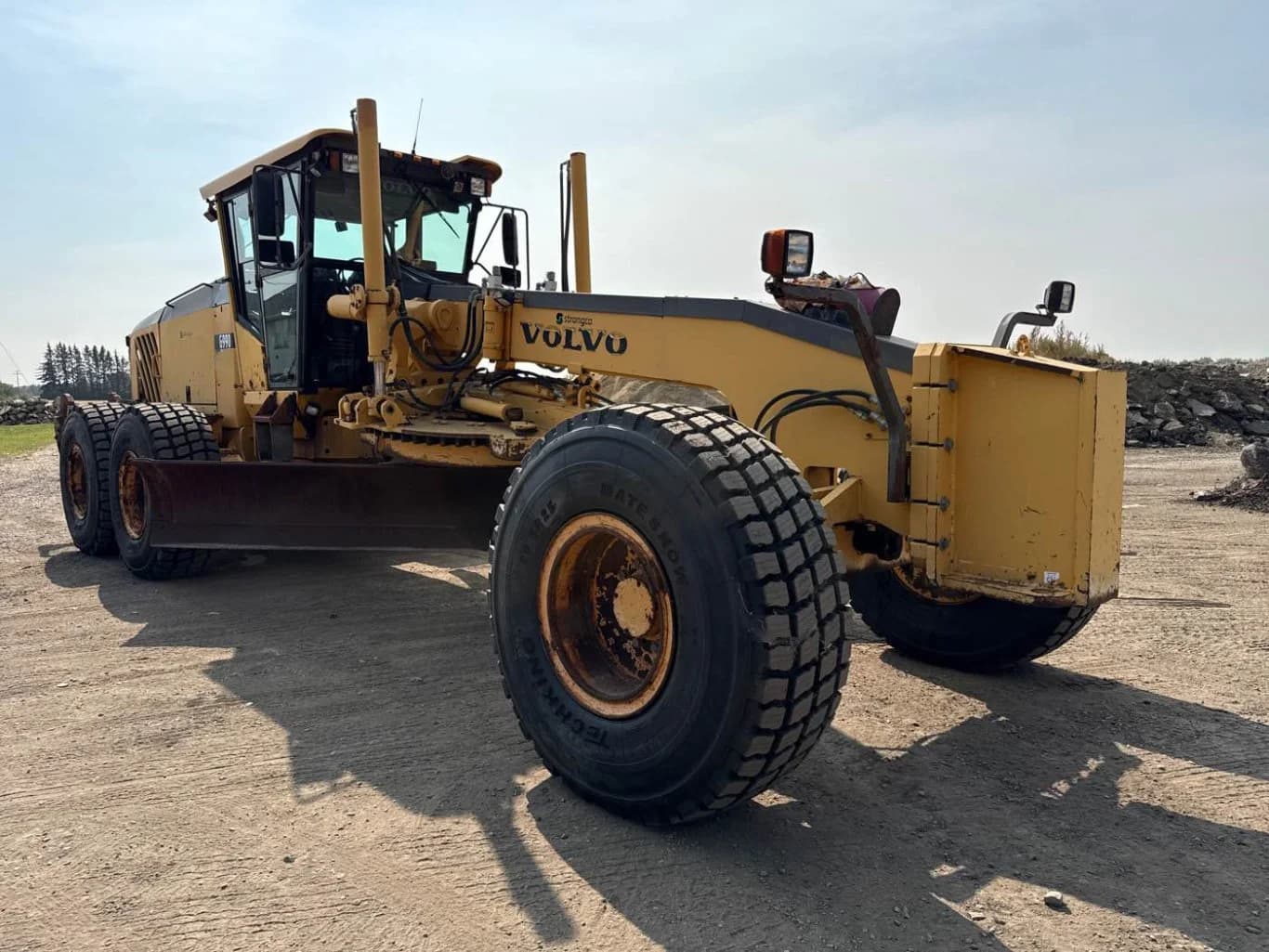
Komatsu (GD series) and Volvo (G900 series) — both reach high hours with good maintenance and have solid parts support in most regions. As with any machine, lender comfort is strongest on the mainstream models where resale is easy to predict.
Across all brands, the pattern is the same: a documented major-component rebuild — engine, transmission, or circle — resets the remaining-life clock in a lender's eyes far more than the badge on the hood does.
How Motor Grader Hours Affect Financing
Lenders evaluate grader hours through the lens of risk, but not as a pass/fail gate. There is no hard hours number that triggers an automatic decline in Canada. As one Canadian equipment-finance lender puts it, "hours are the mileage on heavy equipment" — underwriters use them to estimate remaining life and repair risk, then structure the deal around four things: hours today, expected annual usage, projected hours at the end of the term, and whether any major component is nearing a rebuild. If the projected end-of-term value still supports the loan, the deal works. If it does not, the lender shortens the term, raises the down payment, or declines — in that order. Hours drive the structure, not a flat cutoff.
What lenders actually cap on is age at the end of the term — often a 10-to-15-year window depending on the lender and the asset. Used-equipment terms are commonly capped by year and model age, hours, condition and inspection results, and resale-market depth. Because a grader's useful life is long, its remaining-life runway is often generous even at high hours — which is part of why graders finance well. Lenders size the amortization to that remaining life: if the machine will realistically last another 7 to 10 years in your use-case, a longer term is on the table; if it is already middle-aged, the lender wants it paid down before it becomes a maintenance liability.
The following table reflects common patterns we see when contractors finance graders. Every lender underwrites differently based on borrower strength, machine age, dealer support, and intended use — but it gives you a general sense of how the structure moves, not whether you get a yes:
| Hours | How the Deal Structures | Typical Terms Available |
|---|---|---|
| Under 4,000 | Strongest collateral | Longest terms, lowest down, best rates |
| 4,000 - 8,000 | Straightforward | Standard terms and down payment |
| 8,000 - 12,000 | Value-driven | Shorter term or more down; circle and records hold the term |
| 12,000 - 20,000 | Tighter structure | More down, shorter term; documentation and a clean circle matter most |
| Over 20,000 | Appraisal-led | Broker or specialized lenders; a documented rebuild can restore financeable life |
As of the June 10, 2026 decision, the Bank of Canada held its overnight rate at 2.25% — the fifth consecutive hold — with the major banks' prime rate at 4.45%. Equipment loan pricing floats above prime with a spread that widens as credit and machine age weaken, so any future Bank of Canada move shifts the whole picture.
Where BDC fits. The Business Development Bank of Canada finances new or used equipment up to 125% of the purchase price — enough to roll in delivery, attachments, or training — with terms up to 12 years and, if you qualify, interest-only payments for up to the first 24 months. BDC confirms the final rate during application review and may require a down payment depending on the structure and risk profile. It is a mainstream-flexible option for a well-kept grader; a documented rebuild and clean inspection are what open the longer terms.
So How Many Hours Is Too Many?
There is no single number — but here is a practical framework.
If you are buying a grader as a core machine for the next 5 to 10 years, look for something under 8,000 hours from a major brand, and inspect the circle before anything else. You will get solid performance, straightforward financing, and a machine with substantial resale value left.
If you are buying for a specific project, seasonal municipal work, or as a second machine, a grader in the 8,000-to-15,000-hour range can be a smart buy when the circle is tight, the records are complete, and the price reflects the hours. Budget for the first major rebuild and expect the financing structure to tighten.
Over 20,000 hours you are buying a machine in the back half of a long life. That can still make excellent sense — a documented rebuild resets the remaining-life clock, and a well-priced high-hour grader with a fresh circle can outrun a tired mid-hour machine with no history. Go in with a proper inspection and a maintenance budget.
If you need help financing a used grader at any hour range, you can apply with IronFinance and we will match you with a lender who fits your situation. We will give you a straight answer about what is realistic for the machine you are looking at.
Sources: EquipmentWorld — how to inspect a used grader; Ritchie Bros. — motor grader inspection tips; BDC equipment financing; Bank of Canada — June 10, 2026 rate decision; Mehmi Group — used-equipment financing, age and hours. Working-life and wear figures reflect North American field data where Canadian-specific figures are not published; they are engineering and service-life ranges, not model-level pricing. Information current as of July 2026.
For related reading, see our hours guides for the excavator, skid steer, dozer, skidder, wheel loader, backhoe, and telehandler, plus our guides on financing high-hour equipment, how to finance heavy equipment in Canada, and current equipment loan rates.
Already own equipment, or eyeing a different machine?
Frequently Asked Questions
How many hours does a motor grader last?
A well-maintained motor grader will typically deliver 8,000 to 12,000 hours before a major component needs rebuilding or replacing, and machines with total service lives around 30,000 hours are common. Graders are among the longest-lived machines in the fleet because they carry light structural loads compared with a dozer or excavator. The realistic working life depends far more on the circle and blade wear, the operating environment, and maintenance discipline than on any single number on the meter.
Is 10,000 hours a lot on a motor grader?
It is a decision point, not a death sentence. Around 10,000 to 12,000 hours is the window where the first major component — engine, transmission, or circle — commonly comes due for a rebuild, and it is roughly the B50 component-life point where about half of graders have needed a major overhaul. But a well-maintained major-brand grader (Cat 140/160 M-series, John Deere 670/770/870G, Komatsu GD) with a tight circle and good records routinely has substantial working life left past 10,000 hours toward that 30,000-hour total-life mark.
What wears out on a motor grader?
The signature wear point is the circle — the turntable that rotates the blade. As little as an eighth of an inch of circle wear can throw the blade three-eighths of an inch out of alignment, which defeats the tenth-of-an-inch accuracy a grader is bought for. After the circle, watch the cutting edge (replace at half an inch or less — far cheaper than replacing the moldboard), the articulation joint, the front axle, and the tandem-drive seals. Most of these wear on the environment the grader worked in, not on the hour meter.
Do motor grader hours affect financing approval?
Yes, but indirectly. Canadian lenders do not publish a hard hours cutoff. They cap on the machine's age at the end of the term — often a 10-to-15-year window depending on lender and asset (BDC, for example, lends up to 12 years on new or used equipment) — and read hours as the 'mileage' that estimates remaining useful life and repair risk. High hours mean less collateral value, so lenders offset with more down or a shorter term rather than a flat decline. Documented major-component work can reset that read and make even a high-hour grader financeable.