
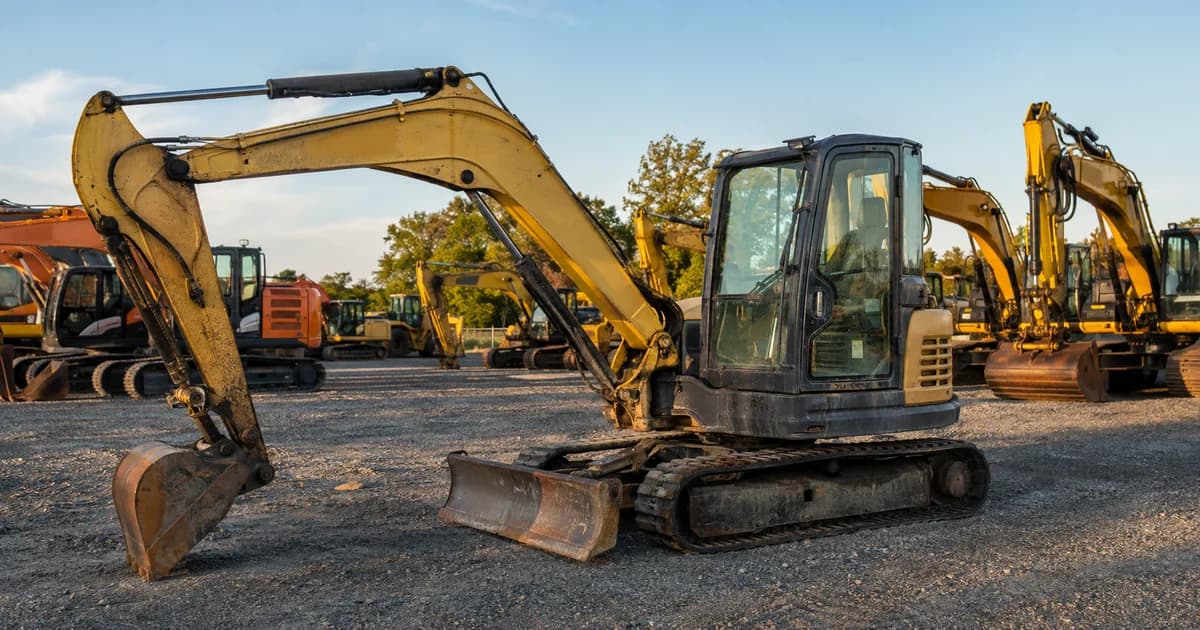
You found a 2019 excavator on a dealer lot — good hours, tight undercarriage, priced where the steep depreciation has already been absorbed by somebody else. You ask about leasing it, expecting the low monthly payment leasing is famous for. The quote comes back looking almost exactly like a loan payment, and the salesperson has quietly stopped saying "lease" and started saying "$1-buyout."
Nothing went wrong. You just met the arithmetic of used-equipment leasing, and it is worth understanding before you shop, because it decides which structures you will actually be offered — and whether leasing is buying you anything a loan would not. The general mechanics of leasing live in the equipment leasing guide; this page is specifically what changes when the machine is not new.
Why the Lease Advantage Inverts on a Used Machine
A lease's low payment is borrowed from the machine's future value. On a new machine, the lessor can confidently assume a big residual — say 35-40% after five years — so your payments only have to cover the depreciation in between. That gap between price and residual is where the famous lease payment advantage lives.
On a used machine, the depreciation a lease would finance has already happened. Heavy equipment loses its value front-loaded: the steepest drop is in the first years of life, which is exactly why late-model used iron is good buying. But it also means there is less future depreciation left for a lease to spread out — and the residual that remains is smaller and far less certain. Nobody wants to promise today what a 12-year-old excavator will be worth in five more years.
So the structure follows the residual. Where the residual is still predictable — late-model, major brand, dealer machine — fair-market-value leases survive and can genuinely work. Where it is not, the FMV structure disappears first, and what is left is the $1-buyout: a lease that pays the machine down to a token dollar, carries no residual bet, and therefore prices almost exactly like a loan. The older the machine, the more "leasing it" just means "financing it with different paperwork."
The Age-Plus-Term Cap That Actually Decides It
Most lessors run some version of the same rule: the machine's age plus the lease term cannot exceed a ceiling, because the lease has to end while the machine still has working life. ATB Financial publishes its version outright for its agricultural equipment leases: a maximum 10-year lease, where the equipment's age plus the amortization period cannot exceed 10 years. Where the ceiling sits varies by lessor and machine class — some specialist lessors write older iron than that — but the age-plus-term arithmetic underneath is the same everywhere.
Play that forward and you can see why old iron prices itself out of leasing before any formal cutoff:
| Machine age | Longest lease under a 10-yr cap | What that does to the payment |
|---|---|---|
| 2 years | 8 years | Long term, low payment — leases like new |
| 5 years | 5 years | Standard term, standard payment |
| 7 years | 3 years | Short term — payment jumps |
| 9 years | 1 year | Not a lease anyone writes |
The specific numbers are ATB's rule rather than a universal law — caps vary by lessor and machine class — but the mechanic is market-wide, and it is the same one lenders run on loans for older iron: the term has to fit inside the asset's remaining life.
Hours bend the effective age. The cap runs on calendar age, but the residual behind it runs on remaining working life — and a 2018 machine with 2,000 hours reads years younger than a 2016 with 9,000 to whoever must stand behind the term-end value. Records, undercarriage, and boom condition move the read the same way they move resale. That evaluation is machine-specific, and it is exactly what the hours guides cover: excavators, skid steers, dozers.
What Actually Leases: The Used Sweet Spot
Three to six years old, major brand, from a dealer — this is the used-lease sweet spot. A 2020-2023 Cat, Komatsu, Deere, or Volvo machine has a known value, deep resale demand, and enough life left for a real term. Lessors write FMV and $1-buyout leases on these without much friction, and because the first owner absorbed the steep early depreciation, a lease here is often the best value in the whole leasing market.
Past roughly 7-8 years, the options thin. The FMV structure goes first — the residual is unguessable — and many lessors step back rather than write short, expensive terms. Specialist lessors do still write $1-buyout deals on older iron, but at shorter terms and higher payments, which is why the practical route from here is often a loan: the used heavy equipment financing guide covers how lenders underwrite by age and hours.
Private-sale machines usually become financing deals. The lessor is the buyer in a lease — it purchases the machine to rent it to you — so it needs clean title, a lien search, and a value it trusts. A dealer unit clears that in a day; a private-sale find may need an appraisal, and many lessors will simply route it to a loan instead. Financeable, yes. Leaseable, occasionally.
Challenged credit narrows this further but does not close it. Used-equipment leasing with a bruised file exists — expect $1-buyout structures, larger upfront payments, and pricing at the top of the tier bands. The bad-credit leasing guide covers why the lessor can say yes and what it costs.
The Structure You Will Be Offered — and What It Does to the Tax Pitch
On used iron, assume the quote is a $1-buyout unless the machine is late-model. Two consequences follow, and both are worth knowing before the sales conversation:
Economically, you are looking at a loan. A $1-buyout at the same rate and term prices within a rounding error of a loan payment — there is no residual absorbing anything. That is not a criticism; it can still win on approval speed, down payment, or paperwork. But the comparison to run is $1-buyout total-of-payments vs. loan total-of-payments, and the lease-rates-vs-loan-rates guide shows exactly how to do the conversion — including the factor trap to watch for.
The "write off the whole payment" pitch evaporates. Canada taxes by legal form: a $1-buyout is a conditional sale, so the CRA treats it as a purchase — Capital Cost Allowance plus interest, the same as a loan. The full-payment deduction belongs to true FMV leases, which are precisely the structure that thins out on used machines. If the tax treatment is the reason you wanted a lease, check which structure you are actually being offered before it matters; the lease-vs-finance guide walks the split properly, and your accountant has the final word on your contract.
What a Used Lease Costs
Used-lease pricing runs on the same credit tiers as everything else — the current rate table applies, with effective lease rates tracking roughly 6-16%+ by tier off Bank of Canada prime at 4.45%. Age pushes you toward the upper half of your tier the same way it does on a loan, and the shortened term from the age cap raises the payment even where the rate holds. Quotes will usually arrive as a rate factor rather than a percentage; on used iron especially, convert to total-of-payments before comparing anything.
How to Shop a Used Lease Without Getting Burned
Tip 1: Ask which structures are on the table before negotiating anything. If the answer is "$1-buyout only," you are shopping loans in lease paperwork — get a loan quote alongside and compare totals.
Tip 2: Bring the machine's residual story with you. Hours, service records, undercarriage or boom condition. You are asking someone to believe in this machine's future value; evidence moves the term and the price.
Tip 3: Fit the term to the machine's remaining life, not the payment. A short term under the age cap means a higher payment on paper — but stretching for a longer term on a tired machine is how you end up making payments on iron that no longer works.
Tip 4: On a private-sale machine, ask early whether it can be leased at all. If the answer is no, that is fine — it is a financing deal, and better to know before you have negotiated a price around the wrong product.
Tip 5: Get the buyout and end-of-term terms in writing on anything FMV. On a used machine the residual is the deal. Who set it, what happens if the market disagrees, and what the return conditions cost.
Mistakes That Cost Used-Equipment Buyers Money
Chasing the FMV payment on a machine that is too old for one. If a lessor does offer a low-payment FMV structure on a 9-year-old machine, look hard at the residual and the return conditions — the risk went somewhere, and it is usually into your end of the contract.
Assuming a lease approves easier than a loan on old iron. Often it is the opposite: the lessor owns the residual risk and is more age-sensitive than a lender secured by a lien. Do not burn weeks courting the wrong product.
Comparing the factor to a loan rate. Worth repeating on used iron, where $1-buyout quotes should land near loan payments — if the factor-implied payment is well above the equivalent loan, the pricing is in the gap.
Leasing a machine you plan to run for a decade. On used iron with the age cap, that decade will not fit inside any lease — you will own it through a buyout anyway, so price the ownership path from the start.
Sources: ATB Financial agricultural equipment lease terms (maximum 10-year lease; equipment age plus amortization not exceeding 10 years — cited as a published example of the age-plus-term mechanic, which varies by lessor and machine class) — ATB Financial; lease vs. purchase tax characterization (legal-form test) — Canada Revenue Agency, T4002; rate environment — Bank of Canada (policy rate 2.25%, prime 4.45%, July 2026); lender categories — BDC. Structure availability and age thresholds are market practice and vary by lessor and machine class; rates are directional benchmarks as of August 2026, not offers.
Getting a Straight Read on the Machine You Found
Whether a specific used machine is a lease, a loan, or a walk-away is exactly the kind of question that is faster to answer than to research. Send us the machine — year, hours, price, dealer or private — and we will tell you straight which product fits it and what the realistic structure looks like, before you commit to anything.
Ready to move? Start an application. Still comparing? The lease-rates-vs-loan-rates conversion, the full leasing guide, and the used equipment financing guide are the three pages that finish the picture.
Already own equipment, or eyeing a different machine?
Frequently Asked Questions
Can you lease used heavy equipment in Canada?
Yes — but what is on offer changes with the machine's age. Leasing runs on residual value, and a late-model used machine from a major brand still has a predictable one, so 3-to-6-year-old dealer iron leases readily and is often the best value in the market because the steepest depreciation has already happened. Past roughly 7-8 years the residual gets hard to defend, fair-market-value structures disappear first, and what remains is usually a $1-buyout lease — which behaves like a loan — or simply a loan.
How old is too old to lease equipment?
There is no fixed legal ceiling — it is arithmetic. Lessors commonly cap the machine's age plus the lease term: ATB Financial's published rule for its agricultural equipment leases, for example, is a maximum 10-year lease where the equipment's age plus the amortization period cannot exceed 10 years, and the ceiling varies by lessor and machine class. Under a cap like that, a 4-year-old machine can carry up to a 6-year lease, a 7-year-old machine only 3 — and the shorter the term, the higher the payment, which is what actually prices old iron out of leasing before any formal cutoff does.
Do hours matter for leasing a used machine, or just age?
Both, because the residual is really about remaining working life. A 2018 machine with 2,000 hours reads younger than a 2016 with 9,000 to whoever has to stand behind the term-end value. Hours, maintenance records, and undercarriage or boom condition shape the residual the same way they shape financeability and resale — which is exactly what our machine-specific hours guides walk through.
Can you lease a machine from a private seller?
It is harder, and often it quietly becomes a financing deal instead. In a lease the leasing company buys the machine in order to rent it to you, so it needs a clean title, a lien search, and a value it trusts — easy on a dealer unit, slower on a private sale, which may need an appraisal before anyone will write the deal. Private-sale machines are regularly financed in Canada; they are only occasionally leased.
Is leasing used equipment cheaper than financing it?
Usually not in any meaningful way, because on used iron the structure that survives is the $1-buyout lease — and a $1-buyout prices almost exactly like a loan at the same rate and term. The fair-market-value structure that genuinely lowers payments on new machines depends on a large, confident residual, which is precisely what an older machine no longer has. Compare any used-lease quote against a loan quote on total of all payments, not on the payment or the factor.