
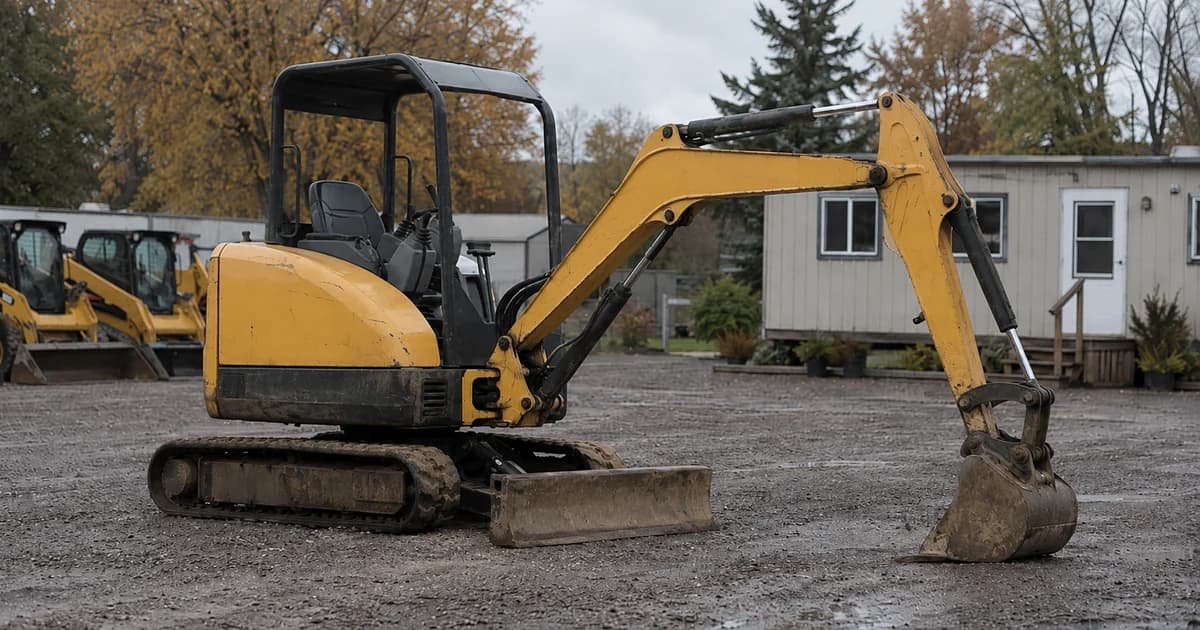
Your bank said no on the loan. Two weeks later a leasing company said yes on the same machine, and the salesperson made it sound like leasing companies just have bigger hearts. They do not. They have a different piece of paper — and that piece of paper is the whole reason a contractor with a 580 score can put a machine to work this month while the loan application sits in a decline pile.
This page is the intersection two of our other guides only wave at: the bad-credit financing guide covers loans with a bruised file, and the equipment leasing guide explains how leasing works assuming your credit is fine. Here is what happens when the file is not fine and the product is a lease — why the door opens, what it costs to walk through, and where it genuinely does not open at all.
Why a Lessor Can Say Yes When a Bank Says No
It comes down to who owns the machine. In a loan, the lender hands you money and takes a security interest — a lien — over a machine you own. In a lease, the leasing company buys the machine itself and rents you its working life. It holds title for the whole term. You never own it until the buyout.
That changes what default looks like from the funder's chair. A lender enforcing a lien is pursuing a security interest against your asset; a lessor on default is recovering its own equipment. Both are registered under the provincial Personal Property Security Act — since 2007 Ontario's PPSA (like the other common-law provinces) treats a lessor's interest under a lease of more than one year as a security interest whether or not it secures payment, so the lessor registers and follows the same notice-and-disposition rules a lender does. This is not a magic wand: as one law firm put it, just because you own it doesn't mean it's yours if you fail to register. But the ownership position is cleaner, and the recovered machine goes straight back into the lessor's inventory. Lower loss severity is what lets a lessor accept a file a bank's credit committee cannot. The default guide walks the PPSA process itself, and it applies to both.
So "easier to approve" is real — and it is structural. Not softer standards; a stronger fallback. That distinction matters because it tells you exactly which files it helps: ones where the machine is solid and the credit history is the problem. It does not rescue a file where the business itself cannot make the payment.
What the Approval Actually Looks Like
Here is the honest shape of a challenged-credit lease in Canada right now, priced off Bank of Canada prime at 4.45% (policy rate held at 2.25% on July 15, 2026):
| Credit Range | Typical Effective Lease Rate | Upfront | Structure You Will Be Offered | Who Writes It |
|---|---|---|---|---|
| 620–679 | ~12-14% | 10-20% | $1-buyout, sometimes FMV on late-model iron | Equipment finance companies, some credit unions |
| 550–619 | ~14-16% | 15-25% | $1-buyout, first/last + deposit | Independent lessors, private equipment lenders |
| Below 550 | ~16%+ | 20-30%+ | $1-buyout only, shorter term | Specialist lessors only |
Three things fall out of the table:
The structure is almost always a $1-buyout. A fair-market-value lease requires the lessor to bet on the machine's residual and your ability to keep paying — on a challenged file it will rarely take both bets. The $1-buyout removes the residual bet: you pay the machine down to a token dollar. That is what gets offered.
"Upfront" is usually not called a down payment — and on a bruised file it is a lot more than first-and-last. The leasing guide is right that a clean-credit lease often takes just the first and last payments upfront instead of a percentage down; that is the whole cash-flow appeal. A challenged file loses most of that appeal. The lessor still takes first and last, but adds a security deposit sized to its exposure — and the total lands in the same 15-25% band a bad-credit loan asks for. Same cash effect, different label. It also runs to shorter terms: 36-48 months is typical, with 60 reserved for stronger files.
The rate is a lease-flavoured version of the same tier pricing. Sub-620 pays mid-teens whether it borrows or leases. Nobody is discounting the credit risk because the product name changed.
See Your Likely Rate Range
Two questions, no credit pull. Get a directional rate range and the lender category your file is most likely to fit.
Pick a credit tier and equipment age to see your likely rate range.
Approvable and Affordable Are Different Questions
The lease opens the door. Now the honest part: what walking through it costs, and why the leasing brochure's two big promises mostly do not survive contact with a challenged file.
The lower-payment promise mostly evaporates. Leasing's famous low payment comes from a fair-market-value structure financing only the depreciation. A $1-buyout finances the whole machine, so its payment lands almost exactly where a loan payment lands at the same rate and term. Here is a $95,000 used skid steer or mini excavator, the kind of machine that leases readily on a bruised file:
| Good credit — loan | Bruised credit — $1-buyout lease | |
|---|---|---|
| Upfront | 10% ($9,500) | 20% ($19,000) |
| Financed | $85,500 | $76,000 |
| Rate / term | 8.5% / 60 mo | 15% / 48 mo |
| Monthly | ~$1,754 | ~$2,115 |
| Total of payments | ~$105,250 | ~$101,527 |
| Total cost to own | ~$114,750 | ~$120,527 |
Read it two ways. The bad-credit lease costs about $5,800 more to own and $361 more a month, with $9,500 more cash at signing — real money. But it is also a machine on the job this month instead of a decline letter, and the shorter term means it is paid off a full year sooner. The bad-credit financing guide runs the same math on a larger machine against the revenue it earns; the conclusion is the same — the premium is the price of working now, not a reason to sit out.
The "write off the whole payment" promise mostly evaporates too. Canada taxes leases by legal form. A $1-buyout is, in law, a conditional sale — so the CRA treats it as a purchase: Capital Cost Allowance plus interest, exactly like the loan. The full-payment deduction belongs to true FMV leases, which is precisely the structure a challenged file is unlikely to be offered. If the tax angle was the reason you were steered toward leasing, check the structure before it matters; the lease-vs-finance guide walks the split, and your accountant has the final word.
Convert the factor before you compare anything. Challenged-credit leases are frequently quoted as a rate factor rather than a percentage, and a small-looking factor can hide a rate several points higher than it appears. The lease-rates-vs-loan-rates guide shows the conversion; on a bruised file, ask the lessor for total-of-payments and the equivalent APR in writing before you sign.
What Moves the Approval More Than Your Score
Monthly business revenue. This is the number the lessor sizes the payment against, and it can carry a soft score a long way. Consistent deposits into a business account, month after month, are the strongest thing you can bring.
Time in business. Two-plus years of operating history turns a "risky file" into "an operator who had a bad stretch." Even one full year with clean recent statements helps materially.
The machine. A late-model, mainstream unit — Bobcat, Cat, Deere, Kubota — from a dealer, with a known resale market, is easy for a lessor to own and easy to re-lease if it comes back. Odd, old, or private-sale iron narrows the field fast, and the used equipment leasing guide explains why age and hours matter as much to a lessor as to a lender.
The upfront. More cash at signing lowers the lessor's exposure and is the single most reliable lever on both approval odds and rate. If you can move from 15% to 25%, the file reads differently.
A story that matches the file. A bruised score with a specific, finished cause — a bad contract, a slow-pay client, an oil-price year — plus a rebuilding pattern since, is a very different file from a score that is still sliding. Say what happened.
Where the Door Genuinely Does Not Open
Being straight about this saves everyone a week, and it is our own criteria as much as the market's.
It has to be a business leasing a business machine. Equipment leasing is commercial credit. A machine for an acreage or personal projects is not a file anyone in this market will write, whatever the score.
There has to be monthly revenue. A lease payment is sized against income arriving in a business account. Strong revenue can carry a soft score; a good score with no income behind it generally carries nothing — and a bad score with no income is not a lease file at all.
A pre-revenue start-up with challenged credit is a different lane. A conventional lessor will decline it, and our lender network needs to see the revenue too. That is not the end of the road — very new or low-revenue businesses with bruised credit are exactly the profile our bank-declined page is built to route to the right funder, so start there rather than at a form that will bounce.
Watch the ceiling. Legitimate challenged-credit lease pricing sits in the mid-teens, occasionally low twenties. Canada's criminal rate of interest is a 35% APR (48% on commercial loans of $10,000-$500,000) — a legal ceiling, not a market rate. Anything approaching it is a sign you are talking to the wrong funder, not a deal.
Getting Approved: The Practical Moves
Tip 1: Lead with the revenue, not the score. Put twelve months of business bank statements in front of the lessor before they pull the bureau. Let the deposits frame the file.
Tip 2: Pick the machine the lessor wants to own. Late-model, mainstream, from a dealer, with a clean invoice. You are asking someone to buy this machine and trust they can re-lease it — make that easy.
Tip 3: Bring the upfront you can, and say what it is. First-and-last plus deposit, or a down payment — the lessor's exposure drops either way. Ask which structure they prefer; some price the deposit route better.
Tip 4: Ask for the $1-buyout total-of-payments and the equivalent APR in writing. Then get a loan quote on the same machine and compare totals. On a bruised file they are often close — pick on approval, speed, and terms, not on the payment.
Tip 5: Plan the next deal while signing this one. Twelve to eighteen months of clean lease payments is exactly the history that gets you a better rate on the next machine. The first approval's job is to build the file for the second.
Mistakes That Cost Bruised-Credit Buyers Money
Assuming a lease is a discount on the credit risk. It is a different fallback for the funder, not a softer price. Sub-620 pays mid-teens either way.
Signing an FMV lease because it was offered at all. If a lessor does offer a low-payment FMV structure on a challenged file, look hard at the residual and the return conditions — the risk went somewhere, and it is usually into your end of the contract.
Buying the tax pitch on a $1-buyout. It is taxed as a purchase. If someone sold you leasing on the write-off, check the structure before your accountant does.
Chasing a lease on a machine that is too old or too odd. A lessor is more age-sensitive than a lender, not less — it has to own the thing. Old or private-sale iron is often a financing deal, and courting the wrong product costs weeks.
Applying broadly and blindly. Multiple hard pulls across lessors and lenders in different weeks bruise the score further. Work through one broker who submits to several funders on a single pull.
Sources: policy rate and prime — Bank of Canada, July 15, 2026 rate decision (policy rate held at 2.25%, prime 4.45%); Canadian credit-score tiers — Equifax Canada; criminal rate of interest — Criminal Code s.347 (Justice Laws) and Canada Gazette, Part II (Jan 1 2025); lease vs. purchase tax characterization (legal-form test) — Canada Revenue Agency, T4002; PPSA treatment of leases over one year as security interests whether or not they secure payment (Ontario, 2007 amendments) — Ontario PPSA (e-Laws) and Cassels, on registering true leases; default process — our default guide; challenged-credit lease structure (15-25% down, mid-teens, 36-48-month terms, security deposits) — practitioner convention corroborated by Mehmi Group. Rate, upfront, and structure ranges are directional practitioner conventions as of August 2026 that move with prime and vary by lessor — not quotes or approvals. Worked figures are standard amortization arithmetic on the stated assumptions. Tax treatment depends on your specific contract; confirm with your accountant.
Getting a Straight Read on Your File
Lease, loan, or the bank-declined lane — which one your file fits is a five-minute question with the right details in front of the right person, and it is faster to ask than to find out by applying. Send us the machine and the basics — year, hours, price, your monthly revenue and time in business — and we will tell you straight which product fits and what the realistic structure looks like, no credit pull, before you commit to anything.
Ready to move? Start an application. Bank already said no and the business is new or small? Go straight to the bank-declined page — it routes that profile to the funder built for it. Still reading? The bad-credit financing guide and the equipment leasing guide are the two halves this page sits between.
Already own equipment, or eyeing a different machine?
Frequently Asked Questions
Can you lease heavy equipment with bad credit in Canada?
Yes. Leasing is often the more approvable route for a Canadian contractor with a bruised file, because the leasing company owns the machine through the term — it holds title rather than a lien on your asset — so its recovery position on default is stronger and it can say yes to files a lender's credit committee will not. Expect the deal to be shaped by that: a $1-buyout structure rather than a fair-market-value lease, roughly 15-25% upfront (first and last payments plus a security deposit, or a down payment), and pricing in the mid-teens. Approvable and affordable are different questions; this page covers both.
What credit score do you need to lease equipment in Canada?
There is no fixed floor. Below about 620 the file moves from banks and captives to independent equipment finance and leasing companies, and roughly 550-619 typically prices around 14-16% with 15-25% upfront; below 550 it is 16%+ with larger upfront and shorter terms, and only specialist lessors write it. What moves a challenged-credit lease approval more than the score itself is monthly business revenue, time in business, the machine (mainstream, late-model, from a dealer), and the size of the upfront payment.
Is it easier to get approved for a lease than a loan with bad credit?
Often, yes — and the reason is structural, not generosity. In a loan the lender advances cash against a lien on a machine you own; in a lease the lessor buys the machine and rents it to you, keeping title. If you default, it is recovering its own asset, which is a cleaner position than enforcing a security interest against yours. That lets lessors take on credit risk a bank will not. The trade-off is that the structure they will offer a challenged file is almost always a $1-buyout, which prices like a loan and is taxed like a purchase.
How much do you need upfront to lease equipment with bad credit?
Plan on roughly 15-25% of the machine's price in cash at signing, taken as first-and-last payments plus a security deposit, or as an outright down payment. On a $95,000 used skid steer or mini excavator that is about $14,000 to $24,000. Below 550 it climbs to 20-30% or more. Bringing more upfront lowers the lessor's exposure and is the single most reliable way to improve both approval odds and rate on a bruised file.
Do bad-credit equipment leases have the same tax write-off as regular leases?
Usually not, and this catches people. Canada taxes leases by legal form: a true fair-market-value lease deducts the payments, but a $1-buyout is a conditional sale, so the CRA treats it as a purchase — Capital Cost Allowance plus interest, the same as a loan. Because a $1-buyout is the structure most lessors offer challenged credit, the full-payment deduction that leasing brochures advertise generally does not apply. Confirm your own contract's treatment with your accountant.
What if my business is too new or too small to lease equipment?
Then a conventional lessor is likely to decline regardless of the machine, because there is no monthly revenue to size a payment against — and our own lender network needs to see that revenue too. That is not the end of the road. Very new or low-revenue businesses with challenged credit are a different lending lane, and our bank-declined page routes that profile to the funder built for it rather than to a form that will bounce.